

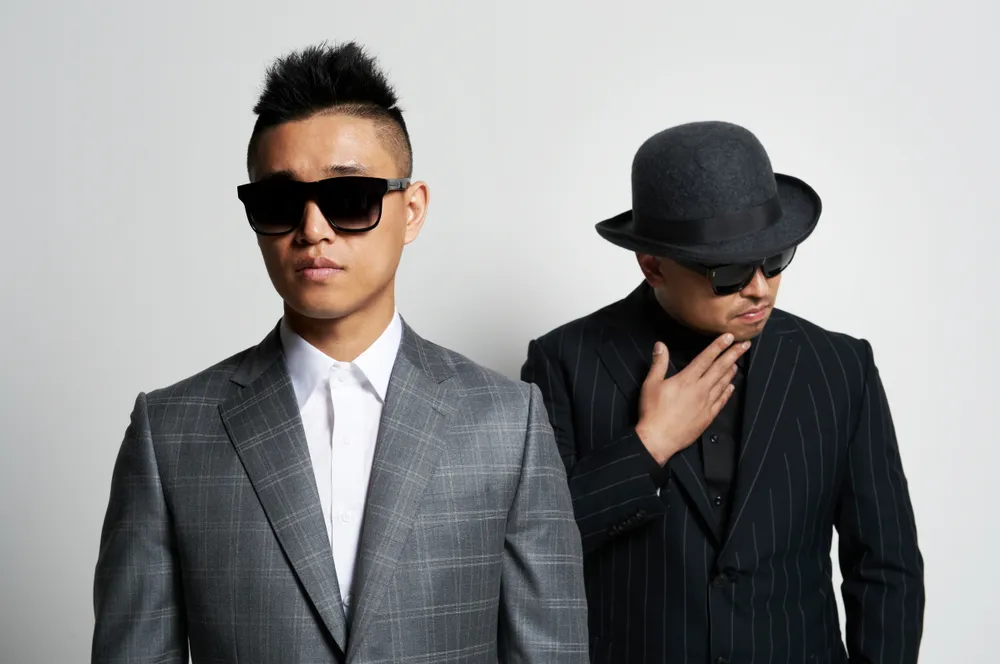
Leessang wasn’t an idol act that pivoted into rap. They were rappers first — from an era when Korean hip-hop still had something to prove.
Gary (Kang Hee-gun) and Gil (Gil Seong-joon) debuted as Leessang in 2002, after earlier underground activity in the late ’90s. Their early catalog lived in that space between boom-bap and soul-infused introspection. They weren’t chasing dance charts. They were writing diary entries over piano loops.
Then television happened.
Gary became a breakout star on Running Man, where his dry wit and unexpected romantic persona made him one of the most recognizable faces in Korea. Gil joined Infinite Challenge, arguably the most influential variety program of its generation.
Suddenly, Leessang wasn’t just respected in hip-hop circles. They were household names.
That mainstream exposure amplified their music instead of softening it. Their tracks climbed digital charts, their tours expanded, and their songs became staples in cafés, taxis, and university festivals. In the early 2010s, Leessang wasn’t niche. They were everywhere.
And yet — they never diluted their musical identity.
What They Were Known For: Soul, Storytelling, and Structural Risk
- Leessang’s sound had distinct markers:
- Jazz and soul-based instrumentals
- Female vocal features that amplified emotional tension
- Confessional, almost painfully honest lyricism
- A balance between warmth and grit
They normalized vulnerability in mainstream Korean rap before it was fashionable. Their songs dealt with heartbreak, exhaustion, ego, ambition, regret — often in the same track.
But the most technically fascinating piece of their identity was Gary’s flow.
Gary: The Offbeat Architect
If rock has metal or punk as its disruptive edge, Korean hip-hop has Gary.
Gary is one of the hardest rappers to imitate because he refuses to sit comfortably inside the beat.
Most rappers ride the rhythm predictably — bar by bar, cadence aligned with the instrumental. Gary does something stranger.
He raps against the beat.
- He’ll stretch phrases past expected stops.
- He’ll compress syllables into uncomfortable pockets.
- He’ll let the instrumental move forward while his cadence drags behind it — or jumps ahead.
Instinctively, that should sound messy. With Gary, it sounds orchestral.
- There are moments in Leessang tracks where:
- He connects three bars into one extended rhythmic thought, then fractures the fourth with a completely different cadence.
- He locks bars two and three into one tight internal flow while bars one and four pivot stylistically.
- He abandons melodic rap entirely, delivering something raw, almost jagged — rhythmically sharp but emotionally unfiltered.
His delivery isn’t always smooth. Sometimes it feels intentionally abrasive.
- He can sound soft — reflective, conversational.
- Then, without warning, he drops a verse like a hammer.
- Other times, he sounds borderline feral — intensity dialed up, syllables snapping like percussion.
It’s controlled chaos.
And because he bends structure without breaking it, copying him is nearly impossible. If you try to mimic that offbeat timing without precision and the right emotion, it collapses. With Gary, it feels deliberate — like a drummer playing polyrhythms against a steady metronome.
That unpredictability is part of why Leessang’s catalog still holds up technically.
Gil: The Resonance That Anchored the Chaos
If Gary was a structural risk, Gil was emotional gravity.
Gil has one of the most recognizable voices in Korean music — not just in hip-hop, in music, period.
First, the resonance.
His tone sits in the chest with unusual depth. It’s full without being bloated, textured without being muddy. The moment he enters a track, you know it’s him. There’s no mistaking it. Some voices need production tricks to feel large. Gil’s voice naturally occupies space.
Then there’s the rasp.
It’s rough, yes — but not abrasive. It doesn’t feel forced or stylized. It sounds like a lived experience. There’s a grain to it that carries something close to exhaustion, something close to pain, but it never becomes shrill or fatiguing. It’s the kind of rasp that feels organic, not theatrical.
And technically, his range is far wider than people give him credit for.
He can push into higher registers without flipping into falsetto. The transitions are seamless. There’s no audible strain. It feels almost unfair how stable he remains under pressure. You get the sense he could hit demanding notes in the middle of chaos — tying his shoe while a child jumps on him — and still land cleanly.
There’s a rockstar quality in his projection.
A tortured poet’s sensibility in his phrasing.
And yet, when he softens, there’s an almost luminous quality to it — something surprisingly gentle.
In Leessang’s catalog, Gil often functioned as the emotional anchor. Where Gary bent rhythm, Gil grounded melody. Where Gary fractured cadence, Gil expanded space.
That contrast is part of what made Leessang feel complete.
Gary stretched the beat.
Gil filled it.
And together, they built a sound that still feels structurally distinct in Korean hip-hop.
From Underground Purists to Cultural Fixtures
At their commercial peak:
- They topped digital charts repeatedly.
- They sold out national tours.
- Their singles dominated streaming platforms.
Their variety show presence made them familiar even to non-hip-hop audiences.
Leessang proved that Korean hip-hop could be commercially dominant without abandoning introspection. They bridged underground credibility and mainstream fame at a time when those worlds rarely overlapped cleanly.
And at the center of it was a rapper who treated rhythm like elastic.
Now, with that context, let’s move into 10 Leessang tracks that capture their emotional depth, technical experimentation, and cultural impact.
Ballerino (feat. Jung In)
This is the song that turned Leessang from respected rappers into digital chart dominators.
Melancholic piano. Jung In’s aching hook. Gary’s fractured cadence. Gil’s textured presence. It’s heartbreak delivered without theatrics. Structurally simple. Emotionally devastating.
Tears (눈물)
“Tears” is Leessang stripped down to emotional core.
What makes it unique is how unguarded it feels. There’s no attempt to intellectualize the pain. The production leans minimal and somber — enough instrumentation to hold the mood, but not enough to distract from the confession.
Gary doesn’t rely on technical fireworks here. His offbeat tendencies are present but softened. The phrasing feels almost spoken at times, like he’s narrating something he hasn’t fully processed yet. The restraint makes it heavier.
Gil’s voice is where the ache crystallizes. The rasp carries natural wear, and when he rises into higher notes, he doesn’t oversell them. He holds them steady, which makes the emotion feel contained rather than explosive.
It’s not dramatic crying.
It’s the quiet kind — the kind that happens when no one is watching.
Clowns
The “clown” metaphor is simple but effective:
The person who makes everyone laugh is often the one carrying the most private pain.
Leessang uses the idea of a circus performer — smiling in front of an audience, collapsing backstage — as a parallel to entertainers and, more broadly, to anyone who hides vulnerability behind functionality.
It’s introspective without being self-pitying.
There’s no dramatic orchestration trying to force tears. The production stays restrained, almost skeletal, which makes the lyrics land harder.
I’m Not Laughing (난 웃지 않아)
One of Leessang’s rawest emotional cuts.
What makes it unique is the restraint. The production is minimal, almost bare, which leaves nowhere to hide. Gary doesn’t lean into rhythmic tricks here — his delivery feels heavy and grounded, like he’s choosing each word carefully. The offbeat tendencies are still there, but subdued, tightened into something more internal.
Gil’s voice does the real damage. The rasp isn’t dramatic — it sounds tired. Not performance-tired. Life-tired. When he rises into the higher notes, he doesn’t explode; he holds them with control, which makes the emotion feel contained rather than theatrical.
It’s not a breakup anthem. It’s closer to emotional burnout set to music.
Quiet. Direct. Uncomfortable in the best way.
Rush (feat. Jung In)
“Rush” captures Leessang at their most kinetic without losing emotional depth.
What makes it unique is the forward motion in the production — there’s a sense of propulsion in the beat, almost like it’s constantly leaning ahead of itself. Gary responds by playing with timing, slightly dragging or tightening his phrasing so it feels like he’s pushing against the momentum rather than simply riding it.
Jung In’s hook adds lift, giving the track emotional width, while Gil anchors the song with that unmistakable resonance — textured, steady, and controlled even when the melody climbs.
It feels like ambition and restlessness set to music.
Someday (언젠가는)
“Someday” is Leessang in reflective mode.
What makes it unique is its patience. The production doesn’t rush to impress — it unfolds gently, leaving space between lines. Gary’s delivery is less aggressive here, more conversational, but still rhythmically unpredictable. He bends phrasing slightly off-center, just enough to keep the emotional tension alive.
Gil’s voice carries quiet optimism layered over fatigue. The rasp softens, the resonance feels warm rather than heavy. When he reaches upward, it’s controlled and sincere — not dramatic, just honest.
It’s a song about endurance. Not the loud kind. The kind that survives quietly.
The Girl Who Can’t Break Up, The Boy Who Can’t Leave
(헤어지지 못하는 여자, 떠나가지 못하는 남자 – feat. Jung In)
This is peak Leessang storytelling.
What makes it unique is the emotional stalemate. The song doesn’t dramatize a breakup — it dissects the paralysis before it. Two people who know it’s over, but neither moves first. That tension sits in every bar.
Gary’s flow is deceptively simple here. He doesn’t overcomplicate the rhythm, but he subtly shifts cadence across lines — tightening one bar, stretching the next — like someone hesitating mid-sentence. It mirrors the indecision in the lyrics.
Jung In’s hook is devastating without being loud. It aches. Gil’s presence adds warmth and weight, grounding the song so it never tips into melodrama.
It’s not about heartbreak after the explosion.
It’s about the silence before it.
The Pursuit of Happiness (행복을 찾아서)
This one feels cinematic.
“The Pursuit of Happiness” stands out because it balances ambition and vulnerability without romanticizing either. The production has lift — brighter, more expansive than their darker cuts — but there’s still tension underneath. It sounds hopeful, but not naïve.
Gary approaches this track with controlled intensity. He doesn’t go berserk; instead, he builds momentum through phrasing. Some lines feel like they’re leaning forward, slightly ahead of the beat, like someone chasing something just out of reach. His cadence tightens and loosens in small pockets, creating a sense of movement rather than aggression.
Gil brings the emotional payoff. His resonance fills the space naturally, and when he climbs into higher notes, he does it without strain or falsetto. The rasp adds texture, but the tone remains clear. It feels earned.
The song isn’t about instant success.
It’s about the long road toward it — and the quiet fear that you might never arrive.
Who’s Life Is This For (누구를 위한 삶인가)
This is Leessang at their most existential.
What makes it unique is the directness of the question. There’s no metaphor cushion here. The song cuts straight into identity, pressure, and the quiet resentment that builds when you start living according to other people’s expectations.
The production feels restrained but heavy — not dark in a dramatic sense, just weighted. It creates space for the lyrics to sit uncomfortably.
Gary’s flow leans into that discomfort. He plays with phrasing in a way that feels almost argumentative — tightening certain bars, then loosening the next, as if he’s debating himself in real time. It’s not melodic. It’s deliberate.
Gil’s voice adds gravity. The rasp doesn’t sound decorative; it sounds lived-in. When he lifts into higher notes, it feels less like a performance and more like someone pushing through frustration.
It’s not rebellious in a loud way.
It’s rebellious in a reflective way.
FAQ Section
What makes Gary’s rap style unique?
Gary is known for rapping offbeat, bending rhythm and connecting bars unpredictably while maintaining control. His flow often feels orchestral against mainstream beats.
Why is Gil’s voice distinctive?
Gil’s voice is resonant, textured, and naturally raspy. He can hit high notes without falsetto and maintains stability across a wide vocal range.
How did Leessang become mainstream?
Their popularity expanded significantly when Gary appeared on Running Man and Gil on Infinite Challenge, bringing their music to national audiences.
What are the best Leessang songs to start with?
“Ballerino,” “The Girl Who Can’t Break Up, The Boy Who Can’t Leave,” “Rush,” “Clown,” and “Tears” are essential entry points.
