

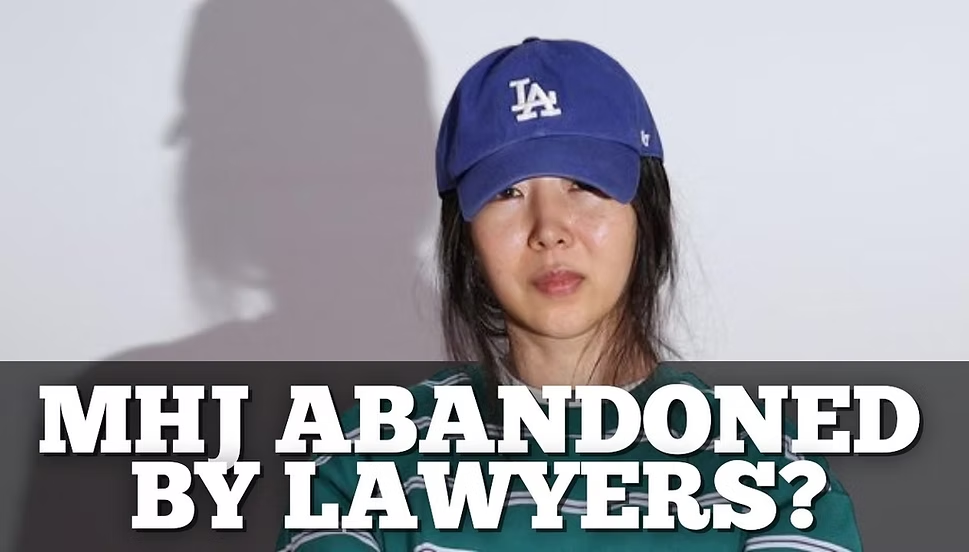
In the whirlwind legal drama between Min Hee-jin, ADORE, and HYBE, recent news that her law firm has quit has sent ripples across online communities. But before jumping to conclusions, let’s explore the many potential reasons why a law firm—or individual lawyers—might step away from a case. Here’s a breakdown of the most plausible explanations.
Conflict of Interest
One of the most common and legitimate reasons for a law firm to withdraw from a case is conflict of interest. This happens when the firm discovers new facts or evidence that place them in a compromising position—perhaps contradicting their ethical guidelines or business obligations. It’s possible the client was not entirely truthful, or that new revelations created a scenario that the firm could not represent in good conscience.
Breakdown in Communication or Trust
If trust erodes between the client and the legal team, continuing the partnership becomes unfeasible. A disagreement on legal strategy, concealment of crucial details, or irreconcilable differences in handling the case can prompt lawyers to step away. In the legal field, trust is essential. Without it, representation breaks down.
Unpaid Legal Fees
Legal services—especially from one of South Korea’s top law firms—come at a premium. Lawyers charge by the hour, and falling behind on payments is a fast way to get dropped. If Min Hee-jin couldn’t meet her financial obligations to the firm, they’d be within their rights to withdraw.
Discovery of Withheld or Misleading Information
Similar to conflict of interest, lawyers may exit a case if they discover that critical information was hidden or misrepresented. This not only breaches the client-attorney relationship but could violate contractual or ethical boundaries set at the beginning of the partnership.
Change in Legal Strategy or Required Expertise
Legal cases often evolve. If a case shifts into a new phase—say, from negotiation to litigation—or requires specialized knowledge outside the firm’s expertise, the firm might step aside. For example, a commercial law firm may not have the skills to handle criminal or media law aspects of the case.
External Pressure or Risk to Reputation
Given the high-profile nature of the dispute, the firm may have faced pressure from clients or stakeholders wary of association with the controversy. While rare, firms sometimes withdraw to protect their brand image. However, this reason alone typically isn’t enough under legal standards unless substantial risk is proven.
Ethical Violations by the Client
Lawyers are bound by a professional code of conduct. If a client violates ethical guidelines—such as lying, attempting to manipulate the legal process, or engaging in illegal acts—the firm may be forced to resign.
Completion of a Legal Phase
Min Hee-jin is juggling multiple cases: against an ADORE employee, HYBE regarding shareholder agreements, and Source Music.

If a specific phase or task—like document filing or initial representation—is complete, the law firm may simply be stepping back as their role concludes. It doesn’t necessarily indicate trouble.
Strategic Shift by the Client
Clients sometimes shift their strategy mid-case. If Min Hee-jin decided to change direction, pursue a different legal route, or hire a new firm with specialized knowledge, the original firm may step down. This isn’t uncommon and doesn’t always signal a falling out.
Mutual Agreement to Part Ways
Sometimes both parties recognize the partnership isn’t working. The law firm may feel unable to represent her effectively, or Min Hee-jin may be seeking different qualities in her representation. Either way, mutual termination is a professional, not emotional, decision.
Consolidation of Legal Representation
If Min Hee-jin was working with multiple firms or lawyers across cases, she may have decided to consolidate her legal efforts under one roof. Other firms or lawyers could have bowed out to avoid redundancy or conflicting strategies.
Jurisdiction or Administrative Barriers
Changes in the legal arena—like a shift to a different court, new international legal parameters, or unfamiliar jurisdictional rules—may lead a firm to withdraw if they’re not equipped to operate in that specific domain.
Rumors are swirling that Min Hee-jin’s legal team quitting is a sign she’s about to lose her case. But based solely on the withdrawal, we can’t confirm anything. We don’t even know if it was a single lawyer, a group, or the entire firm stepping away—and we don’t have confirmation of the reasons.
What we do know is that multiple cases are still ongoing. ADORE and NewJeans are currently working together again, likely out of legal necessity, as breaking contracts could cost the group millions in penalties. Meanwhile, IU has stepped in as the sole ambassador for a brand that previously worked with NewJeans.
The bottom line? Don’t draw conclusions just yet. Until more official updates are made public, speculation doesn’t help. Legal battles are complex, and what looks like a red flag could simply be a routine change.
Stay tuned.
