

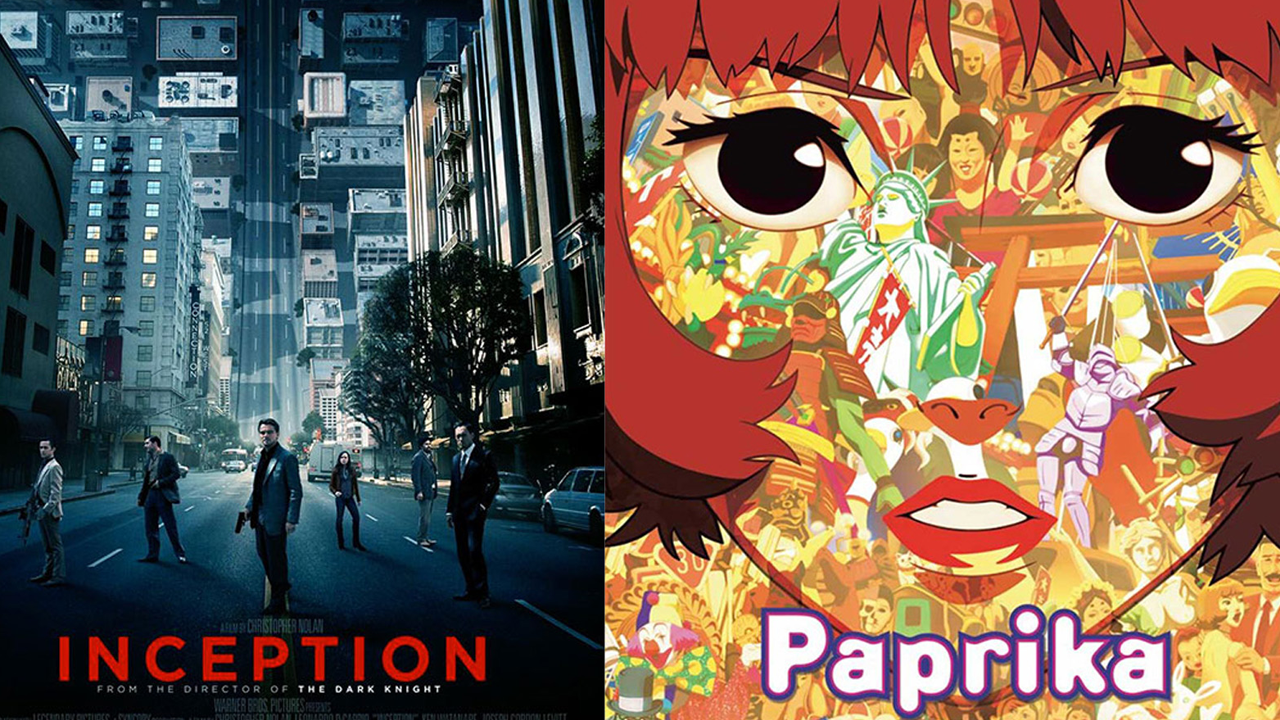
Did you know that Inception, Reservoir Dogs, Magnolia—and many other respected, well-loved, and even box-office–winning Hollywood films—are actually suspiciously similar to other Asian movies?
These aren’t remakes. Remakes are acknowledged, legally licensed, and paid for. These Hollywood movies are just strongly similar to Asian movies but there is no indication of permission, not rebranded, and packaged as an entirely original creations.
Here are 10 Asian movies, and the Hollywood films that were borrowed—sometimes a little, sometimes a lot—without giving proper credit.
1. Inception (2010) ⇒ Paprika (Japan, 2006)
Inception is often considered Christopher Nolan’s best film to date. I love Nolan, and I love Inception, but its concept is uncannily similar to Paprika, a Japanese animated film from 2006, itself based on a 1994 manga.
Inception follows a team that uses experimental dream-sharing technology to infiltrate dreams, extract information, or implant ideas.
Paprika? A dream terrorist steals a device that allows him to enter other people’s dreams, and a psychologist enters the dream world to retrieve it.
The most striking similarity? Paprika’s iconic hallway scene with cop Toshimi Konakawa. As he runs through a dreamscape, the hallway ripples and folds, sending him tumbling. Compare that with Nolan’s unforgettable rotating hallway sequence. The resemblance is hard to dismiss.

2. Kill Bill (2003–2004) ⇒ Abhay (India, 2001)
The storylines differ, but Kill Bill’s animated violence owes inspiration to Abhay. Quentin Tarantino himself privately admitted this to Indian director Anurag Kashyap.
Kamal Haasan, who starred in Abhay, wasn’t offended. In fact, he seemed flattered:
“When I did the animation action sequence in 2001, critics called it self-indulgent. After Tarantino endorsed it, people were kinder.”
“When I did the animation action sequence in 2001, critics called it self-indulgent. After Tarantino endorsed it, people were kinder.”
– Kamal Haasan, ABHAY
3. Magnolia (1999) ⇒ Manila By Night (Philippines, 1980)
Paul Thomas Anderson’s Magnolia is revered for weaving seemingly unrelated narratives into a single film. But Filipino director Ishmael Bernal had already done this nearly 20 years earlier in Manila By Night.
Both abandon the traditional three-act structure. Both connect characters through coincidence, not contrived plot devices. Both tackle social issues like love, addiction, forgiveness, and survival.
Even their framing is inverse: Magnolia begins in the morning and ends at night; Manila By Night begins in the evening and ends at dawn. The similarity in concept is undeniable, even if the details differ.
4. The Lion King (1994) ⇒ Kimba, The White Lion (Japan, 1965)
Disney has denied this for decades, but the overlaps are impossible to ignore:
A lion cub suffers a devastating loss, grows up under the guidance of a talking bird, and reclaims his throne.
- A wise baboon.
- An evil lion with a scarred eye and hyena henchmen.
- A narrative about the “circle of life.”
That’s The Lion King. That’s also Kimba, The White Lion.
Animator Tom Sito admitted, “If you grew up in the ’60s, you probably saw Kimba. I don’t think anyone consciously thought, ‘Let’s rip off Kimba,’ but it was in our memory.”
Yet co-director Rob Minkoff, who had lived in Tokyo during Kimba’s prime-time run, claimed not to know it at all. Hard to believe, given Osamu Tezuka was already celebrated as “Japan’s Walt Disney.”
5. Pearl Harbor (2001) ⇒ Sangam (India, 1964)
Plot recap: An air force pilot undertakes a dangerous mission, goes missing, and is presumed dead. His grieving girlfriend moves on—only to get engaged to his best friend. But then, surprise! The pilot returns alive.
That’s not just Pearl Harbor. That’s also Sangam.

6. Chronicle (2012) ⇒ Akira (Japan, 1988)
The basics are the same: a young man gains supernatural powers, spirals into destructive madness, and must be stopped by his less powerful friends before he destroys the world.
Critics argue Chronicle is less a rip-off and more a spiritual successor, given its use of the found-footage style, which Akira didn’t have. Fair enough. But the narrative parallels are too strong to brush off without at least acknowledging Akira’s influence.
7. Reservoir Dogs (1992) ⇒ City on Fire (Hong Kong, 1987)
The last 20 minutes of Ringo Lam’s City on Fire are nearly identical to Reservoir Dogs—including the legendary Mexican standoff.
Some say Tarantino openly admitted the influence. Others insist he only mentioned it in passing. Either way, City on Fire never received official credit, which means no compensation.
Sure, Reservoir Dogs is full of Tarantino’s stylistic trademarks. But the debt to Hong Kong cinema is undeniable.
8. A Fistful of Dollars (1964) ⇒ Yojimbo (Japan, 1961)
This one’s infamous. Sergio Leone’s A Fistful of Dollars copied Yojimbo almost scene for scene. Akira Kurosawa sued and won, eventually receiving partial screen credit.
In a now-legendary letter, Kurosawa wrote:
“I’ve seen your movie. It’s a very good movie. Unfortunately, it’s my movie.”
Other Hollywood offspring of Yojimbo include Last Man Standing (1996) and The Warrior and the Sorceress (1984).

9. Leap Year (2010) ⇒ Jab We Met (India, 2007)
The bubbly, chatty heroine who drags a man into her whirlwind life? The forced hotel room stay? The falling in love, dramatic separation, and eventual reunion?
That’s Leap Year. That’s also Jab We Met.
The Hollywood version denies any inspiration—but side-by-side, it’s hard not to notice the similarities.
10. The Guardian (2006) ⇒ Umizaru (Japan, 2004)
Both films spotlight their respective coast guards—the U.S. Coast Guard in The Guardian and the Japanese Coast Guard in Umizaru.
Both center on brotherhood, sacrifice, and redemption.
At least this time Hollywood admitted the connection, calling The Guardian “loosely based” on Umizaru. But “loosely” might be doing some heavy lifting here.
And a Few Official Adaptations You Might Not Know
Some Asian films did make it to Hollywood with acknowledgment and licensing. The original Godzilla (Gojira, Japan) spawned an empire. The Lake House was adapted from Korea’s Il Mare.
James Cameron even admitted that Avatar drew inspiration from Studio Ghibli’s Princess Mononoke.
So yes, Asia’s fingerprints are all over Hollywood—sometimes with credit, and sometimes without.
