

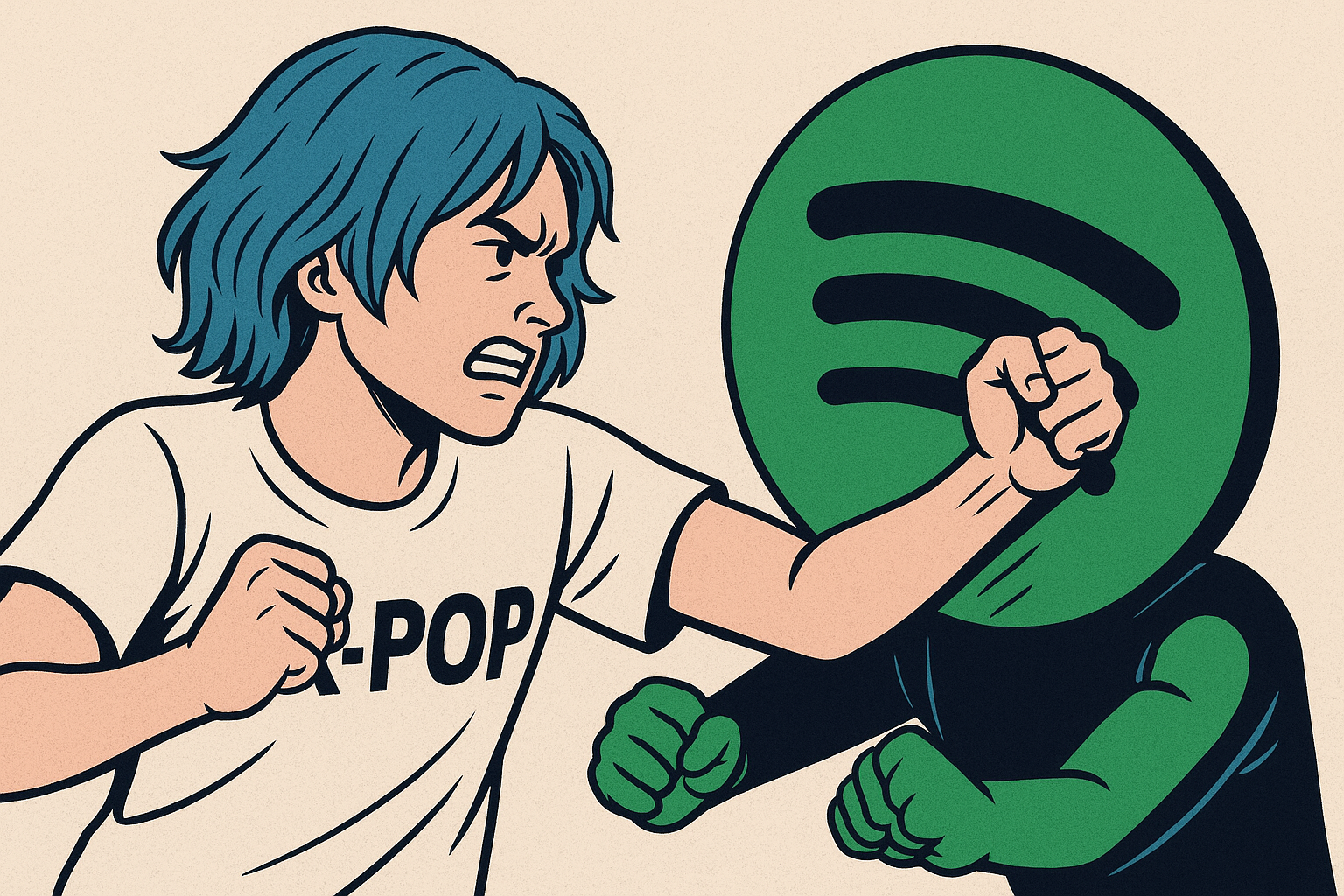
It’s that time of the month again—the ritual where fans drag each other online over Spotify deleting streams from their favorite artists.
Let’s clear the air. First, Spotify deletes streams across all artists—not just K-pop. Second, it’s not always about “bot streams.” Spotify often deletes streams by real users who just happen to stream like bots. And third, Spotify does not delete streams that come from autoplay or recommendations. Which means, yes, if an artist pays for more recommendations through Spotify’s own marketing program, those streams are safe.
So let’s get this straight: Spotify happily counts the streams it pushes on you but is quick to slash your manual plays if you don’t stream the way it wants.
REMEMBER: SPOTIFY’S ALGORITHMS ARE LOOKING FOR PATTERNS
If there’s one thing to remember, it’s this: Spotify algorithms hunt for patterns.
- If you cycle through different versions of the same song back-to-back with a predictable filler in between—that’s a pattern.
- If you only ever play one artist’s discography and nothing else—that’s a pattern.
- If you shuffle endlessly between the same 3–5 playlists—that’s a pattern.
And once Spotify finds a pattern? You’re flagged.
The fix: break the pattern. Don’t line up different versions of the same track consecutively. Insert gaps—maybe two songs here, then seven songs, then three, then six. Keep it irregular. Because 100 streams that count are worth more than a million that get deleted.
THE HARD TRUTH ABOUT SOLO-STREAMING
Many fans insist on only streaming their faves and ignoring everyone else. That’s your choice—but know this: your streams are more likely to get deleted. Worse, it feeds the narrative that your favorite’s success comes from bots.
And while we’re here: stop streaming nonstop. 24-hour loops look exactly like bot activity. Give your account a rest. Sleep. Restart in the morning. If you really can’t stop and you can afford it, split your effort between two accounts. Alternate them. At least then the algorithm sees a difference.
THROW THE ALGORITHM OFF ITS GAME
If you can’t stomach playing your bias’s bandmate or labelmate, fine. But at least mix in other artists. Throw in some Michael Jackson, some Beatles, or a local artist from your own country. Fillers from completely unrelated acts keep your streaming habits human.
STOP FEEDING THE BEAST
Spotify’s decision to make stream counts public wasn’t some noble gesture—it was a marketing ploy. They knew fans, media, and journalists would turn numbers into a battleground. They were right. Headlines, bragging rights, fanwars—Spotify got exactly what it wanted.
Deleting streams is another clever play. It stirs up outrage and keeps everyone paying attention. If you’re sick of it, stop giving it energy. Either enjoy the music without obsessing over deletions, or switch to a platform that actually pays artists more and sounds better.
Because let’s be honest: streams don’t pay much anyway and Spotify is one of the, if not the worst.
Spotify’s decision to make stream counts public wasn’t some noble gesture—it was a marketing ploy. They knew fans, media, and journalists would turn numbers into a battleground. They were right. Headlines, bragging rights, fanwars—Spotify got exactly what it wanted.
THE MONEY TRAIL: WHY DELETIONS CUT DEEPER
Now let’s follow the money.
Spotify doesn’t pay per stream at a fixed rate. It uses a system called streamshare: it pools subscription + ad revenue, subtracts costs, and divides among rights holders based on their portion of total streams that month.
On average, Spotify pays about $0.003 to $0.005 per stream. Sounds okay—until you do the math:
- It takes 300–350 streams for $1.
- That $1 doesn’t all go to the artist. It first gets split with labels, publishers, distributors, and other intermediaries.
- For many signed artists, their actual take-home is closer to 15–30% of that dollar, sometimes less.
Compare that to competitors:
- On Napster, it takes just ~53 streams to earn $1.
- On Apple Music, ~175 streams.
- On Tidal, reports suggest payouts above $0.01 per stream—about 100 streams per $1.
And here’s the kicker: Spotify finally turned a profit recently, reporting nearly $500 million in net income—but only after slashing payments to artists via “cost controls” and aggressively monetizing marketing tools. Their profit margins hover at under 3%, but hey, Wall Street is happy.
So while your artist fights to prove their streams are legit, Spotify is winning the bigger game: pleasing shareholders, not musicians.
THE FEAR OF FEEDING THE “BOT” NARRATIVE
Here’s the psychological trap: when fans exclusively stream their favorite artist and then get purged, it reinforces a damaging narrative—“Your success is just bots.”
Spotify benefits from that. Why?
It keeps fans on edge, constantly overanalyzing their habits.
It fuels rival fandoms, who weaponize deletions against each other.
It guarantees Spotify’s stream counts stay central to the cultural conversation.
Remember: the decision to make streams public wasn’t about transparency—it was a marketing move. And it worked. Fans obsess. Media covers it. Rivalries heat up. Spotify wins.
Deleting streams is just another way to feed that beast, keeping attention locked on them.
FOCUS ON THE GAINS
Some artists lose 15 million streams to deletions—and still walk away with over 50 million left. That’s not a loss. That’s a flex. Many artists fight tooth and nail just to reach 500,000 streams, and here your fave is pulling in tens of millions even after cuts. Focus on what remains, not what’s taken away.
Spotify is a marketing tool. Treat it as such. Find the angle that benefits your favorite artist instead of obsessing over the scraps Spotify deletes.
YOU CAN’T BEAT THE HOUSE
Spotify is not a neutral platform. Its marketing tactics are as blatant as they come.
Artists can pay for recommendation boosts.
The biggest playlists add songs that dropped an hour ago, regardless of whether they’re hits.
Even blocked artists sneak onto feeds.
Spotify’s numbers aren’t a measure of truth—they’re a marketing ploy. So don’t expect fairness. Learn how to use the system, don’t expect to beat it.
SPOTIFY IS JUST ONE PLATFORM
At the end of the day, Spotify is only as powerful as you let it be. It’s one streaming service among many. If your favorite artist is selling out stadiums, shifting culture, changing lives, and leaving a mark on music history—streams are just a bonus.
Charts fade. Playlists change. Algorithms glitch. But quality music endures. And in that field, no amount of deleted streams can erase the impact of real artistry.
