

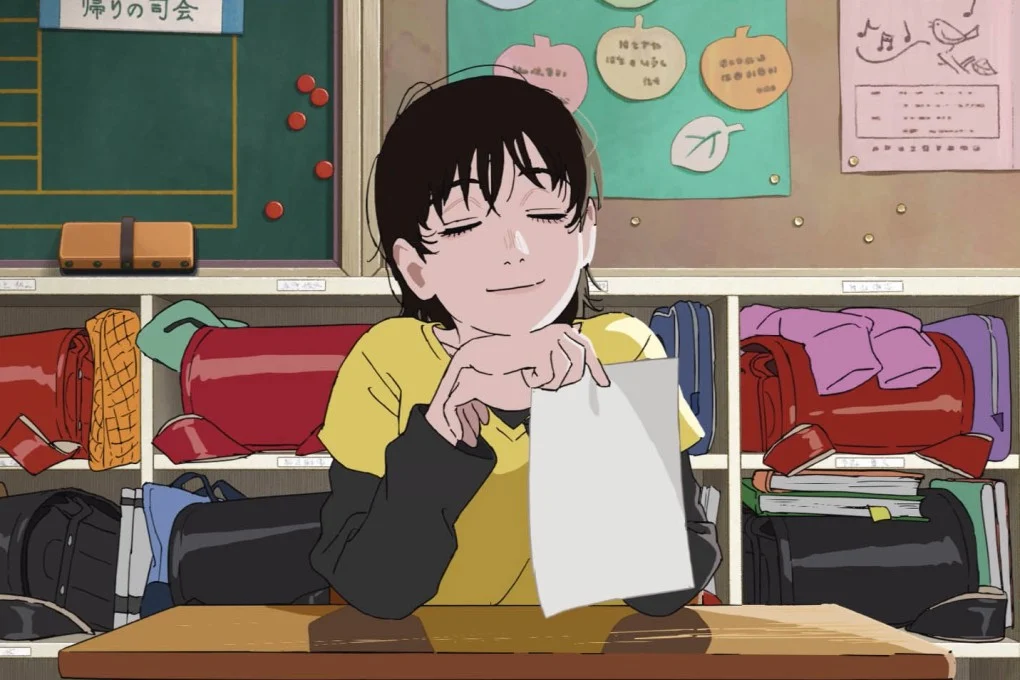
Hirokazu Kore-eda, one of Japan’s most acclaimed contemporary filmmakers, has been tapped to direct the live-action adaptation of Tatsuki Fujimoto’s Look Back—a project already generating rare anticipation inside both film and manga circles. The pairing is striking: Fujimoto’s raw, emotionally charged story about artistic obsession and grief meets Kore-eda’s quiet but deeply human approach to storytelling. For many critics, this collaboration feels like the moment these two creative worlds were always moving toward.

The World of Look Back
First published as a one-shot manga in 2021, Look Back follows two young girls—Fujino and Kyomoto—whose lives intersect through drawing. Fujino is confident, brash, and driven; Kyomoto is reclusive, hyper-detailed, and quietly brilliant. Their budding friendship, rooted in mutual admiration and rivalry, evolves into a shared dream of becoming manga artists. When tragedy strikes, the story shifts into an exploration of grief, responsibility, and the weight of unfulfilled potential. Fujimoto compresses ambition, insecurity, and artistic loneliness into a work that resonated widely with young Japanese readers. Its emotional clarity, stripped-down pacing, and abrupt brutality made it one of his most celebrated pieces.
A live-action version of Look Back requires a director who understands subtlety, vulnerability, and the emotional tremors beneath everyday life. Kore-eda is that director.
Why Kore-eda’s Style Fits This Story
Kore-eda’s films often unfold with a quiet rhythm—observational rather than demonstrative. His characters rarely shout, and his camera avoids spectacle. What he excels at is emotional accumulation: small gestures, glances, silences, and decisions that build into something devastating.
He also gravitates toward moral ambiguity, grounding stories in a reality that doesn’t tidy itself for the audience. People make poor choices, noble choices, impulsive choices, and Kore-eda captures the humanity behind them without judgment. Look Back—a story about guilt that has no clear resolution—lives within that same moral space.
His work is not stylized reality but ‘actual’ reality. The world looks exactly as the characters feel it: slightly worn, imperfect, and deeply familiar.
Fujimoto’s story about ambition, guilt, and artistic connection aligns naturally with Kore-eda’s fascination with moral ambiguity. Kore-eda’s films gather emotion slowly, through small choices and lived-in detail—exactly the kind of sensitivity Look Back requires.
Kore-eda’s Lineage of Quiet, Unforgettable Films
Shoplifters (2018)
The Palme d’Or winner that introduced Kore-eda to a wider international audience. Shoplifters examines an unconventional family surviving through petty crime, navigating love, exploitation, and systemic neglect. The film’s final scenes—a quiet, devastating unraveling of the family—demonstrated his ability to handle ethical complexity with precision. It remains his most successful global release.
Nobody Knows (2004)
Based on a real case of abandoned children in Tokyo, the film follows four siblings left to survive in an apartment after their mother disappears. Kore-eda cast non-professional actors and filmed their growth over a year, resulting in performances that still feel unmatched in their naturalism. It was a breakthrough: a study of resilience and vulnerability told without melodrama.
Our Little Sister (2015)
A portrait of three adult sisters who take in their younger half-sibling. The film is quiet by design—domestic routines, small reconciliations, and the slow knitting-together of a fractured family. It showcased Kore-eda’s skill at turning ordinary life into emotional architecture.
Like Father, Like Son (2013)
A story built on one seismic question: what defines a parent? When two families discover their sons were switched at birth, Kore-eda explores identity, class, and fatherhood without leaning on dramatic confrontation. The emotional restraint made the film even more powerful, earning the Jury Prize at Cannes and cementing his reputation in Europe.
Across these films, Kore-eda established himself as the foremost chronicler of Japanese social and emotional life. His characters aren’t extraordinary; they’re believable in ways that remind audiences of their own quiet contradictions.


Why Look Back Could Be Kore-eda’s Western Breakthrough
Fujimoto already has global recognition. Chainsaw Man turned him into a mainstream name in the West, and Look Back is considered one of his most accessible, emotionally direct works. Pairing this material with Kore-eda’s craftsmanship creates an opportunity few Japanese live-action films receive: a story with a built-in international audience, guided by a director already respected at Cannes, Toronto, and Venice.
Kore-eda’s previous successes abroad came largely from art-house distribution circuits. Look Back, backed by one of Japan’s most popular contemporary manga creators, stands a chance of crossing into Western mainstream conversation—especially as streaming platforms compete for Japanese content with global resonance.
Kore-eda knows how to translate emotional truth across cultural boundaries. Fujimoto knows how to distill trauma and ambition into compact, unforgettable narrative beats. Their collaboration could become a rare crossover moment where a Japanese live-action film moves beyond niche acclaim and into broader global attention.
Everything about this project suggests possibility: an acclaimed director, a beloved source material, and a story that speaks to universal experiences of friendship, regret, and the fear of never becoming who we hoped to be.
If the adaptation lands with the clarity both artists are known for, Look Back could serve as Kore-eda’s strongest introduction yet to audiences who have admired his work from afar but never fully entered his world. And it might be the project that brings his understated filmmaking to the center of the international conversation.
