

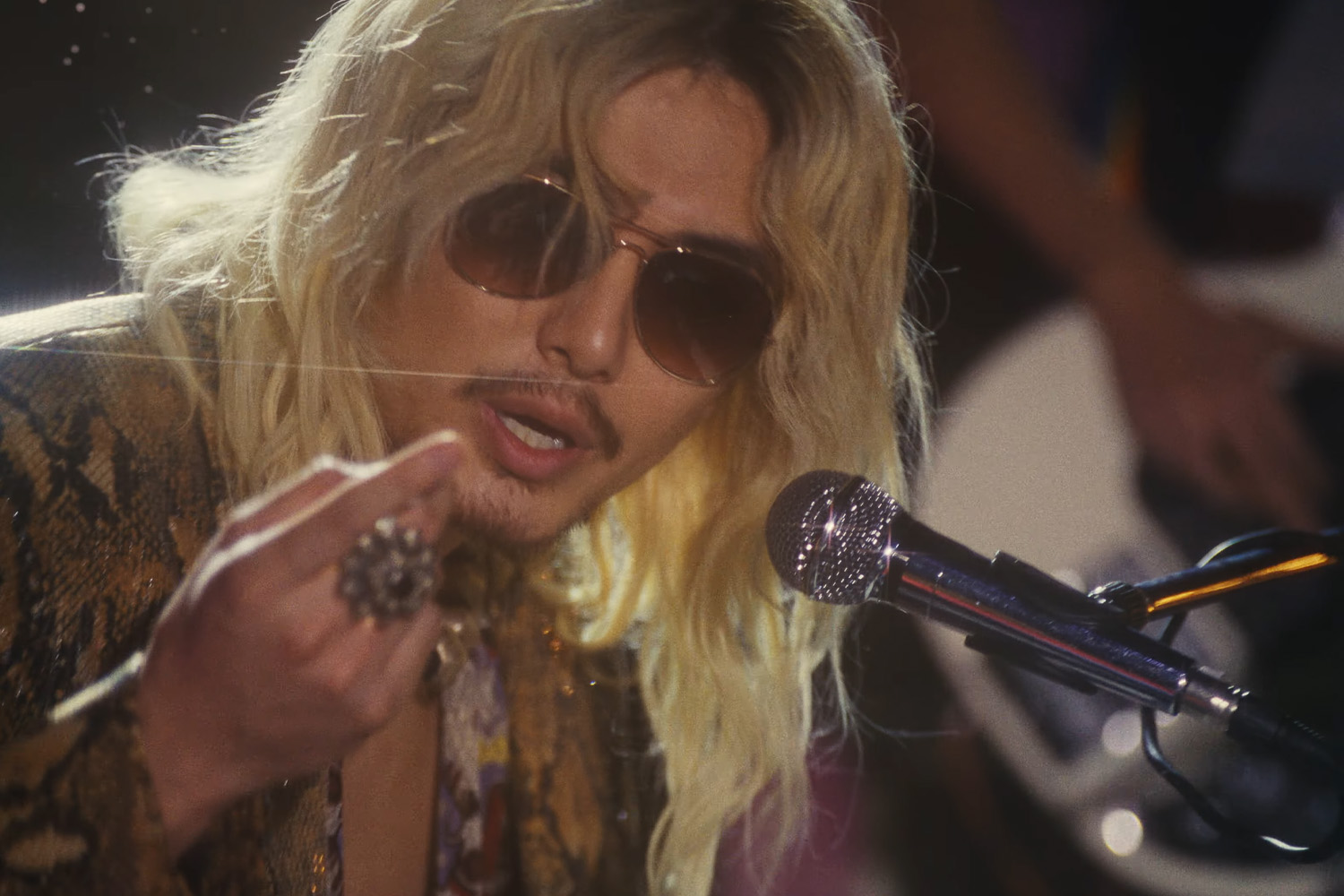
“Casket Girl” looks like a vintage TV performance stitched into a road-movie hallucination, but the real story sits underneath all that neon chaos: it’s about what happens to an artist when the thrill of fame seduces him away from the people who actually keep him alive.
The Girl is the grounding force, family friends, people who truly care for him, the real him, not the Fujii people admire. The Hitchhiker is the destructive impulse, the people that give you the excitement, the rock and roll lifestyle that musicians dream about but actually destroy you.
Once you decode that, every scene stops being random and becomes an emotional map of a man losing himself… and then crawling back to sobriety, clarity, and the only relationship that survived the spiral.
1. The Video’s Structure: Performance as Illusion, Road Trip as Reality
The retro TV studio performance is deliberately artificial – fake audience, a greasy late-night host, dancers who feel hired rather than connected.
This world is the public-facing Fujii Kaze—the polished image, the charming performer, the version of him that exists for consumption.
The road trip is the opposite – messy, unfiltered, seductive, and dangerous.
Everything that matters emotionally happens there. The “show” is just to establish the character of Fujii, the popular celebrity, on the top of his career but is bored with the good and balance of his life. The unraveling happens in the road trip.
2. The Characters: They are the Different People in His life
THE GIRL (HOPE): His Stability, His Real Life, His Good Influences
She is warm, quiet, and introspective. She journals, drinks coffee, eats with restraint, sits shotgun without demanding attention.
She doesn’t pull him anywhere—she grounds him. These are the people that care for Fujii and stick around not because of what they can get from him but because they truly care. That’s why they try to not be too much of a bother.
Fujii becomes bored because:
- her world lacks thrill,
- her pace is normal,
- her affection is steady instead of intoxicating.
This is the real tragedy: she represents the people celebrities needs, and everything fame convinces him he’s outgrown.
THE HITCHHIKER: The toxic people that find you when you become famous
He is exactly what fame promises:
- thrill without boundaries
- indulgence without accountability
- recklessness disguised as freedom
He eats greedily, drinks excessively, spends Kaze’s money like it’s nothing, disrupts every scene he enters.
He taps the gas station clerk’s cheek—not to flirt, but to assert dominance.
He climbs into the front seat the moment he’s invited.
He begins eroding the girl’s presence the minute he arrives.
This is bad company.
This is the fun hell many celebrities fall into, they enjoy but it destroys them.
READ THE REVIEW OF FUJII KAZE’S FIRST ENGLISH ALBUM, PREMA.
3. The Turning Point: When Fujii Invites The Guy Into Their Car
This is the most important shot in the MV.
Knowing he was the criminal at large, he still invites him into their car and physically relocates the good influence in his life—literally pushes her into the background—to make room for the toxic impulse he prefers in the moment.
From here, the spiral becomes inevitable. She tries to keep up but cannot match his chaos. The hitchhiker consumes every space they enter. She tries to stay away at first but her eventual drinking symbolizes her losing herself trying to keep him alive.
From the very beginning, you can see there is no romantic aura between Fujii and the girl because this is not a love triangle. This is the battle of the good and the evil.
4. The Spiral: The Psychedelic Breakdown
When the camera begins zooming erratically into the hitchhiker’s face, the MV shifts from realism to psychological horror.
This is the moment where Fujii crosses a line. Something irreversible happens. It can be anything. Crime, drugs, merely losing himself. All that wild stuff we hear celebrities get into, when “fun” becomes destruction
The girl’s hand mimicking a gun at Fujii is symbolic. She’s trying to “wake him,” trying to kill the destructive pattern, trying to save him by force if she must.
The blood on Fujii’s hands is the cost of this intervention. Someone or something is lost—they got the hitchhiker out, but not without damage.
This reads like:
- scandal
- addiction
- betrayal
- self-harm
- public breakdown
Pick any metaphor. The symbolism works for all.
5. The Ending: Morning After the Ruin
Fujii wakes up and the hitchhiker is gone.
So is the car. So is the freedom he thought the chaos gave him.
The only thing left is the girl. The person he pushed aside is the one who stayed.
The thrill that stole everything is completely absent—because it never loved him back in the first place.
The rest of his life will be the quiet aftermath of self-destruction.
HIROKAZU KORE-EDA TO DIRECT LIVE-ACTION LOOK BACK: WHY THIS ADAPTATION MATTERS
6. The Lyrics: Who Is the Real “Casket Girl”?
Even though the destructive figure onscreen is the male hitchhiker, the lyrics repeatedly personify a female “Casket Girl” but The “girl” in the lyrics is not a woman—it’s the addiction itself. It’s whatever force seduces you, empties you, and buries you while convincing you it’s love.
Lines like:
“Use me up, can’t get enough of all her lies.”
“You came to make me go insane.”
“There’s nothing you can do, you’re already dead.”
—all point to a cycle of choosing what destroys you.
The outro—
“Casket girl, we got some kind of freedom”
—isn’t triumph; it’s bargaining.
It’s the moment you admit. “I can leave this but only if I take responsibility for why I stayed.” It’s ownership of addiction rather than demonization of it.
7. The Myth Behind “Casket Girl”: Vampires, Death Brides, and the Seductions That Empty You Out
The phrase “Casket Girl” isn’t random.
It carries centuries of folklore—most famously from 18th-century New Orleans, where the legend of the Casket Girls (Les Filles à la Cassette) still lingers around the French Quarter.
According to the legend, young women were shipped from France to Louisiana to become brides in the colonies. They arrived carrying small coffin-shaped chests—cassette trunks—which fueled rumors that:
- the girls were undead
- the “caskets” carried supernatural objects
- their arrival brought misfortune or moral decay
Even more dramatically, later retellings linked them to early vampire mythology, suggesting that:
- they drained the life from the men who desired them
- they brought ruin disguised as beauty
- their presence marked a “haunting,” not a romance
In folklore, the Casket Girl is never evil.
She is enchanted—a figure men project their desires onto until those desires consume them.
This duality—beautiful and fatal—mirrors the dynamics in Fujii Kaze’s MV perfectly.
8. Why the TV Show Matters
The cheesy host and the staged funk performance create a double narrative:
The TV show is the life the public sees. The road trip is the life that destroys him off-camera. The host cheerfully closes the “show,” oblivious to the emotional carnage underneath.
This is commentary on celebrity:
- you can fall apart privately and still look perfect publicly
- performance doesn’t stop just because your life is burning
- fame keeps smiling even when you’re bleeding out
- It’s a brutal but accurate depiction.
Lifetime Of Redemption
“Casket Girl” works because it never spells out what it’s really about. It hides everything in character choices, framing, and the slow collapse of a road trip that was doomed the moment Fujii let the wrong presence into the car. Once you understand who the Girl stands for—and what the Hitchhiker represents—the entire video stops being a chaotic aesthetic experiment and turns into a map of how easy it is for anyone, especially an artist, to drift from themselves.
That final morning is clarity. It’s the uncomfortable moment when the thrill is gone, the damage is done, and the only person left beside you is the one who cared before any of the noise started.
