

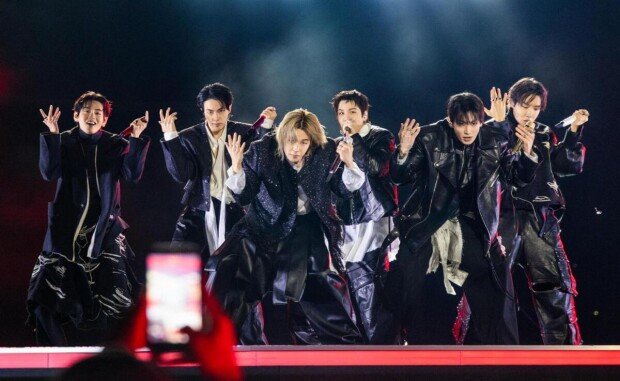
Big Hit released about 29,000 tickets for free. Even then, ARMYs expressed disappointment at such a low number of tickets. The tickets were released to the general public as well—no need to be a paid WeVerse member. The crowd layout was already released prior to ticketing, and the public was fully aware that a huge part of the ticketed crowd wouldn’t even see the stage clearly.
When photos of the crowd showed it being scattered rather than cramped together, it wasn’t a lack of interest—it was by design.
Area Restrictions
From the night before, trains skipped the Gwanghwamun stop, and buses were rerouted. My niece, who arrived in Seoul past midnight on the 21st, had to walk several kilometers hauling her heavy luggage from the Myeongdong bus stop. This effectively blocked people staying in the immediate area—or coming from outside it—from easily reaching Gwanghwamun.
To give everyone an idea of what was required, it takes about 27 minutes to walk from Sungnyemun Gate to the monument of King Sejong, and another 20 minutes to go all the way to the plaza. Entering that zone required people to be frisked, have their belongings inspected, and, at times, present IDs.
By noon on the 21st, the area from Gyeongbokgung Palace to the statue of King Sejong was already barricaded, and they slowly expanded the barricaded area by the hour.
My hotel was 7 minutes away from the monument of King Sejong, but because they required everyone to take a roundabout route, it would take me 2 hours to make it back to my hotel. I had to go straight to check-in for the concert after walking around since 9 a.m.
It would have been one thing if it was a smooth walk, but with almost every police officer—and security personnel deployed by HYBE—relentlessly blowing whistles in everyone’s ears and/or yelling at the top of their lungs to keep people moving, it wasn’t a pleasant experience.
I knew it was going to be chaotic, but the noise and constant need to move took a toll. You couldn’t pause for a split second without being told to keep moving.
A friend took two of her friends from overseas to Gwanghwamun, daring to walk from Myeongdong to the square, hoping to let get them to stay with her in a private restaurant room she had rented just outside the barricaded area to watch the concert. After one roundabout, they decided to go back to their hotel—tired, slightly deaf, and absolutely exhausted.
That is the story of most visitors—those who didn’t have tickets and weren’t booked in hotels located within the vicinity of Gwanghwamun.
104,000 vs. 240,000 vs. 40,000 Crowd Size
The ~22,000 estimate covers the ticketed crowd inside the main barricaded area. A bigger crowd was just outside the barricaded zone—scattered in the plaza and different areas with big screens, in restaurants, cafes, bars, hotels, and other spots around Gwanghwamun. Several cafes, restaurants, and noreabang (karaoke places) charged extra for people to stay longer and watch the Netflix livestream. That contributes to the 104,000 estimate released by HYBE and police (based on mobile data, foot traffic, etc.).
There were an estimated 240,000–260,000 people who made it to Seoul overall (close to pre-event expectations, though actual in-area turnout was lower because of security).
Economic Impact
According to estimates by Money Today on the 22nd, applying the Korea Culture & Tourism Institute’s (KCTI) input-output analysis model, the total economic impact of this single event reached up to 1.4503 trillion KRW (approx. $1.1B USD). This includes:
- 408.1 billion KRW in direct consumption
- 697 billion KRW in production inducement effects
- 345.2 billion KRW in value-added effects
- 5,917 jobs created
This surpasses KCTI’s earlier estimate of BTS’s 2022 concert impact, which was calculated at 1.2207 trillion KRW per show. That earlier model was based on Jamsil Olympic Stadium (65,000 capacity), with a total of 195,000 attendees over three days and an average per capita spending of 1.28 million KRW.
For CU convenience stores operated by BGF Retail, sales at 10 stores near Gwanghwamun increased by 270.9% compared to the previous week, while sales at three stores adjacent to the main road jumped by 547.8%. Sales items were also tailored to the BTS concert: the top four best-selling products were all BTS albums, and the fifth was 3A batteries (4-pack). The large-scale purchase of batteries needed for light sticks unusually propelled them to the top of sales rankings. The remaining top sellers included banana-flavored milk and kimbap.
GS25, operated by GS Retail, saw sales at its store closest to the concert venue increase by up to 378.4%, while sales at five nearby Gwanghwamun stores rose by 233.1% and visitor numbers increased by 181.2%. As more people waited outdoors for extended periods, sales of practical items like hand warmers (5,698.8%), power banks (2,016.9%), and batteries (3,530.8%) exploded. Increased foreign purchases also boosted sales of transportation cards (647.5%). The IGIN Highball, for which BTS’s Jin serves as a global ambassador, saw a 1,742.3% increase compared to the previous same weekday. Additionally, three types of IGIN keyrings and one IGIN perfume prepared specially to commemorate the concert each generated sales exceeding 10 million Korean won. At 7-Eleven and Emart24, sales were driven by batteries, wet tissues, and ready-to-eat foods.
Some media publications ran articles about businesses not getting the traffic they expected. This may be true for some spots. The police crowd control certainly kept people out, but convenience stores, hotels, and restaurants around the area all reported dramatic increases in sales.
Could they have sold more had the police not been as strict? Certainly. The more foot traffic you bring into an area, the more business you will generate. That’s business 101.
Why Such Control and Restrictions
If multiple fans can try to break into Jungkook’s house—a private, well-secured area—it is reasonable to think people would try to get close to BTS in a public open space. That is reason enough to be careful.
The bigger concern, however, was security.
There were real threats amid very real geopolitical tensions, and those who want to cause unrest won’t find a better time than a concert like this. It would have been a spectacular statement on their part.
A cultural celebration led by the biggest band in the world, with their families present, diplomats and ambassadors from different countries, and fans from all over the world congregating in one place.
If something had happened, it would have been a tragedy BTS would most likely not recover from. It would have been a worldwide sensation for all the wrong reasons. And South Korea just had a tragic crowd accident in 2022, during Holloween, leading to the deaths of 159 people and injuring 197 others. A number like that would crush BTS’s lifetime of work.
It would have canceled their whole tour; Big Hit, and by extension HYBE, would never be trusted again. BTS and all groups under HYBE—including their executives, staff members, and investors—would be blamed, lambasted, and destroyed.
Everyone erred on the side of caution, and as a result, BTS started and finished their show peacefully. Fans had fun. Millions tuned in to their homes.
The other factor is that Gyeongbokgung Palace and Gwanghwamun Square are sacred places for Koreans. They had to make sure nothing got damaged and not an inch of the area was disrespected.
Many other shows and events have been held in the same area, but none has drawn this level of attention outside the Pope’s visit.
BTS, like all global superstars, is a polarizing figure—their admiration and popularity come with hate. Everything they do is magnified. A single incident could have been blown out of proportion, damaging their reputation and costing more than the worth of the conglomerate built on their backs. Other groups may someday do something similar, but they won’t face nearly as much scrutiny because they aren’t BTS. It was not worth risking the rest of their career to bring in 100,000 more people into the square.
BTS managed to accomplish what they sought to do: make a comeback, highlight their Korean identity, display the heart of Korean history to 300 million people simultaneously, and—more importantly for their fans—loudly signal their return to music.
Erring on the side of caution was the right move.
Bloomberg and BBC Blame BTS for South Korea’s Market Tanking
I know the latest narrative they’re pushing is all about HYBE’s stock drop. So, let’s get this straight.
About a week or so before BTS’s ARIRANG comeback concert, HYBE stock hit (or came within a dollar of) its all-time high. That’s completely normal. When a stock reaches an all-time high, a lot of investors naturally want to cash out and lock in profits. That’s exactly why it usually pulls back — it’s profit-taking, not some big scandal.
This had nothing to do with Heesung leaving, fans pressuring the company, or anything like that.
Then the stock dropped even further — and again, this had nothing to do with BTS. It was driven by escalating geopolitical tensions between the US, Israel, and Iran. Two days ago, President Trump issued a strong warning about the Strait of Hormuz, where a huge amount of global cargo and oil passes through. He gave them a short ultimatum, and as the deadline approached, markets got nervous.
When that happens, investors pull money out of high-risk assets — and yes, entertainment stocks like HYBE fall into that category. So the broader market sell-off hit HYBE too.
Let me be very clear: BTS did not underperform. I’ve said this in my video and livestream, and I’ll say it again. The concert was safe, peaceful, and delivered exactly what it was meant to — a powerful cultural comeback from the heart of Seoul.
Sure, some small businesses around Gwanghwamun wished more people had been allowed in. More foot traffic would have meant more sales, no question. But we also have to be realistic. The security threats were real. With the biggest band in the world performing, international fans everywhere, diplomats, ambassadors, and the members’ families all present — the stakes were incredibly high.
One incident could have been catastrophic. Remember the Itaewon crowd tragedy in 2022 that killed 159 people? Something like that at this event would have destroyed BTS’s legacy, ruined HYBE’s reputation, and likely ended their world tour before it even started.
That’s why the strict controls were necessary. I know I’m probably one of the few saying this, but the Seoul Metropolitan Police actually did a solid job containing the area and keeping everyone safe. It wasn’t perfect for every ARMY — especially those without tickets — but at least no one got hurt and the show went off without any major incidents.
Bloomberg and BBC can spin it however they want, but the stock drop wasn’t caused by BTS “failing” — it was normal profit-taking plus global market jitters over real geopolitical risks.
BTS paved the way again. They delivered a historic moment while prioritizing safety. That’s not failure — that’s responsible leadership in a complicated world.
Once Again, BTS Paved The Way
What this event brought, outside of what BTS sought to achieve, are lessons on global events like this in the era of internet, accessibility, and violence.
BTS gave the Seoul Police and their company an event to actually experience how to control a crowd, implement it with security measures and balance it with fan experience. They saw the result and how it affected BTS, their company, the fans, and the businesses counting on the crowd.
The next time, they could do better and that wouldn’t be possible if BTS didn’t dare to dream to announce their comeback to the whole world from the heart of Korean culture.
