

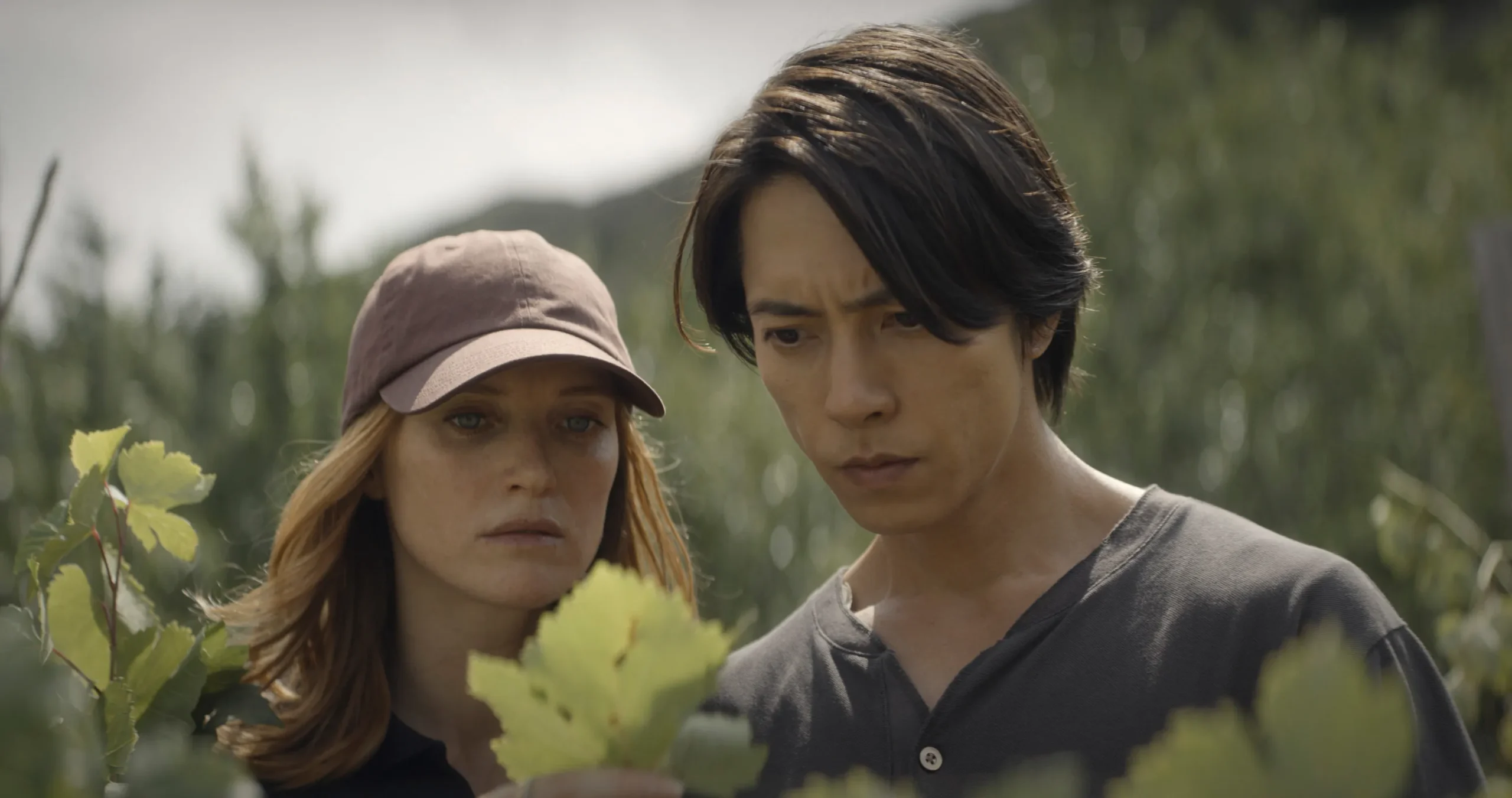
If you’re looking for something to sink into, Drops of God is one of those rare series where both seasons are worth your time—just for very different reasons.
Season 1 pulls you in with structure: a high-stakes inheritance contest built around decoding wine like it’s a language only a few can truly speak. Season 2 lets that structure dissolve and asks a more interesting question—what happens after the competition ends?
That shift is exactly why the show lingers.
Fleur Geffrier leads as Camille Léger, the reluctant “Mozart of wine” with synesthesia and unresolved grief, alongside Tomohisa Yamashita’s Issei Tomine, her half-brother and former rival. Season 1 positions them as opponents—two people shaped by the same father but raised in completely different emotional climates. The tension is clear, the rules are defined, and the narrative moves with purpose.
By the end of that first season, the contest resolves with something unexpectedly restrained: not triumph, but a fragile understanding.
Season 2 (available on Apple TV+) picks up from there—and quietly flips the entire engine of the show.
What begins as a globe-trotting search for a mythical bottle from their late father Alexandre’s private reserve gradually sheds its scavenger-hunt framing. Halfway through, the series leans into what it was always best at: character-driven storytelling that feels closer to a subdued Japanese film than a prestige Western drama.
No car chases. No raised voices engineered for effect. Just glances, silences, and emotional undercurrents that land with precision.
This isn’t physically explosive television. It’s emotionally violent—the kind that unsettles because it’s so carefully observed and rarely explained out loud.
Siblings in the Mirror
The search lands Camille and Issei in Georgia—the cradle of winemaking—where they meet Tamar and Davit, another pair of estranged siblings torn apart by their father’s manipulations and a looming threat to sell the family vineyard for development. The parallels are deliberate and deliciously understated. Both sets of siblings were pitted against each other by flawed patriarchs. Reconciliation for Tamar and Davit looks impossible. For Camille and Issei? The show leaves it artfully ambiguous, trusting viewers to read between the lines rather than handing out exposition dumps.
This is where Drops of God shines brightest. In an era of over-explained plots and second-screen multitasking, the series respects your intelligence. Key details from earlier episodes resurface organically through new characters and quiet conversations. Creator Quoc Dang Tran (Season 1) and director Oded Ruskin keep the supporting dynamics fresh: Issei’s confrontation with his mother (Makiko Watanabe) about her affair and attempted infanticide hits harder than any wine-tasting showdown. The man who raised him, Hirokazu, carries quiet dedication laced with decades of betrayed pain. Meanwhile, Camille’s fierce independence starts mirroring her father’s controlling nature—the very thing she swore she’d never become. It’s Greek tragedy dressed in casual linen shirts and vineyard dust.
The performances sell every layer. Geffrier and Yamashita project a magnetic determination that’s almost contagious. You don’t need to be a wine obsessive (I’m not) to feel the sensual pull of expertise, heritage, and that rare moment when a sip transports you somewhere deeper. The show celebrates epicurean greatness across French and Japanese cultures without fetishizing it.
Water as Metaphor, Closure as Release
Water threads through the entire series like a recurring motif. Season 1’s winning answer? “Rain.” Season 2 sees Issei flirting with the abyss through deep-sea diving, nearly drowning in his search for meaning. The finale brings it full circle with a delicate, metaphor-rich scene: the siblings take their father’s ashes (still in the urn) off the coast of Marseille and gently press the canister beneath the waves until it sinks. No sweeping speeches. Just a simple hug afterward, shoulder to shoulder on the boat, bonded in a way that feels quietly fated.
It’s restrained, elegant, and profoundly moving—the kind of ending that makes you exhale slowly and realize the real inheritance wasn’t the bottles or the guide. It was the messy, ongoing work of figuring out who you are, neither through others nor in total isolation.
Why It Feels So Japanese (Even When It’s Not)
Adaptation purists might still gripe about changes from the Tadashi Agi manga—swapping the original Japanese lead for a French woman, dialing back some surreal mind-palace visuals, and leaning more Euro-centric. But treating the show as its own entity pays off. The storytelling leans hard into that subdued, character-obsessed style you see in so many great Japanese films and dramas: intensity through restraint, where a single glance or paused breath carries more weight than a monologue. The “violence” comes from within—childhood trauma, identity crises, the slow realization that escaping your parents’ shadow might mean becoming a little like them anyway.
Season 2 isn’t as flashy as the contest-driven Season 1 (which dropped alongside Succession and got unfairly overshadowed). It trades some of that initial thrill for deeper emotional maturity, globe-trotting locations (Japan, France, the Caucasus), and the realistic messiness that follows a “happy” ending. The middle stretch slows down to let the Georgia mirror story breathe, but it never feels wasted. When Camille’s ambitious plan to share the rare wine backfires, the quiet sense of loss hits the audience as hard as it hits her.
Pour Yourself a Glass and Dive In
Whether you’re a wine novice or a seasoned sommelier, Drops of God Season 2 proves you don’t need explosive plot twists when characters this rich are doing the heavy lifting. It’s luxurious without being pretentious, dramatic without being loud, and ultimately hopeful in the most grounded way—siblings choosing to sit shoulder to shoulder, even when the future stays a little hazy.
If Season 1 hooked you with the contest, Season 2 rewards you with the complicated reality afterward. It’s like that second bottle you open after the first one impresses: more layered, a touch more mature, and somehow even more satisfying.
Verdict
Stream it. Let it unfold slowly. Watch closely. The intensity will sneak up on you—and unlike most TV these days, it won’t shout to make its point.
