

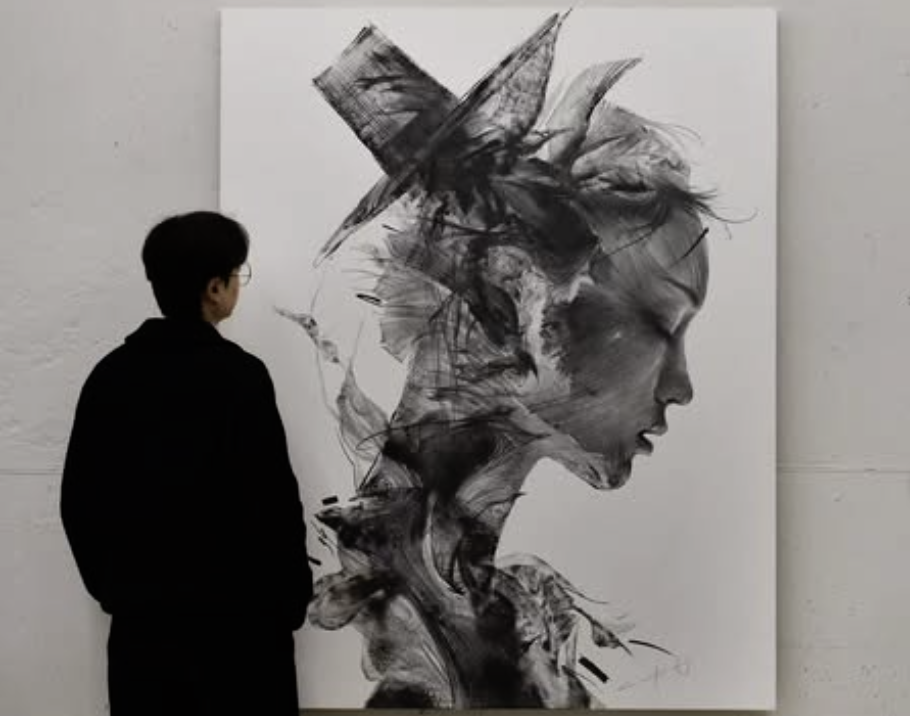
South Korean artist Lee K. (also known as Lee Killust) is stepping onto a new stage with his first solo exhibition in the United States.
Titled ZINILVO: 진일보—a phrase that translates roughly to “one step forward” or “gradual progress”—the exhibition runs from June 5 to June 28, 2026, at nonfromseoul gallery in Los Angeles. The show marks Lee K.’s seventh solo exhibition overall, but his first on American soil.
For the artist, it represents far more than a new venue.
After months of preparation, experimentation, and adaptation to a new city, the exhibition arrives as a personal and professional milestone. In an Instagram post announcing the show, Lee K. reflected on the uncertainty, exhaustion, and gratitude that accompanied the journey.
“Arriving in Los Angeles and preparing for my first solo exhibition in the United States has been both exciting and surreal,” he wrote. “There were moments of uncertainty, moments of exhaustion, and many moments of gratitude.”
Curated by his longtime friend and collaborator Q, ZINILVO brings together more than 80 works spanning years of his artistic development, including large-scale graphite pieces, emotionally charged portraits, and mixed-media works exploring memory, identity, and the human condition.
From Seoul Studios To International Exhibitions
Born in 1983, Lee K. is a Seoul-based contemporary artist whose work has been exhibited across South Korea and internationally in the United States, France, Germany, Portugal, Russia, and beyond.
His growing reputation earned him recognition as one of Singulart’s “Top 22 Artists to Watch” in 2022. He has participated in major international events including the FOCUS Art Fair, exhibiting at prestigious venues such as the Carrousel du Louvre in Paris and later in New York.
His work has also appeared through collaborations and projects involving Bentley Motors Seoul, Disney Korea, and other cultural institutions, helping establish him as one of a new generation of Korean contemporary artists building audiences beyond traditional gallery circles.
Yet despite these achievements, many international audiences first encountered Lee K. through an unexpected connection.
The Jimin Connection
For many BTS fans, Lee K.’s name is immediately associated with Jimin.
Beginning around 2019, the artist repeatedly returned to the BTS member as a creative muse, producing portraits that quickly spread throughout global fan communities. One of those works was featured during the 2022 FOCUS Art Fair at the Carrousel du Louvre in Paris, introducing many ARMYs to his work for the first time.
Importantly, the artwork was exhibited at the Carrousel du Louvre exhibition space and was not part of the Louvre Museum’s permanent collection—a distinction often lost as images circulated online.
But reducing Lee K. to “the artist who paints Jimin” spectaclarly misses the larger story.
The reason Jimin became a recurring subject is not celebrity alone.
In interviews, Lee K. has described being fascinated by Jimin’s visual complexity. He sees a face that simultaneously blends Eastern and Western aesthetics, masculine and feminine qualities, strength and vulnerability. Depending on the lighting, angle, or expression, the subject seems to transform.
For an artist deeply interested in identity and emotional nuance, that ambiguity offers endless creative possibilities.
During the opening of ZINILVO, Lee K. once again demonstrated that connection by creating a new Jimin portrait live in front of attendees in roughly 30 minutes, showcasing both his technical skill and continuing fascination with the subject.
Yet the artist himself remains the heart of the story.


A Signature Language Of Lines
Many artists become known for their subjects.
Lee K. may ultimately be remembered for the way he draws them.
What separates his work from traditional portraiture is the visual language he has developed over years of experimentation.
At first glance, his portraits appear realistic. Faces emerge immediately from the canvas. The likeness is unmistakable. But a closer look reveals something very different.
These images are not constructed through smooth surfaces or photographic precision. Instead, they are built from thousands of individual marks, strokes, scratches, contours, and layers of graphite.
The result is a fascinating play between realism and abstraction.
From across a room, viewers see a face but up close, they see movement.
The portrait dissolves into a dense network of swirls that seem to vibrate until it breaks apart and some pieces land smooth and some rugged. That sublime chaos is what forms the soul of the face drawn.
The Power Of Absence
Most portrait artists spend their careers trying to reveal more of their subjects.
Lee K. often achieves the opposite effect. He removes them.
Many of his portraits appear unfinished. Eyes are left hollow. Mouths disappear. Portions of faces dissolve into graphite marks before fully forming. Sometimes entire sections of the subject seem suspended somewhere between presence and absence.
At first, these omissions can feel surprising. After all, portraiture has traditionally been associated with precision. The artist’s task is often to capture every detail faithfully.
Lee K. appears less interested in documenting a face than in suggesting a person.
A photograph can provide information. It can tell us the exact shape of a nose, the curve of a mouth, the color of an eye.
But information alone does not necessarily create emotional connection.
Paradoxically, it is often the missing pieces that make Lee K.’s subjects feel alive.
By withholding details, he creates space for viewers to participate in the work. The eye searches for what is absent. The mind begins filling in gaps. The portrait becomes less about observation and more about interpretation.
The result feels almost musical.
In music, silence is not the absence of meaning. Silence is part of the composition. Lee K.’s unfinished faces seem to operate according to a similar principle.
The missing elements are not empty spaces. They are active parts of the work. They encourage viewers to look beyond physical appearance and engage with something less tangible: emotion, memory, vulnerability, identity.


The Power Of The Eyes
That emotional focus extends into another defining characteristic of Lee K.’s work: his treatment of the face itself.
Many portrait artists place equal emphasis on every feature.
Lee K. often does the opposite.
Throughout his body of work, mouths are frequently minimized, obscured, distorted, or partially erased. In contrast, the eyes become intensely detailed and emotionally charged.
The choice is deliberate.
The artist has spoken about viewing language as something that often fails people. Words can be misunderstood, manipulated, or inadequate. The eyes, however, communicate something more direct.
As a result, many of his portraits seem locked in silent conversation with the viewer.
Melancholy.
Loneliness.
Determination.
Exhaustion.
Hope.
These emotions emerge not through narrative but through gaze.
The experience can feel intimate, even confrontational, forcing viewers to engage with emotions they might otherwise overlook.
Come For The Subject, Stay For The Art
Lee K.’s practice draws from a diverse range of influences, including contemporary portraiture, East Asian ink traditions, tattoo culture, and expressive mark-making.
Working primarily with graphite, charcoal, oil, pencil, and ink, he creates surfaces rich with texture and accumulated history.
The physical process itself becomes visible.
Lines remain exposed.
Corrections remain visible.
Layers overlap and collide.
Rather than hiding the construction of the image, Lee K. invites viewers into it.
This emphasis on process reinforces many of the themes that run throughout his work: identity, vulnerability, memory, emotional scars, resilience, and the silent struggles people carry within themselves.
His monochromatic graphite works often feel introspective and meditative.
His oil paintings, by contrast, can feel explosive and emotionally violent.
Lee K.’s work honors the extraordinary qualities of his subjects while remaining firmly rooted in broader questions about human experience. Whether viewers come for Jimin, portraiture, or contemporary Korean art, they will encounter something deeper.
The subjects may draw you in.
The art is what makes you stay.
EXHIBIT DETAILS:
Nonfromseoul Studio
777 S Alameda St #120
Los Angeles, CA 90021
June 5 – June 28
