

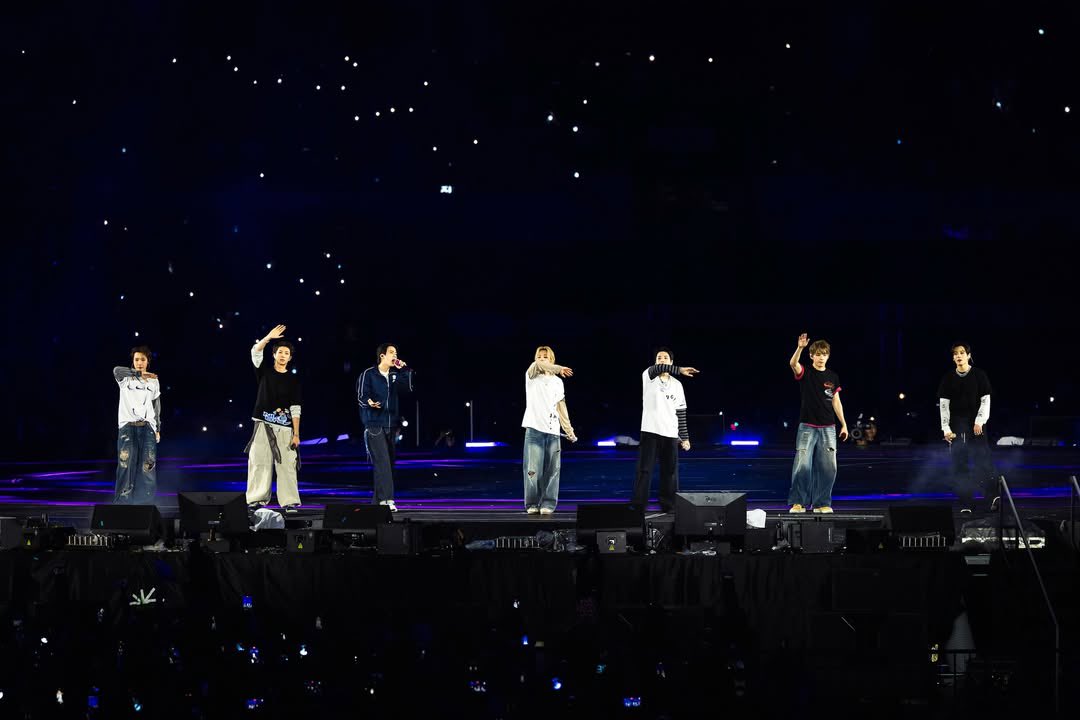
“ALIENS” felt like, well, they were aliens observing humanity—detached, factual, looking at everything from outside with that objective, almost amused distance.
Here in “2.0”, it’s more like them addressing humanity directly. They’ve stepped forward, still carrying that outsider clarity but now turning it outward with calm confidence, speaking to the noise, the expectations, the attempts to copy or dismiss them. It’s not confrontational or bitter. It’s just… factual. Like they’ve seen the full picture, lived through the last few years, and are now setting the record straight while moving on their own terms.
It’s also unpredictable. It feels like the song will talk about one thing, only for it to shift in the last line.
As someone who’s followed them for years, “2.0” isn’t angry, not loud. It’s calm, layered in that very BTS way—full of Korean conversational nuance, cultural depth, and quiet assurance. They acknowledge the attempts to replicate, invalidate, or replace them without ever sounding defensive.
Instead, there’s this amused detachment, like they’re looking back at the game they’ve already transcended. The production supports it perfectly: conversational flows that build naturally, escalating impact without forced drama, and lines that keep revealing more with every listen.
Here’s my breakdown of the lyrics, the delivery, and what’s really being said beneath the surface.
[Verse 1: SUGA, j-hope]
그래 방탄처럼 그게 말은 쉽지?
(geurae bangtancheoreom geuge mareun swipji?)
Yeah, saying “be like BTS”—that’s easy, right?
Explanation:
“말은 쉽지” is a very Korean way of calling something out as easy to say but hard to do. It carries a slightly dismissive tone—not aggressive, but definitely skeptical. It’s like: you can say that all you want, but you clearly don’t understand what it actually takes or what it means.
If you put this into proper context, and considering how they have acknowledged that they are aware of how people try to invalidate or try to put them down, it also seems sarcastic. They emphasize how it seems so easy to claim they can be replicated and yet, no one has even come close.
우린 뜀틀 누가 맨날 뛰어넘니?
(urin ttwimteul nuga maennal ttwieoneomni?)
Who’s out here clearing the vault every single time?
Explanation:
“뜀틀” (vault) is literally a gymnastics vault. In Korean context. However, remember that in many Asian countries, and especially in Korea, they value the process of achieving something as much as the achievement itself. So, this is not just about “jumping higher.”
So, this actually also points to the work it requires to achieve what they have achieved- physical training, discipline, repetition. It implies consistent performance under pressure, repeatedly executing something difficult.
Obviously, the question is rhetorical—it highlights how abnormal their consistency is. To a certain degree, even they surprise themselves. Like, they are sort of expecting others will be able to raise the bar and yet, they are still the ones clearing it over and over again.
There’s also a hint of fatigue in it. It kinda sounds like, geezuz if someone can just take our place so we can rest.
웃기기는 한데 사실 안 웃기지
(utgigineun hande sasil an utgiji)
It’s funny—but actually, it’s not funny
Explanation:
This is a classic Korean conversational structure: acknowledge the surface perception, then correct it. It softens the delivery while still making a firm point. Almost like: I see why you think that, but you’re wrong.
However, we need to put this line into context, this feels like him saying something like, this is ridiculous, not funny but ridiculous. This whole situation is ridiculous. What people are saying are ridiculous but he isn’t self-pitying. It’s actually more about other people. The next line puts it in better context.
십년은 말야 어림 반 푼어치
(simnyeoneun marya eorim ban puneochi)
Ten years? That’s not even close
Explanation:
“어림 반 푼어치” is an older expression meaning “not even worth considering” or “not even in the ballpark.” It carries a slightly sarcastic, dismissive tone.
It refers to how they and their achievements are being quantified or measured in the most basic and superficial of ways. The use of an old phrase adds weight—it feels deliberate, almost like they’re rejecting a simplistic way of measuring their journey.
What they’re really pushing back against in that line is the idea that their success can be casually explained by “they’ve just been around for ten years.” It’s not a rejection of the time itself—it’s a rejection of how people simplify it. When they say “십년은 말야 어림 반 푼어치,” they’re basically saying that using ten years as the explanation doesn’t even come close to capturing what actually happened. It ignores the pace, the pressure, the consistency, and the level they had to sustain the entire time. So the tone isn’t defensive or emotional—it’s more like a quiet correction. If that’s your takeaway, then you’re already looking at this the wrong way.
[Pre-Chorus: RM, j-hope]
Yeah, yeah, yeah, yeah, yeah, pull up at your block
We gon’ knock, knock, knock, knock, yeah
Had your little fun, fella?
Pop, pop, pop, pop, yeah, came back for what’s mine, we don’t (Stop, ride)
Explanation:
RM actually acknowledged in his Rolling Stone interview that the line “had your little fun, fella?” was directed at haters—specifically those who, during their nearly four-year group hiatus, spent that entire time trying to discredit them, invalidate them, or in some cases, actively tear down what they had built.
And now that BTS is back, the line lands differently.
It’s not aggressive. It’s not even angry. It’s almost… amused.
Because from BTS’s perspective, all that effort—the constant criticism, the narratives, the attempts to diminish them—didn’t actually lead to anything meaningful. Nothing really shifted. Nothing replaced them. Nothing erased what they had already established.
So when they say, “had your little fun, fella?” it comes across less like confrontation and more like a quiet, slightly condescending check-in.
Like:
You did all that… and this is where we are?
There’s a teasing quality to it, but it’s not playful in a light way—it’s more dismissive. Not cruel, just… unimpressed.
I’m not sure if teasing is the best word but from BTS’s point of view, all that energy directed at them wasn’t threatening—it was just noise. A moment. Something temporary. So the line becomes a way of putting things back into perspective:
Was that your best? You had total freedom to do anything you wanted, you were all working together and this is all you can come up with?
[Chorus: Jimin, V]
You know how I do, do, do, do, do, do
You know how I do, do, do, do, do
불을 붙여, brand new / 붙여, brand new
(bureul butyeo, brand new / butyeo, brand new)
Light it up—brand new / set it off—brand new
Explanation:
“붙이다” means both to attach and to ignite. Here, it leans toward ignition—starting something, creating momentum.
But it’s an active word. It’s not just them declaring that they are starting chapter 2. This is them doing something to start their chapter 2.
And that may sound simplistic but it follows the theme of everything they have said from the beginning.
In Suga’s second verse (urin ttwimteul nuga maennal ttwieoneomni?), that’s when he mentioned the vault, he didn’t just refer to the achievement but to the work they put into it.
This is similar to that. They aren’t just saying, this is chapter 2. They are actually working on their chapter 2.
[Verse 2: j-hope]
Ayy, ayy, ayy
그래, 기분 마치 brand new
(geurae, gibun machi brand new)
Yeah, I feel like brand new
Explanation:
J-Hope pulls it down a little bit in terms of tone.
While Suga was very strong and that carried it on to the chorus. “기분 마치” (gibun machi) is casual—like “it feels like.” It keeps the tone light and conversational. This line contrasts with the heavier statements earlier—it introduces ease, not tension.
But this line is actually more of a set up to his next line.
Spec 다른 step, 뛰지 않는 step two
(spec dareun step, ttwiji anneun step two)
Different specs, different step—not your typical step two
Explanation:
“Spec” in Korean refers to credentials, qualifications, measurable value (used heavily in job culture). So “Spec 다른” means operating on a completely different standard.
“뛰지 않는 step two” suggests this isn’t a predictable progression—it’s not automatic that after you are done with step 1, you automatically move to step 2.
This J-hope saying, what we’ve got is something we created. It’s not a laid out template we just run through. We made this. Other people’s chapter 2 is different from ours.
So, he actually goes back and supports what Suga said in the first verse, that everything they have achieved, they made. It was not handed to them and no one has been able to replicate.
Two, two point, oh, update된 후
(two, two point oh, update doen hu)
2.0—after the update
Explanation:
“된 후” means after becoming—implying completion. He is saying that even before starting chapter 2, they are already elevated. They are not upgrading or leveling up, they are already up there, different.
In that context, it means their chapter is bound to separate them even further from the rest.
여기저기 또 한 번 일냈네, ten out of ten
(yeogijeogi tto han beon ilnaetne, ten out of ten)
Caused another scene everywhere again—ten out of ten
Explanation:
“일냈네” implies creating impact or stirring things up. It’s often used with a slightly impressed or amused tone but it doesn’t feel like bragging—it feels almost observational or factual, like: of course this happened again.
You will be able to feel the impact of this line better if you contrast it with his first bar. Remember that he opened with
그래, 기분 마치 brand new
(geurae, gibun machi brand new)
Very casual, almost humble. And then by the third verse, he is going:
Yeah, look at our impact. The world is talking about us. What else is new?
He escalates even further in the next line.
이젠 버려, 못 쓸 폐품 수거하러 가
(ijen beoryeo, mot sseul pyepum sugeohareo ga)
Throw it away now—go collect the useless scraps
Explanation:
“폐품” (waste, junk) is very literal. This isn’t a soft metaphor—it’s intentionally harsh. He’s really talking about discarding things that no longer serve any purpose, things that are just adding dead weight.
In the context of this second chapter—how selective they’ve become with what they do, who they work with, and who they allow into their space—it’s pretty easy to see what he’s getting at. They’re cutting off anything that doesn’t benefit them anymore.
That could mean people. It could mean narratives. It could mean expectations.
But it could also be internal—old systems, old processes, even old strategies in how they approached music, promotion, or the industry itself. Things that worked before, but don’t necessarily fit who they are now.
And then there’s that shift at the end of the line.
Because it doesn’t just stop at “we’re throwing this away.”
He adds:
go collect it.
And that’s where it gets a little sharper. It almost redirects the discarded things to the haters. Like:
These things don’t matter to us anymore—if you want them, go ahead and pick them up.
There’s a kind of dismissal in that. Not loud, not aggressive—just very clear.
We’ve moved on. You’re still dealing with what we already left behind.
여유 있게 다시 수고하러
(yeoyu itge dasi sugoharo)
With ease, back to the grind again
Explanation:
“여유 있게” means with composure—with space, without rushing. It implies a kind of control, like you’re not being pushed or pressured, you’re moving at your own pace.
“수고하다” means working hard, but it also carries an acknowledgment of effort. It’s not just labor—it’s effort that’s recognized, even respected.
So this line holds two ideas at once:
They’re still working hard.
But now, they’re doing it with control. With calm.
And that’s something they’ve consistently talked about in interviews. In this second chapter, they’re still focused, still putting in the work—but the motivation has shifted. It’s no longer just about chasing external markers like awards or sales. It’s about finding ways to enjoy what they’re doing, maintaining their bond, and figuring out how to keep going together for a long time.
This line actually deepens the song a bit. Because for most of the track, they’re addressing the outside—haters, narratives, expectations.
But here, it turns inward. It recenters everything.
At the end of the day, it’s not about proving anything to anyone.
It’s about them—their art, their process, and their team.
Check the BTS ARIRANG’s track by track analysis:
- ARIRANG TRACK-BY-TRACK ANALYSIS: “BODY TO BODY”LYRICS ANALYSIS AND BREAKDOWN
- ARIRANG TRACK-BY-TRACK ANALYSIS: “HOOLIGAN” LYRICS ANALYSIS AND BREAKDOWN
- ARIRANG TRACK-BY-TRACK ANALYSIS: ‘INTO THE SUN’ LYRICS ANALYSIS AND BREAKDOWN
- ARIRANG TRACK-BY-TRACK ANALYSIS: ‘THEY DON’T KNOW ‘BOUT US’ LYRICS BREAKDOWN BREAKDOWN
- ARIRANG TRACK-BY-TRACK ANALYSIS: ‘INTO THE SUN’ LYRICS ANALYSIS AND BREAKDOWN
- ARIRANG TRACK-BY-TRACK ANALYSIS: ‘COME OVER’ LYRICS ANALYSIS AND BREAKDOWN
