

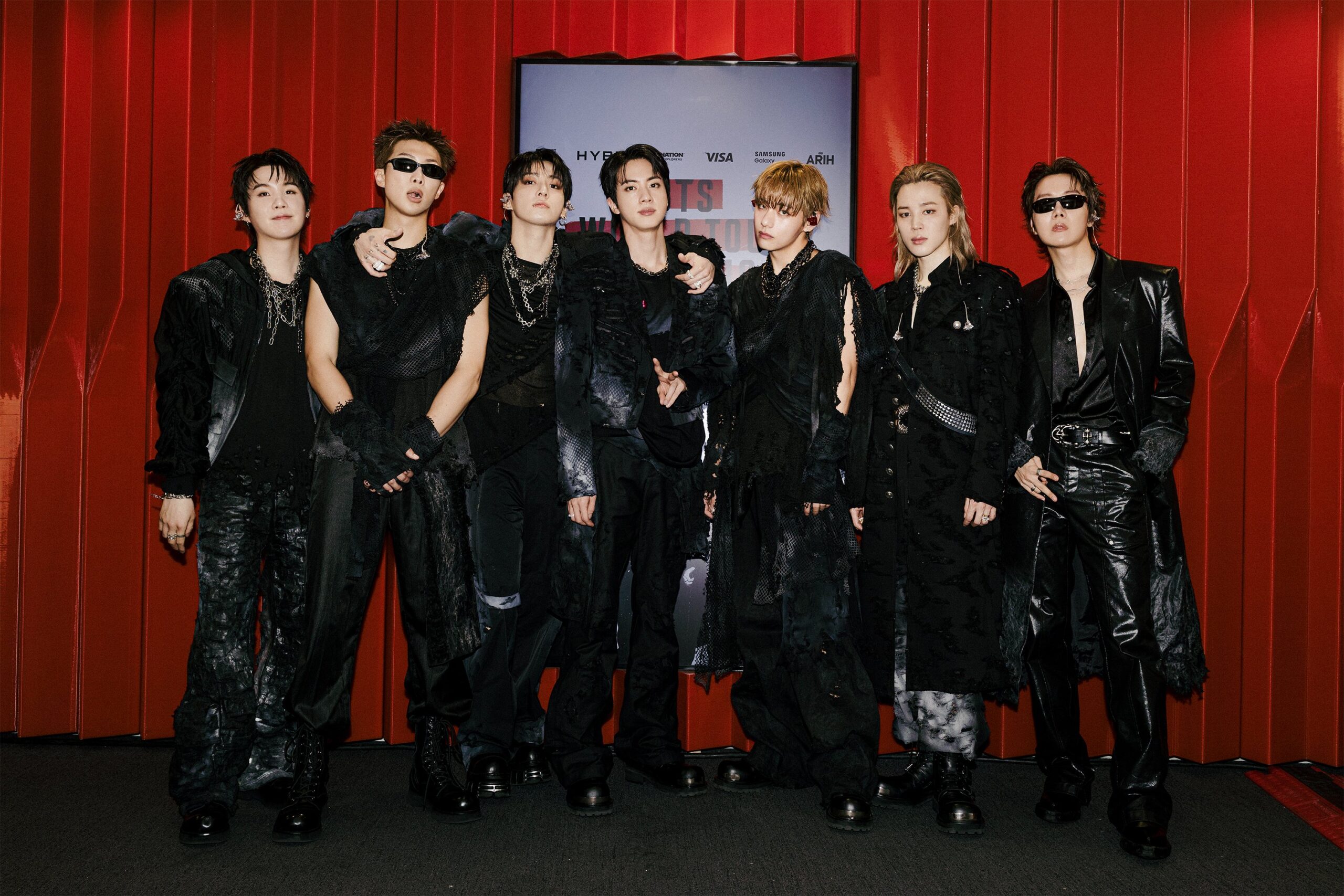
I had a lot of questions when I first listened to the song. First being, why is the intro so different and detached from the entire song? Who are they talking to? The fans? Each other? The media? The haters? How can the song be so different from the original intent? Jimin said that initially, the concept was ‘you make me weak’ and it was supposed to bea about fans mythologizing them or putting them on a pedestal to the point that they don’t hear critical feedback that would help them improve. How then did it go about how people try to figure out their journey?
It took me remembering who the primary writer is, Jimin. He has always been highly cerebral, straightforward and logically poetic in his writing. He also works off big ideas before distilling it to smaller ideas. That gave me some clarity. I realized that this is bigger than what I am attempting.
The Intro
The intro almost sounds detached from the rest of the song. It doesn’t sound like the members are standing directly in front of you singing. It sounds distant. Like an old transmission. A voice coming through an old radio or an old recording.
“They don’t know about us
How your voice
Can calm the sea-ee-ee”
There’s something strangely timeless about it.
Considering the larger themes of ARIRANG, how the album keeps returning to old Korean sonic imagery, folklore, transmission across generations, phonographs, preserved recordings, and this idea of BTS slowly becoming mythologized figures themselves.
That’s why I don’t think it’s a stretch at all to interpret the intro almost like: the legendary version of BTS speaking first. Almost like voices preserved somewhere in time.
The seven boys who recorded Arirang onto a phonograph.
The myth.
The symbol.
The global phenomenon people keep trying to analyze and explain.
This is the ‘legend version of them singing, the mythologized persona and that’s why they sound like they are somewhere distant.
And then the actual song starts and suddenly the tone changes completely.
Now they sound casual, funny, sarcastic, and grounded.
Almost like the mythology steps aside and the actual people underneath start talking to someone, and it could be an ARMY. It feels like this is an intimate conversation they are having with an ARMY, their mythology trying to connect, human to human, and converse about how they have been mythologized.
The more the song progresses, the more intimate it feels.
That’s why I think the line, ‘How your voice can calm the sea.’ eventually stops sounding mythological and starts sounding deeply personal.
I think the “voice” here may literally represent music itself.
Because while everybody outside BTS keeps obsessing over marketing, strategy, fandom, industry politics, and formulas for success, the members themselves almost reduce everything back down to something much simpler- music.
[Verse 1: V, Jung Kook]
[Verse 1: V, Jung Kook]
I can show you love, I can show you
If you wanna know me, what can I do for you? (They don’t—)
This feels like them sitting down with an ARMY for a conversation, asking what it is about them you want to know.
It feels like they are expecting that we ask something about them, as people, as artists but the next line is a reality check to them. It feels like it is based on what they regularly experience, they expect people would want to know them as people but they end up with people who want to know about their legend.
[Verse 1: V]
대체 뭐가 달랐냐고 자꾸 물어
(daeche mwoga dallannyago jakku mureo)
They keep asking what made us different
나는 대답해, 나도 몰라
(naneun daedaphae, nado molla)
I answer, I don’t know either
This rejects the idea that BTS has some clean, simple explanation for their success. People constantly try to reduce BTS into marketing, timing, fandom behavior, luck, algorithms, and others.
Everybody wants a formula but BTS themselves are basically saying, ‘We genuinely don’t fully know either.’
This feels more truthful than pretending they have everything figured out because real cultural phenomena are usually larger than anything anyone can clearly comprehend or explain.
[Verse 1: Jung Kook ]
Everybody hears the story that they wanna
This is probably one of the most accurate lines about fame on the entire album. People don’t actually consume public figures objectively. They select narratives emotionally or to serve their own narratives. Some people want BTS to be:
- Creative geniuses or overrated
- Industry leaders or victims
- Revolutionaries or manufactured idols
- Inspirational
- Fake or authentic
And once people emotionally commit to a version of BTS, they filter everything through that version. So the line, ‘Everybody hears the story that they wanna’, basically means
people are not listening to understand us.
They’re listening to confirm what they want to believe. That’s such an emotionally exhausting reality for public figures.
[Verse 1: Jung Kook ]
쟤넨 이거 땜에 떴어, 내가 맞어
(jyaenen igeo ttaeme tteosseo, naega majeo)
“They blew up because of this,” I’m right
This line feels sarcastic. It sounds like BTS mocking the endless theories people create about their success. Everybody always claims they discovered ‘the real reason BTS became huge.’
And BTS is basically imitating those people. The tone feels very eye-rolling.
[Verse 1: Jung Kook ]
We just big boys, aka 촌놈
(chonnom)
We just big boys, aka hillbillies / country boys
그냥 뭐 기세지
(geunyang mwo gisēji)
We just had momentum
Just shut up, shut up, oh (They don’t—)
“WE JUST BIG BOYS, A.K.A. 촌놈”
촌놈 (chonnom)
This word is important culturally. 촌놈 literally refers to:
- a country bumpkin
- someone provincial
- someone unsophisticated
- someone from the countryside
It can be insulting, but it’s also often used self-deprecatingly.
And BTS has referenced this identity before because compared to Seoul elites or traditional entertainment power circles, several members genuinely came from smaller towns or less privileged backgrounds.
So when they say, ‘We just big boys, a.k.a. Chonnom,’ they’re almost reducing all the mythology surrounding them down by stating that they are literally just some guys from the countryside. There’s humor in it but also realism. Maybe at heart, they remain just some guy from Korea, sons to their parents, brothers to their siblings, a human being… just like everyone else.
ARIRANG TRACK-BY-TRACK: “BODY TO BODY” AND BTS’S INVITATION TO COME CLOSER
ARIRANG TRACK-BY-TRACK: BREAKING DOWN BTS’ “HOOLIGAN” LYRIC BY LYRIC
[Pre-Chorus: RM]
Hold up, chill, and take a bubble bath, bae (Ayy)
It sounds intentionally unserious.
Almost like he’s mocking how overcomplicated the discourse around BTS has become.
[Pre-Chorus: RM]
Do the math and go, just say what you say (Just say; They don’t—)
Oh, it’s hard and that we cannot explain (Ayy)
Every time we tryna, tryna explain, we find
BTS has spent years trying to explain themselves through interviews, documentaries, livestreams, lyrics, speeches. Nothing and everything together is not enough to communicate them to the world.
Some experiences simply cannot be translated fully into words, especially experiences this unusual. And maybe that’s why they stopped over-explaining themselves as much in recent years and have limited who they spoke with.
[Verse 2: SUGA]
항상 쉬운 길만 찾기 바빠 괜시리
(hangsang swiun gilman chatgi bappa gwaensiri)
Always busy looking for the easy way for no reason (ayy)
오지랖들은 태평양쯤 뺀질이
(ojirapeudeureun taepyeongyangjjeum ppaenjiri)
Your nosiness is as big as the Pacific Ocean, and you act all slick about it (uh)
This line is VERY Korean culturally. “오지랖” refers to people who:
- overly interfere
- involve themselves unnecessarily
- act nosy
- insert opinions where they weren’t asked
And comparing it to the Pacific Ocean (“태평양”) exaggerates how huge that interference has become. So the line basically means There’s a ridiculous amount of opinionated people whose opinions are unnecessary or groundless. Very Korean style humor.
[Verse 2: SUGA]
알기 쉽게 설명해 줄까, baby?
(algi swipge seolmyeonghae julkka, baby?)
Should I explain it simply for you, baby?
몰라도 돼 뭘 또 굳이 알려 하니?
(mollado dwae mwol tto gudi allyeo hani?)
You don’t need to know, why insist on understanding it?
This is the moment where I became convinced that the song initially starts as something more intimate, almost like a human-to-human conversation, only for BTS to slowly realize they are once again talking to someone who sees them primarily as celebrities to be analyzed rather than people trying to sincerely connect.
Right around this section, the tone subtly changes. They start sounding tired. Maybe even slightly bored, maybe even frustrated.
That’s why SUGA’s delivery here almost sounds sarcastically patient, ‘Should I explain it simply for you, baby?’
It sounds like he’s talking to someone desperately searching for:
- shortcuts
- simple narratives
- easy explanations
- neat formulas for BTS’s success
This line feels surprisingly emotional to me because after years of trying to explain themselves, BTS almost sounds tired here. As if they are saying there is no need for people to have access to every part of them. I think that’s healthy. Not everything needs public explanation.
[Verse 2: J-HOPE]
걔넨 특별해 Asian 중에
(gyaenen teukbyeolhae Asian junge)
“They’re special among Asians”
This line is VERY loaded because it references the way BTS was often discussed in Western media early on. Every praise has qualifiers. They are ‘exceptional for Asians’ or ‘successful despite being Korean.’
And BTS sounds aware of how patronizing that framing can feel.
[Verse 2: J-HOPE]
영웅스러운 존재, too hard to break
(yeongungseureoun jonjae)
“Heroic beings, too hard to break”
그냥 사람 일곱인데
(geunyang saram ilgobinde)
We’re just seven people
Uh, we can’t relate
This sounds like BTS mocking the mythology people project onto them. People either dehumanize them or over-mythologize them.
They immediately undercut it with ‘그냥 사람 일곱인데 (We’re just seven people).’
That contrast is honestly the emotional thesis of the song. The world keeps turning them into symbols. But internally, they still see themselves as: seven human beings trying to survive this life together.
[Verse 2: J-HOPE]
Ah, you said we changed? (Changed)
We feel the same, shit
BTS probably understands better than anyone how dramatically their lives changed and continue to change. So, whenever people say, oh, their music changed. They changed. They aren’t the same BTS I used to like.
It feels like they are saying, ‘no shit sherlock’. Of course we will change. We grow up, mature, evolve as artists. Our lifestyle has changed.
[Chorus: Jimin, Jung Kook]
They don’t know ’bout us, they don’t know ’bout us (Oh-oh) (3x)
They don’t know ’bout us, they don’t know ’bout us
That’s why they repeated “They don’t know about us.” It doesn’t even sound defensive to me anymore. It sounds almost amused.
Like BTS understands that people will continue trying to dissect them endlessly while missing the emotional core entirely.
Because to outsiders, BTS became a phenomenon or a strategy or a global case study.
But internally, to the members themselves, it’s just seven people making music together because it helps them survive the chaos around them.
[OUTRO]
“They don’t know about us
How your voice
Can calm the sea-ee-ee”
The outro returns to the exact same distant, almost ghostly tone as the intro.
Throughout the song, BTS almost attempts to step down from the mythology surrounding them and have a real conversation. The verses become casual, sarcastic, grounded, even funny at times. They sound like normal people trying to explain themselves honestly.
But as the song progresses, they slowly realize the conversation is happening with someone who still views them primarily as celebrities to decode rather than people to genuinely connect with.
By the time the outro comes back, it almost feels like BTS retreats back into that mythologized form again, back into the distant voices… the legend people created around them.
And that makes the repeated line, ‘How your voice can calm the sea’ feel even sadder and more intimate by the end.
After all the noise, all the analysis, all the public narratives, BTS ultimately returns to the one thing that actually feels real and grounding to them.
This is where I think the song connects back to the original explanation BTS gave about it supposedly being inspired by how people mythologize them to the point that they no longer receive genuine constructive criticism.
I think the song slowly realizes why that happens. It’s because BTS has stopped being viewed purely as artists.
They became symbols.
That’s why the song sounds tired sometimes because BTS almost seems aware that people no longer hear them normally either.
Even criticism itself becomes distorted.
Some people refuse to criticize them at all because the mythology around BTS became too emotionally strong. Meanwhile others criticize them obsessively because they resent the mythology itself rather than the actual music.
Both reactions are detached from BTS as actual human artists.
Check the BTS ARIRANG’s track by track analysis:
- ARIRANG TRACK-BY-TRACK: “BODY TO BODY” AND BTS’S INVITATION TO COME CLOSER
- ARIRANG TRACK-BY-TRACK: BREAKING DOWN BTS’ “HOOLIGAN” LYRIC BY LYRIC
- ARIRANG TRACK-BY-TRACK: THE HUMOR AND DEFIANCE OF BTS’ “2.0”
- ARIRANG TRACK-BY-TRACK ANALYSIS: ‘NORMAL’ LYRIC BREAKDOWN
- ARIRANG TRACK-BY-TRACK ANALYSIS: ‘INTO THE SUN’ BREAKDOWN
- ARIRANG TRACK-BY-TRACK ANALYSIS: ‘THEY DON’T KNOW ‘BOUT US’ LYRIC BREAKDOWN
- ARIRANG TRACK-BY-TRACK ANALYSIS: ‘INTO THE SUN’ LYRIC BREAKDOWN
