

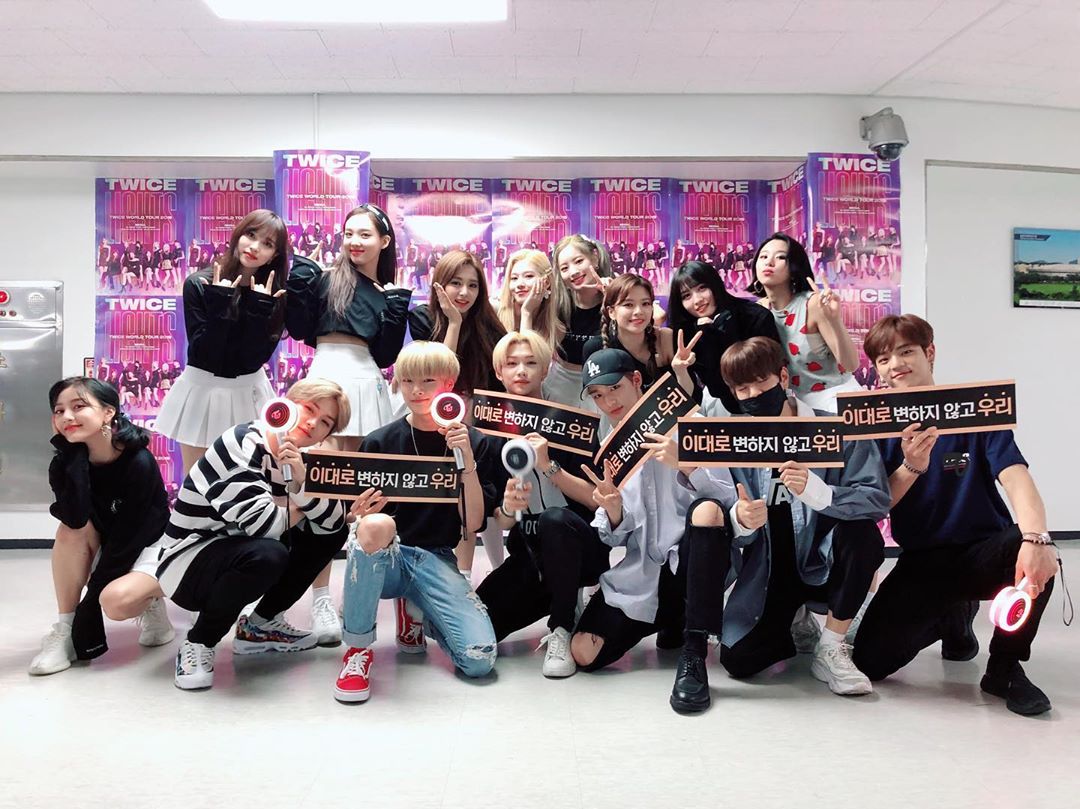
JYP Entertainment’s second-quarter numbers, released August 12, weren’t just a miss — they set off one of the sharper reactions any of Korea’s major entertainment stocks has had this year.
Revenue came in at 183.1 billion won, down 15.1 percent year over year. Operating profit fell much further, dropping 41.4 percent to 31 billion won, roughly 18 percent below what the market had expected. Net profit dropped 40.3 percent to 21.7 billion won, also missing consensus by a wide margin. For the first half of 2026 overall, JYP posted 369.1 billion won in revenue and 64.4 billion won in operating profit — solid on paper, but built almost entirely on a strong first quarter rather than momentum carrying into Q2.
The Comparison Isn’t Fair, But It’s Also the Whole Story
JYP’s own explanation centers on a brutal comparison. In the same quarter last year, Stray Kids were in the middle of a massive world tour and its associated merchandise cycle, and that tour alone pushed JYP’s year-ago quarterly revenue up more than 125 percent with profit multiplying several times over. This year, Stray Kids’ next tour didn’t kick off until July — after the quarter closed. As a result, concert revenue fell 35.7 percent to 39.9 billion won and merchandise sales dropped 34.5 percent to 43.9 billion won.
That explanation is true. It’s also, in a sense, the actual problem. A company with a genuinely deep artist roster should be able to absorb one group’s touring gap without the entire quarter cratering. JYP couldn’t. TWICE’s activity, including a well-attended Tokyo Dome run in April, helped cushion the quarter, and physical album and streaming revenue both grew nicely. But none of that was enough to offset how much of JYP’s profit engine runs through Stray Kids specifically.
The Market’s Reaction Went Well Beyond a Bad Quarter
What followed the earnings release wasn’t a routine round of estimate trims — it was a wave of target price cuts, several of them steep. iM Securities cut its target from 80,000 won to 60,000 won, a 25 percent reduction, while keeping a “buy” rating. Kiwoom Securities made a nearly identical cut, from 81,000 won to 60,000 won. SK Securities brought its target down from 75,000 won to 66,000 won. The shares themselves fell to a 52-week low of 40,850 won in the days after the report, and were trading around 38,800 to 41,000 won by the following week — down sharply from a six-month average target consensus near 82,000 won.
Analysts were explicit about why they’re not just modeling around a soft quarter. One SK Securities analyst pointed to Stray Kids’ looming military enlistments and TWICE’s contract uncertainty as the real medium-term risk, while an iM Securities analyst flagged that individual activity outside the group could take up a larger share of TWICE’s business going forward. In other words, the discount isn’t about this quarter’s tour scheduling — it’s about whether JYP’s two biggest engines are about to become structurally less available.
It’s worth noting JYP isn’t reacting in isolation. Korea’s four major entertainment stocks — JYP, HYBE, SM and YG — have together lost more than 8 trillion won in combined market value this year, with an average share price decline near 41 percent industry-wide. But JYP’s post-earnings drop has been sharper than its peers’, which suggests the market sees company-specific risk layered on top of a rough year for the sector generally.
| Metric | Q2 2026 | USD Equivalent | YoY Change | Analyst Consensus | Variance vs. Consensus |
|---|---|---|---|---|---|
| Revenue | ₩183.1B | $132.7M | -15.1% | ₩201.0B ($145.7M) | -8.9% |
| Operating Profit | ₩31.0B | $22.5M | -41.4% | ₩38.1B ($27.6M) | -18.6% |
| Operating Margin | 16.9% | — | — | 19.0% | -2.1 pp |
| Stock Price, July 1 | ₩53,200 | $38.55 | — | — | — |
| Stock Price, Aug. 20 | ₩40,100 | $29.06 | -24.6% | — | — |
| Target Price Consensus, Q1 | ₩92,471 | $67.01 | — | — | — |
| Target Price Consensus, Q3 | ₩67,389 | $48.83 | -27.1% | — | — |
TWICE’s Ownership Structure Is Quietly Changing
The more unusual development sits inside TWICE. In August, both Jeongyeon and Chaeyoung left JYP itself for their individual activities — Jeongyeon signing with an outside agency, Chaeyoung going independent under her own banner — while both explicitly said their commitment to TWICE as a group is unchanged. Reports at the time also named Jihyo and Tzuyu as exploring similar moves for their individual careers.
That’s a meaningfully different risk than “TWICE breaks up.” The group itself isn’t dissolving, and there’s no indication all nine members are leaving. But if more members shift their individual activity outside JYP’s direct control, the company could keep the TWICE brand while capturing a smaller share of what the group’s individual members generate commercially. It’s a slower, more structural erosion than a group split — and arguably harder for a company to plan around, because it changes not whether TWICE performs, but how much of that value flows back to JYP.
Stray Kids’ Military Service Isn’t a Surprise, But the Clock Is Now Audible
Unlike the TWICE situation, Stray Kids’ enlistment timeline has been visible for years and isn’t really in dispute — the only real question was always when, not if. Lee Know, the group’s oldest member still subject to Korean conscription, is now well into the age range where enlistment becomes unavoidable, with members having publicly acknowledged it’s coming. Bang Chan and Felix, both Australian citizens, are exempt. That means Stray Kids is heading toward a period of staggered availability sometime in the next year or two — precisely the asset the market is currently pricing as JYP’s single most important revenue driver.
Because the timeline is predictable, it isn’t really a shock. But it does put a hard deadline on JYP’s need to develop something else at scale before Stray Kids’ full-group activity becomes intermittent.
OURBIRTHDAY Is Carrying More Weight Than a Normal Debut
JYP’s new girl group OURBIRTHDAY debuted August 19 with the single “Squeezy” — though technically under INNIT Entertainment, a JYP subsidiary label, rather than JYP Entertainment directly. Even accounting for that distinction, it’s still the first new girl group tied to the JYP corporate umbrella since NMIXX in 2022. That’s roughly a four-year gap, and set against HYBE, SM, and even YG’s more frequent debut cycles, it underlines how thin JYP’s active pipeline has become beneath its two flagship acts.
The stakes for OURBIRTHDAY go beyond first-week numbers. What the market actually wants to see is whether JYP can still manufacture an IP with real commercial scale, not just a group that generates modest, steady income. NMIXX, for its part, is still building toward that scale itself — the group released a new EP in May and is set to make its official Japan debut later this year, another data point in whether JYP’s mid-tier acts are closing the gap or simply treading water.
Where This Leaves JYP
None of this means JYP’s business is broken. The company still has two of the biggest acts in K-pop, a reliable album and streaming business, and a founder in Park Jin-young who has been vocal — as recently as a widely circulated 2023 comment urging investors to think in three- to five-year horizons rather than react to short-term dips — about the company’s long-term value. Park has also continued adding to his own stake, which now sits above 15 percent.
But the market’s reaction to this quarter reads less like a judgment that JYP had a bad three months and more like a repricing of what happens next. Stray Kids and TWICE didn’t get less successful — they got so economically important that their upcoming disruptions (enlistment on one side, contract restructuring on the other) now carry outsized weight for the whole company.
The contrast with HYBE is instructive, not because HYBE’s individual groups are necessarily bigger, but because of how many it has running at different points in their lifecycle at once. BTS, SEVENTEEN, TXT, ENHYPEN, LE SSERAFIM, ILLIT, and newer acts like CORTIS and KATSEYE mean HYBE can have one group touring, another releasing an album, another debuting, and another entering a new market, all in the same quarter — so no single group’s scheduling gap moves the whole company’s numbers. JYP has real depth on paper too, with ITZY, NMIXX, DAY6, NEXZ and now OURBIRTHDAY alongside its two flagships. The problem isn’t that those acts don’t exist. It’s that none of them yet operates at a scale where losing a Stray Kids tour for one quarter barely registers.
The real question hanging over JYP isn’t whether this quarter was disappointing. It’s whether OURBIRTHDAY, NMIXX, ITZY and the rest of the roster can grow fast enough to matter before Stray Kids and TWICE’s current, uninterrupted form becomes the exception rather than the rule.
