

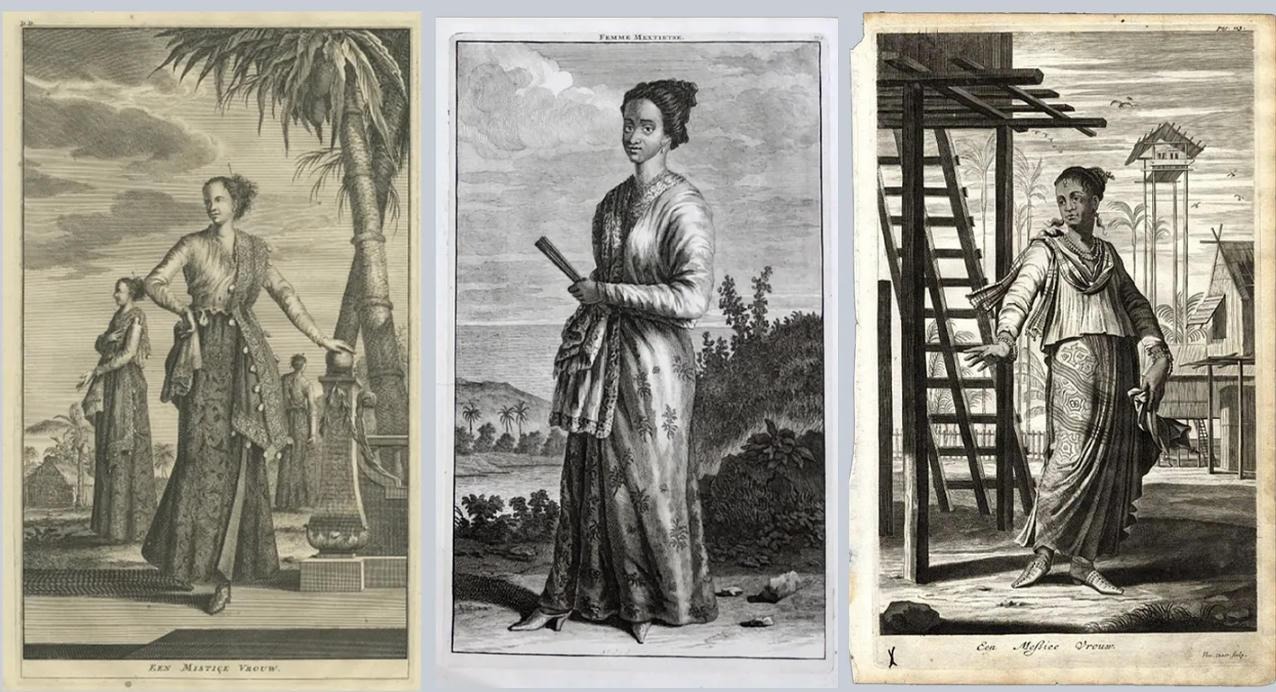
Ask where the kebaya comes from and you will get a confident answer. The problem is you will get several, and they will not match. Java has a court story. Melaka has a port story. Linguists have an Arabic-to-Portuguese story. Peranakan families have a grandmother story. All of them are holding a piece of the same garment.
That is not a failure of research. It is what happens when a piece of clothing grows up in a connected sea, then modern countries try to file it under one flag. The kebaya is open at the front, pinned with brooches, worn over a wrapped kain, and older than the borders now arguing over it.
Indonesia treats it as national dress. Malaysia has its own long kebaya labuh line and a vivid Nyonya tradition. Singapore made the fitted sarong kebaya famous to anyone who has ever boarded a Singapore Airlines flight. Brunei and southern Thailand wear their own versions. In 2024, UNESCO stopped trying to pick a winner and listed the practice as shared.
First, What a Kebaya Actually Is
A kebaya is an open-front blouse, usually fastened with a set of brooches called kerongsang rather than a full button placket. It is worn with a wrapped sarong or long kain. Experts keep coming back to three structural clues: the front opening, extra lapels, and a triangular underarm gusset — kekek in Malay — that lets the arm move. That gusset is one reason many historians hear a Middle Eastern robe in the cut, not a flat Ming jacket.
It is also not the Malay baju kurung. The kurung is a closed tunic. The kebaya opens down the front. Mixing the two up in conversation is easy, and it muddies the ownership debate more than it should.
The blouse is only half the sentence. Indonesian ensembles often pair the kebaya with batik. Malaysian ones may use songket, batik, or other woven cloth. The kerongsang is commonly three brooches down the front, sometimes linked by a chain, in gold, silver, or stones. Look at a finished outfit and you are looking at several crafts at once: cutting, embroidery, textile, metalwork. Each of those crafts has its own hometowns.
The Word Arrived Before the Flag Did
Even the name is a traveler. Most linguists trace kebaya from Arabic qabāʾ or kaba — a long front-opening robe — into Persian, then into Portuguese as cabaia or cabaya, then into Malay. A smaller theory ties the word to Cambay, the Indian textile port that once shipped floral cloth into the region. Either way, the name did not start as a Javanese court term or a Malay village word. It came in with people who were already moving.
That matters because later arguments often treat the name as proof of origin. The Portuguese may have helped spread cabaya through Melaka after 1511. That is not the same as proving Europeans invented the Southeast Asian kebaya. The name is proof of contact. The garment is proof of what local women did with the idea.
Three Origin Stories That Will Not Sit Still
The Java story. Indonesian accounts usually begin in the 15th century, around the late Majapahit world and the first strong Islamic courts on Java’s north coast. Aristocratic women who had worn a kemben — a torso wrap that left the shoulders bare — began layering a long open blouse over it as ideas of modesty shifted. There is no surviving document that records the hour the kemben became a kebaya. The change looks gradual, the way clothing changes usually look. Courts in Cirebon, Surakarta, and Yogyakarta later treated the layered look as refined dress. When the Portuguese reached Java around 1512, some elite women were already wearing an open-fronted upper garment. Court use on Java is old and continuous. That part of the Indonesian claim is not a fantasy.
The Melaka story. After 1511, Portuguese women in Melaka wore a cabaya. Local Malay women and Chinese Peranakans adopted and reshaped it. From Melaka it moved into Johor and along the peninsula’s west coast. Malaysian heritage inventories lean this way, and some also keep Sulawesi, Arabia, and China in the list of possible influences. One fact gets skipped in the tug-of-war: Melaka was already one of Asia’s great trading cities before the Portuguese took it. Ships in that harbor had been linking the peninsula with India, Arabia, China, and the islands for a long time. A style could arrive with one community, change shape in another, and later get claimed by the place that wore it most completely.
The spice-route story. This is the version that survives contact with drawings, trade records, and the clothes themselves. The silhouette sits at a crossroads: a Middle Eastern qaba, a Chinese Ming beizi with its front opening and long sleeves, Islamic pressure to cover the torso, a Portuguese name and cut, and later Dutch lace and white cotton. Cedric Tan, a Peranakan expert who worked on Malaysia’s UNESCO file, has said the quiet part out loud: the kebaya was never a native attire. It was a hybrid attire.
That last version is the least useful for a national campaign and the most useful for anyone trying to be accurate.

Early European prints of women in the Indies already show the open blouse and wrapped kain — before anyone was arguing about UNESCO.
Colonial Closets Changed the Cut
Dutch women in the East Indies started wearing kebaya and batik at home because European court dress was miserable in the heat. They used finer cloth, lace, and pale colors to mark themselves off from Javanese women in plain cotton. Class lived in the fabric as much as in the cut.
Local communities were not passive in that exchange. Imported lace and cloth entered workshops in the Dutch East Indies and the British Straits Settlements. Women decided how those materials would sit on a body they already knew how to dress. Singapore’s National Heritage Board records kebayas using European handmade lace from the late 19th and early 20th centuries. The lace was foreign. The outfit was not.
Peranakan women then took the shorter, fitted, embroidered version and made it unforgettable. The long baju panjang of the early 1900s — ankle-grazing, modest, a little severe — gave way to the tight, colorful Nyonya kebaya that most people now picture when they say the word outside Java. Brooches stacked. Voile replaced heavy cotton. Sulam embroidery turned the blouse into a garden. Floral and animal motifs associated with Chinese aesthetics sat on a Southeast Asian silhouette. The result did not belong exclusively to China, to Malay dress, or to Europe. It became specifically Peranakan.

The Javanese court and Kartini line: structured lace, a clean front, batik kain. This is the look Indonesia often means when it says national dress.

The Peranakan line: shorter, brighter, heavy on sulam. This is the look Malaysia and Singapore often mean when they say kebaya.
Why Jakarta and Kuala Lumpur Both Feel Possessive
Indonesia has the strongest continuous court tradition, the largest everyday wearership, and the nationalist upgrade. Raden Ajeng Kartini was born in 1879 into a Javanese aristocratic family. She argued for women’s education and wrote about women’s lives under Dutch rule. Photographs of her in Javanese dress became part of her public image. After independence, that image hardened into a symbol of modern Indonesian womanhood. The kebaya rode along with it, from Javanese court clothing into national dress. Garuda’s cabin crew still wear the point.
Malaysia is not borrowing someone else’s blouse. The kebaya labuh — longer, more covered — took root among Malay communities on the peninsula. In Perak, the Puteri Kebaya Labuh became associated with royal and aristocratic women, with ties running through Perak, Johor, Melaka, and Selangor. Melaka, Penang, and the old Straits Settlements were the Peranakan laboratory, where Chinese, Malay, and European tastes collided and produced the most photographed version of the garment. Malaysian heritage files treat kebaya labuh and kebaya pendek as Malay and Nyonya inheritance for a reason.
When four countries filed a UNESCO bid in 2022 without Indonesia, Jakarta heard a grab. Social media did what it always does with heritage: it made the temperature rise. None of that feeling is fake. People wear this. Grandmothers taught the stitch. Airlines put it on cabin crew. Weddings still ask for it. The argument is heated because the garment is alive.
UNESCO Called It Shared. That Was the Right Call
The adults eventually got in a room. On December 4, 2024, UNESCO inscribed “Kebaya: knowledge, skills, traditions and practices” on the Representative List of the Intangible Cultural Heritage of Humanity. The nomination came from five countries together: Indonesia, Malaysia, Singapore, Brunei, and Thailand — the largest Southeast Asian group nomination of its kind.
The listing does not settle who invented the first sleeve. It does something more useful. It treats kebaya as a living practice — cutting, sewing, embroidering, teaching, wearing — that crosses ethnicity and borders. The file talks about mothers teaching daughters, and about men who now sit in the workshops too. That is closer to how the garment actually survives than any origin plaque.
The Honest Ending
There is no contradiction in calling the kebaya Indonesian, Malaysian, Singaporean, Peranakan, Bruneian, or Thai. Those names point to different traditions that grew up around a related garment. Indonesia’s version carries Java, the wider archipelago, and a nationalist afterlife. Malaysia’s versions carry the peninsula’s Malay and royal lines. The Nyonya kebaya records what happens when communities live together long enough to invent their own dress code.
If you need a single birthplace, you will not get one that holds. The form took shape in the 15th and 16th centuries across a maritime world that did not have Indonesia or Malaysia on the map. Arabs, Portuguese, Chinese, and Dutch all left fingerprints on the name, the cut, or the cloth. Local women did the work that made those fingerprints into clothing.
The modern map divides the region into countries. The kebaya remembers the older map: islands, ports, and households passing a blouse along until it belonged to more than one place.
Wear it in Yogyakarta or Penang and you are not picking a side in a custody case. You are putting on a garment that learned how to travel.
Further reading
UNESCO listing: Kebaya: knowledge, skills, traditions and practices (2024 joint inscription by Brunei Darussalam, Indonesia, Malaysia, Singapore, and Thailand).
Linda Welters and Abby Lillethun, Fashion History: A Global View, on the qaba / cabaya lineage.
Denys Lombard, Nusa Jawa: Silang Budaya, on the Arabic-to-Portuguese path of the word.
