

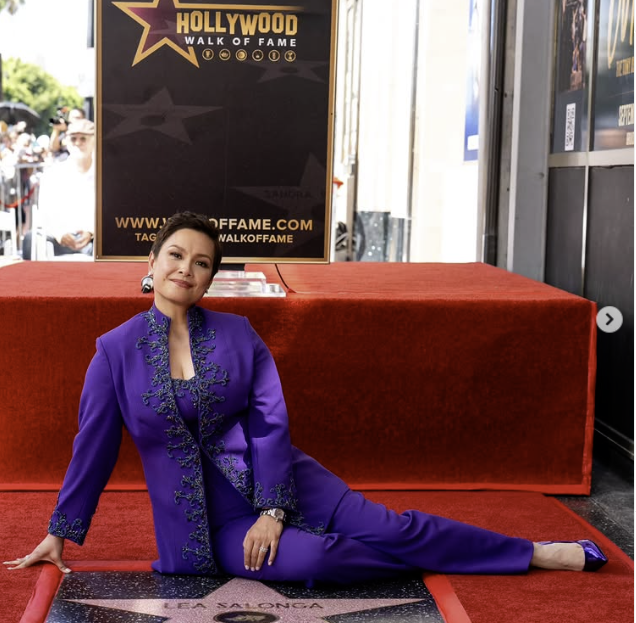
Lea Salonga dropped to her knees on Hollywood Boulevard and put her hands on her own name.
That was September 4, 2026, a little after 11:30 a.m. in front of the Pantages Theatre. The Hollywood Chamber of Commerce unveiled the 2,855th star on the Walk of Fame, Live Performance category, and for the first time the person under the brass letters was Filipina. Ming-Na Wen was there. Brandy was there. Darren Criss was there. Salonga, 55, joked that she had walked this street for years, stepping on famous people, and that it now felt “strangely appropriate for show business” that people would get to step on her.
Then she said the line that will travel farther than the star itself: she hopes a young Filipino kid comes to Hollywood someday, sees the name, and thinks maybe they can get here too.
That is the whole Lea Salonga story in one sidewalk sentence. Not that she arrived. That she left the door unlocked.


Long Before Hollywood, There Was Manila
Maria Lea Carmen Imutan Salonga was born in Manila on February 22, 1971. She made her professional stage debut at seven in The King and I, cut a record at ten, and by her teens was the kind of local phenomenon people in the Philippines still describe with a shrug, as if of course she was going to end up on the other side of the planet.
In 1988, still seventeen, she opened for Stevie Wonder. The same year, the singers’ union in Manila sent her to meet Cameron Mackintosh. He asked what size rooms she was used to. She told him she had just played for ten thousand people. He was trying to find out whether 2,500 seats at Drury Lane would rattle her. It did not.
Kim, Equity, and the Producer Who Was Ready to Walk
Miss Saigon opened at the Theatre Royal, Drury Lane, on September 20, 1989. Salonga was eighteen. She originated Kim, a Vietnamese bargirl who falls in love with an American Marine as Saigon collapses, and she sang the role like someone who understood that the part would eat anyone who treated it as costume drama. London gave her the Olivier Award for Best Actress in a Musical.
Broadway wanted the show. Broadway also wanted a fight.
The first collision was Jonathan Pryce, the Welsh actor Mackintosh insisted on bringing over as the Engineer, a Eurasian pimp, in yellowface makeup and eye prosthetics. Actors’ Equity refused to condone a white actor in that role. Mackintosh canceled the entire New York transfer — a $10 million production sitting on a then-record advance — rather than recast. Equity reversed itself. The show was back on. The argument was not over.
The second collision was Salonga.
Equity’s position, stripped of the press language, was that Kim should go to an Asian American performer. The union’s contract required a foreign lead to be either a “star of international stature” or a provider of “unique services.” A teenager from Manila, however gifted, was not automatically either. Mackintosh said he had looked. The number that stuck in contemporaneous reporting was more than a thousand candidates — one account put it at 1,200 — and no one who could do what she did with that score and that role. He asked for an exception. Equity said no.
He had already shown, over Pryce, that he would pull Broadway rather than lose the casting he wanted. This time the fight went to an arbitrator, NYU law professor Daniel Collins, who ruled in January 1991 that Salonga provided “unique services.” She got a nine-month contract. Miss Saigon opened at the Broadway Theatre on April 11, 1991.
The irony was not lost on her even then. America sold itself as the place where talent beat passport. The union that was supposed to protect actors spent months treating a Filipina who had already created the part as a problem to be managed. She told the Los Angeles Times she found it “kind of ironic to give me such a hard time.”
That spring she won the Tony Award for Best Actress in a Musical, plus the Drama Desk, Outer Critics Circle, and Theatre World Awards. She was twenty. She was the first Asian actress to win a Tony for a performance — Willa Kim, the costume designer, had already won in a design category, a distinction Salonga herself has been careful to make. She was also among the youngest winners in that acting category. The kid Equity tried to keep off the stage left with the prize.
The show itself has never been clean. Miss Saigon is a Vietnam War Madama Butterfly with a helicopter and a lot of Western appetite for Asian women’s suffering. Asian American actors were right to be furious about Pryce. They were also not wrong to want Kim played by someone from this country’s own Asian theater community. Both things can be true at once: the union’s gatekeeping of Salonga was a bad call, and the musical she conquered is still a text that needs arguing with. She did the job so completely that the argument never quite swallowed her.
Two Disney Voices, One Legend
A short list of people who have been the singing voice of two Disney heroines is a short list. Salonga is on it.
In 1992, while she was still the toast of Broadway, Disney brought her in to sing Princess Jasmine in Aladdin. Linda Larkin spoke the role. Salonga and Brad Kane flew the magic carpet on “A Whole New World,” written by Alan Menken and Tim Rice. The song won the Oscar and the Golden Globe. She performed it on the Academy Awards broadcast. She has said she squeezed a friend’s hand and cried the first time she heard her voice come out of the screen.
Six years later she did it again. Ming-Na Wen spoke Fa Mulan. Salonga sang her, including “Reflection,” and came back for Mulan II. In 2011 the Walt Disney Company made her a Disney Legend in the Voice category — the same night the company was, in effect, admitting that two of its most hummed heroines had been a Filipina in a booth.
That is why Wen standing next to her on Hollywood Boulevard was not celebrity filler. They built the same girl. One spoke. One sang. The sidewalk finally put a name under both.
What She Did After the First History
Most people who win a Tony at twenty spend the next decade trying not to become a trivia question. Salonga kept working like someone who still had something to prove to Manila.
She was the first Asian actress to play Éponine on Broadway in Les Misérables, then came back as Fantine. She led the 2002 Flower Drum Song revival. She was Erzulie in the 2018 Once on This Island revival, which earned the cast a Grammy nomination. She did Allegiance with George Takei, Here Lies Love, and, most recently, Stephen Sondheim’s Old Friends on the West End and Broadway. Cameron Mackintosh, still in her corner decades later, has said the surprise was never the voice. It was that she was funny.
The Philippines has spent those same decades hanging medals on her: the Presidential Merit Award, the Congressional Medal of Achievement, Commander of the Order of Lakandula. She has a star on the Eastwood City Walk of Fame in Manila. She has stacked Aliw Awards the way other people stack opening nights. She coaches on The Voice of the Philippines. She turns up in Yellow Rose, Pretty Little Liars: Original Sin, and, because the algorithm has a sense of humor, Netflix’s KPop Demon Hunters.
None of that is why a kid will stop on Hollywood Boulevard. The kid will stop because the name is there.
The Point of a Star That People Will Walk On
Hollywood Chamber president Ron Frierson proclaimed September 4 “Lea Salonga Day” in Hollywood. The City of Los Angeles and the State of California handed her paper. The Manila International Film Festival, which nominated her for the star, gives her its Icon Award on September 6 at the Beverly Hilton. That is the official week.
The unofficial week is quieter. A woman who was told she was not the right kind of Asian for Broadway Kim now has a permanent address two blocks of fame away from the theater that still sells spectacle for a living. She thanked her mother, Ligaya, who managed her through the ugly years. She thanked a son back East who just started his own life in the business — “my proudest production to date.” She told visitors they were free to step on her.
Representation talk gets soggy when it is only a caption under a photo. Salonga’s version has always been more practical. Originate the part. Survive the union. Sing the princess. Come back as Fantine when you are old enough to mean it. Let a Filipino American Tony winner like Darren Criss stand at the microphone and say, out loud, that a homegrown artist from Manila made the sidewalk.
The star is terrazzo and brass. The career under it is the part that was never supposed to happen, and then would not stop happening. If a kid from Quezon City or Daly City or Jersey finds that name under their shoe and decides the industry is lying about the ceiling, the ceremony did its job.
Feel free to step on her. Just look down first.
