

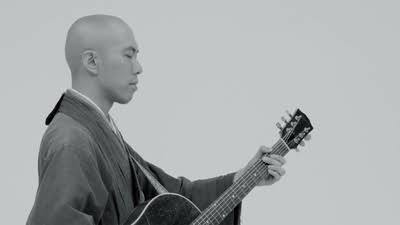
Kanho Yakushiji — 藥師寺寬邦, Yakushiji Kanho — is 47, deputy head priest of Kaizen-ji in Imabari, Ehime, sixteenth generation of a Rinzai Zen temple that has been in the family about four hundred years. He is also the monk who taught a chunk of East Asia to stream the Heart Sutra the way other people stream a chorus. The project he calls Heart Sutra Music turns ten this year. The anniversary has a name, Circle of Harmony, and a calendar that does not look like retreat season.
August 22, 2026, he opened the 37th Traditional Arts Golden Melody Awards at the Taiwan Traditional Theatre Center. First time on that stage. The number was his signature “般若心經 cho ver.,” reworked with Taiwanese arrangers Cho Shih-yao and Chen Hsin-han, Japanese players in the pit, and three opera heavyweights — Wang Hai-ling, Tang Wen-hua, Tang Mei-yun — walking on as Fu, Lu, and Shou for a blessing. At rehearsal he declined the “Japan’s most handsome monk” tag with a no-comment smile and admitted the Taiwan numbers still surprise him. The sutra is in Japanese. The rooms keep filling anyway. He wanted douhua and xiancao while he was in town. Temple work in Japan cut the stay short.
That is the current loop. May 22 he played Hulic Hall Tokyo, first Tokyo concert in four years. September 12 and 13 he is in Shimane’s Unju-ji and Okayama’s Inryo-ji for All-Temple Tour 47, the circuit that treats prefecture temples as venues. October 30 is his first Korea date, YES24 Wanderloch Hall in Seoul. October 31, Legacy Taichung. November 1, Live Warehouse Kaohsiung. Tickets went up August 7. He also keeps putting out records: 2025’s Shinka — Heart Song, with techno versions sitting next to the prayer tracks; singles like Usnisa Vijaya Dharani and Namu Amida Butsu; 2026’s The Enlightenment, which hit No. 2 on Japan’s iTunes New Age albums. The monk unit Re:Buddha, the EDM read of the same texts, travels in the same suitcase when the room wants a kick drum.
The Only Son Who Used a Guitar as an Exit
Born March 17, 1979, in Imabari, on Shikoku. Only son. In the danka system that usually means the temple is the job whether you like the job. His father loved records and kept a guitar he did not play well. Kanho picked it up in junior high, sang, wrote, treated music as the door that was not the main hall. High school band. University friends. In 2003, at 24, they formed キッサコ — Kissaquo — from the Zen case where Zhaozhou tells three different students “go drink tea.” Chorus-pop, major-label debut, touring. The escape was working.
Then it stopped being an escape. A bandmate fell ill. Touring paused. He read. The question he had been dodging — why this house, why this robe — stopped looking like a trap and started looking like material. Around 2010–2011 he went to Kennin-ji in Kyoto for Rinzai training: zazen, cleaning, vegetables, takuhatsu. Two years of that. He came back as vice priest of Kaizen-ji. His father still runs a lot of the day-to-day. Kanho eventually moved the household toward Kyoto so the music could have a desk. He still flies home when the temple needs the sixteenth generation in the room.
Heart Sutra Music Was the Merge, Not the Costume
He tried keeping the identities in separate drawers. Monk in the morning, musician at night. It did not hold. Two years into robes he started setting Buddhist text to the arrangements he already knew how to write. The clip that left the temple was “般若心經 cho ver.” — stacked voices, pop harmony, later synths and electronic drums — uploaded around 2016 and passed around until the view count became a press fact. Current official numbers put the Heart Sutra Music catalog past 100 million views; the YouTube channel sits in the high six figures to a million, depending on who is counting this month. Bilibili in China did the rest of the work Asia’s old music industry could not.
2018 and 2019 he toured China, Hong Kong, and Taiwan. More than ten thousand people in two years, which is a lot of tickets for a Japanese-language sutra. Pandemic: an online Heart Sutra with nearly sixty monks from Japan and the West. 2022, Southeast Asia. 2023, first world tour. 2024, China, Taiwan, Hong Kong, Malaysia, Singapore, Indonesia, Thailand, Australia. He shoots videos on the Shikoku 88-temple route with drones over roofs most tourists only see from a bus. He published 般若心経、私は歌う in 2022. He has covered Jay Chou and keeps looking for Mandarin songs that will sit on the same shelf as a dharani.
The artistic argument is simple and easy to cheapen, so he keeps restating it. Music and Buddhism do the same job if the job is giving a person a place to put their mind. He does not perform as a gimmick monk. He performs in the robe because that is the job, and the arrangement is the other job, and he got tired of pretending they were a conflict. Rinzai talk about seeing your nature sounds academic until you watch a room full of non-Japanese speakers mouth a Japanese Heart Sutra because the cadence finally has a drum.
The Handsome-Monk Headline Is the Least Interesting Thing He Does
Tabloid Taiwan still leads with the face. He will not pick the title up. Fair. The more useful fact is logistical: a working vice priest who is also running a 47-prefecture temple tour, an anniversary world run, a Traditional Arts awards open, and a catalog that now includes techno mixes of songs called Light and Journey. That is not a brand extension. That is a man who noticed the young rooms would not come to morning service and decided the sutra could travel.
There is a risk baked into the format. Sacred text plus EDM can slide into spa-playlist Buddhism, the kind of track that sounds holy because someone said “Heart Sutra” in the title. His better nights dodge that. The cho version works because the voices stack like a choir that forgot it was supposed to be austere. The temple gigs work because the room is still a temple. All-Temple Tour 47 is the tell: he would rather play Unju-ji on a Saturday afternoon than only play the rooms that look good on a poster.
Put This On When You Need the Mind to Sit Down Without a Lecture
Kanho Yakushiji is cultural immersion you can play in a kitchen. The Heart Sutra cho version and the dharani singles are for the commute when you want the nervous system to change channels. The Shinka techno cuts are for late work when silence is too loud and pop is too chatty. The live temple dates are the version that makes the argument physical — wood, incense, a PA that was not designed for this. He is not club music. He is not monastic radio. He is the middle path as a setlist: a reset that still has a hook.
Ten years after the clip left the mountain, the anniversary tour is just the same sentence in bigger rooms. Go drink tea. Then listen to the sutra until the thought gets bored and leaves.
