

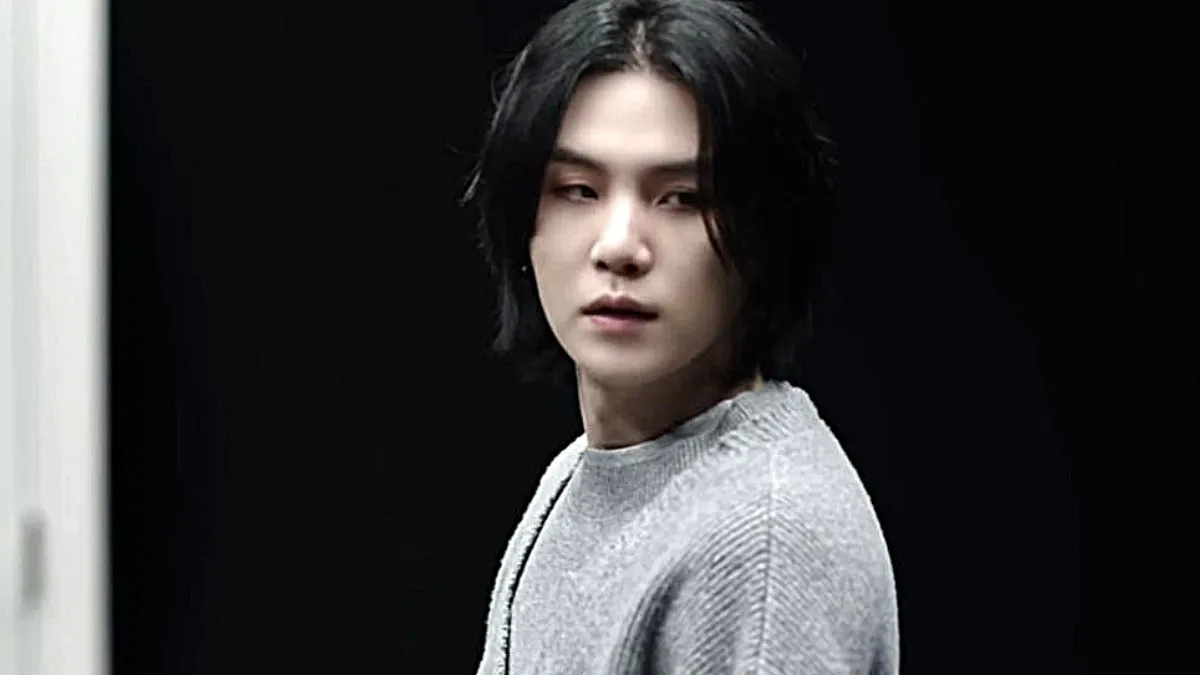
In Amygdala, Agust D concludes the story that began with Daechwita and Haegeum.
And his conclusion is—there is no conclusion.
This man is hell-bent on making our lives miserable. Seriously. He takes us on a rollercoaster of emotion, forcing us to confront the deepest and darkest corners of human existence—only to turn around and say, “What are you doing running around trying to fix social injustice and fight conflict? Sit down and look within yourself. That’s where the real evil is, dumbass.”
So, for the first time in my life, I’ll say this: I’m going to sue Min Yoongi. If anyone wants to join me, I’ll start a class-action lawsuit.
THE TRUTH ABOUT AMYGDALA
The amygdala is an almond-shaped part of the brain responsible for processing and storing emotional memories. It helps us react to situations for self-preservation. It’s not the only structure involved in that process, but it plays a central role.
It links experiences and stimuli to emotional outcomes—helping us avoid danger or seek pleasure. That can mean anything from how you respond to crime to something trivial, like developing a fear of dolls after watching Chucky.
For instance, I dislike being called by my full name because my mother only did that before she spanked me when I misbehaved as a child. My amygdala recorded that connection, so even now, hearing my full name triggers the expectation of pain.
Another person might fear dogs because they were bitten as a child.
Some memories, though, are too painful to remember consciously. We bury them, but they still influence us.
The amygdala stores these memories to teach us how to respond to future experiences. That’s why you might see a color, hear a melody, or step into a place and suddenly feel sad without knowing why.
Maybe it’s the color of the shirt your ex wore when they broke your heart. Maybe it’s the song that played when you learned of a loved one’s death. You may not recall the details consciously, but your brain remembers.
The amygdala doesn’t just preserve memories—it shapes our reactions based on what came before.
WHAT THE SONG IS ABOUT
To understand this one, you need the context of the others.
The first two were outward-looking. They explored what’s wrong with society, how to challenge oppressive systems, how to fight corruption.
Amygdala turns inward.
This time, he faces himself. The song reveals that the real evil isn’t out there—it’s within him.
He created it by repressing painful memories instead of confronting them. His fear and avoidance gave birth to the monster, and his refusal to deal with pain only made it stronger.
In the final scene of the video, when he sees something terrifying, he runs toward his amygdala. But this time, he fails to open the door. The evil within him dies.
Maybe that’s the point: we create the very evil that consumes us. Every bullet we fire to destroy it is one we aim at ourselves.
The only way to end that cycle is to stop running from pain every time it resurfaces.
OUR PAIN CRADLES OUR MONSTER
There’s one scene that captures this perfectly. The first appearance of his second persona—the seed of evil—comes when he recalls his earliest trauma: being born in 1993 while his mother underwent heart surgery. Because she was too weak to care for him, he lived with his grandmother for a long time.
That’s where it begins—for him, for most of us.
The moment we can’t cope, we push the pain away. We ignore it, bury it, pretend it doesn’t exist.
It’s a chilling idea: our evil grows in proportion to our pain.
How do we destroy the part of ourselves that protects us from suffering when that same instinct is what keeps the monster alive?
OUR MONSTER MASQUERADES AS OUR PROTECTOR
My amygdala, please save me.
That plea echoes throughout the song, as if he believes forgetting pain is the only way to stay safe.
The amygdala responds almost gently:
“Come on, let’s erase them one by one, yes, one by one.”
But the evil version of him bears the same scar as the man locked inside the room—his amygdala.
The message becomes clear: every time we hide, forget, or run away, we give that inner evil strength. Each act of denial feeds the monster.
The amygdala is no savior.
Like people in our lives who claim to protect us but quietly weaken us, it keeps us numb until we lose the strength to live fully.
HE HAD TO LIVE WITH THE PAIN TO BECOME WHO HE IS
In the latter part of the music video, as the evil trapped inside the room begins to weaken, Agust D faces something frightening and runs away—a symbolic attempt to escape his struggles.
This time, the door won’t open. He can’t reach his refuge or feed the monster anymore.
He collapses to the floor as his darker self fades away.
He kills his own monster not by attacking it, but by refusing to nourish it with more pain.
IN THE END, IT WAS THE EVIL ASKING TO BE KEPT ALIVE
Agust D differentiates his personas through sound.
The amygdala—the evil self—sings the melodic refrain:
“Come on, let’s erase them one by one, yes, one by one.”
Throughout the song, that voice keeps repeating:
“I don’t know your name, your name, your name… Come on, let’s erase them one by one, yes, one by one.”
But near the end, when Agust D runs to the door, screaming for his amygdala to save him, the melody shifts. The final words we hear are:
“Save me from here, hurry, get me outta here.”
IT COULD BE A PART OF HIMSELF TRAPPED IN THE ROOM
Maybe the voice begging for help is another part of him—pleading to be freed from the evil he created.
That would align with the cycle explored in Daechwita and Haegeum: once you defeat the system, you risk becoming it.
The evil inside us never fully disappears. Once born, it remains a permanent part of who we are—sometimes silent, sometimes resurfacing.
Yet Agust D himself has said that ending the Agust D trilogy reflects a more peaceful state of mind. That suggests he has faced his pain and finally silenced the monster within.
SOMETIMES OUR SAFE PLACE IS THE MOST DANGEROUS
There are so many ways to read this.
It could represent people, places, or systems that claim to protect us but quietly cause harm or it could symbolize our internal habits—the ways we shield ourselves from feeling pain.
Those shields eventually crack. Something always comes along strong enough to break them. And once they do, we realize how much weaker we’ve become from hiding behind them.
We have to face pain directly. Feel it. Live through it.
Because if we don’t, that unhealed part of us eventually manifests outward. And since its only purpose is to protect, it ends up hurting others instead.
