

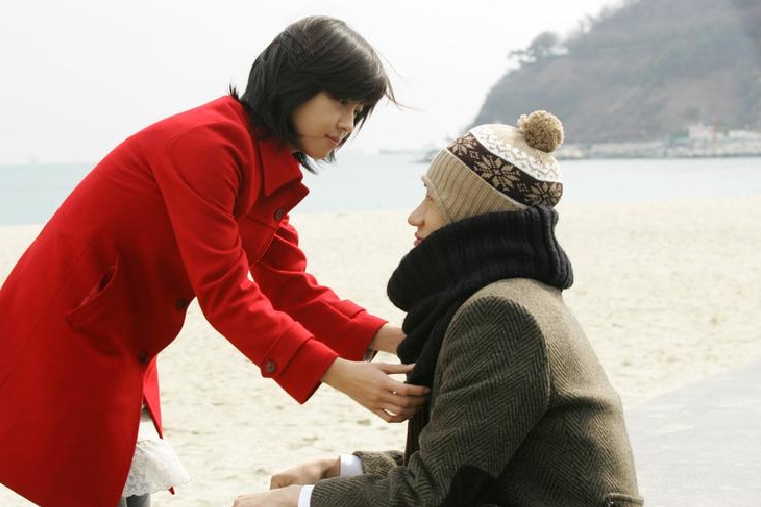
The story unfolds in a direction most romance films avoid: grounded, unembellished, and free of cinematic delusion. Instead of packaging pain into something poetic, Closer to Heaven allows love to exist exactly as it does in real life—at the wrong time, between two exhausted people, who cling to each other anyway because they finally found something that feels right.
Closer to Heaven Synopsis
Closer to Heaven (Love by My Side) revolves around Lee Ji-soo (Ha Ji-won), an undertaker who has been through two failed marriages and has long stopped expecting the universe to cooperate. Her old friend, Baek Jong-woo (Kim Myung-min), returns home to bury his mother, carrying a lifelong battle with Lou Gehrig’s disease. His muscles are failing; his mind is slipping; his time is visibly limited.
Despite all of it—or maybe because of it—they fall in love. Then they decide to marry. It’s an impossible equation, and they solve it by accepting that some answers in life are meant to be brief.
Realistic love stories from Asia: Lunchbox
Direction and Story
There are a thousand ways this film could have spiraled into melodrama. The premise alone practically begs for swelling orchestras, teary monologues, and last-minute miracles. But the director and writer refuse to coat the story in emotional sugar.
They choose realism—quiet, steady, and painfully recognizable.
He is a man who understands life’s cruelty down to the bone. She is a woman who understands people’s cruelty just as well. Their relationship is shaped not by naïveté but by experience. No breathless romance, no dizzy rush—just two adults who found something sturdy in the middle of the wreckage.
One of the film’s strongest decisions is its restraint. The cinematography favors soft lighting and muted palettes, allowing small pockets of beauty to stand out without screaming for attention. Take the dance scene: Ji-soo in a pale blue dress, lit only by a lamp, moving with a softness that feels both intimate and heartbreaking. Her face has no glamor treatment, no tricks—just a woman trying to give her husband the only form of closeness that his body still allows.
Acting
Ha Ji-won anchors the film with an extraordinary performance that avoids every predictable trap. She doesn’t play Ji-soo as a martyr, a hysterical caretaker, a stoic soldier, or a naïve romantic. She plays her as a woman who has already lived through enough disappointment to know exactly what she’s walking into.
Her strength is subtle—the kind that shows up in small movements, half-sighs, practical gestures, and the emotional endurance of someone who understands death on a professional and personal level. She loves him fully, not blindly, and that makes the performance richer.
It helps that Ha Ji-won is intentionally deglamorized. No soft-focus goddess treatment. She looks like a real woman enduring real circumstances, which allows her acting to carry the weight instead of her styling.
Baek Jong-woo, on the other hand, is easy to resent. He knows his condition is irreversible and still chooses to marry her. It’s an objectively selfish act. Kim Myung-min doesn’t try to make him noble; he makes him human.
For half the film, he’s bedridden and acting exclusively with his eyes—and those eyes deliver an entire emotional spectrum: terror, gratitude, guilt, and love that’s both deep and impatient. It’s one of the best “stillness” performances in Korean cinema.
Best action film from the Philippines: Maria
Visuals and Production Design
For a story that leans so grimly into mortality, the film is surprisingly bright. The production design is subdued but never dull, with quiet contrasts and soft touches of color. It reflects a world where beauty still exists—just not loudly.
Shortcomings
The film isn’t flawless. Ji-soo’s past is underexplored. A deeper dive into why a woman with two failed marriages would attach herself to a dying man could have added emotional richness.
There’s also the lingering question the movie never answers:
Did she love him from the start, or did pity open the door?
It’s a delicate line. She only agreed to date him after learning about his illness. You can argue—sensibly—that pity matured into love. You can also argue that she was drawn to someone whose life mirrored her emotional exhaustion. Both readings hold water. The film simply chooses not to confirm either.
Ha Ji Won’s Finest Work
Ha Ji-won’s career is filled with physically demanding and emotionally intense roles, but she is at her best when a film gives her room to breathe rather than perform. Closer to Heaven and Miracle of a Giving Fool remain among her most compelling works for that reason—they rely on her precision, not her power.
Closer to Heaven doesn’t chase plot twists or dramatic gimmicks. It trusts its own emotional gravity. The film pulls you in slowly, then holds you there until you’re convinced these two people deserved more time than life was ever going to give them.
It’s tender, honest, understated—and absolutely worth watching.
