

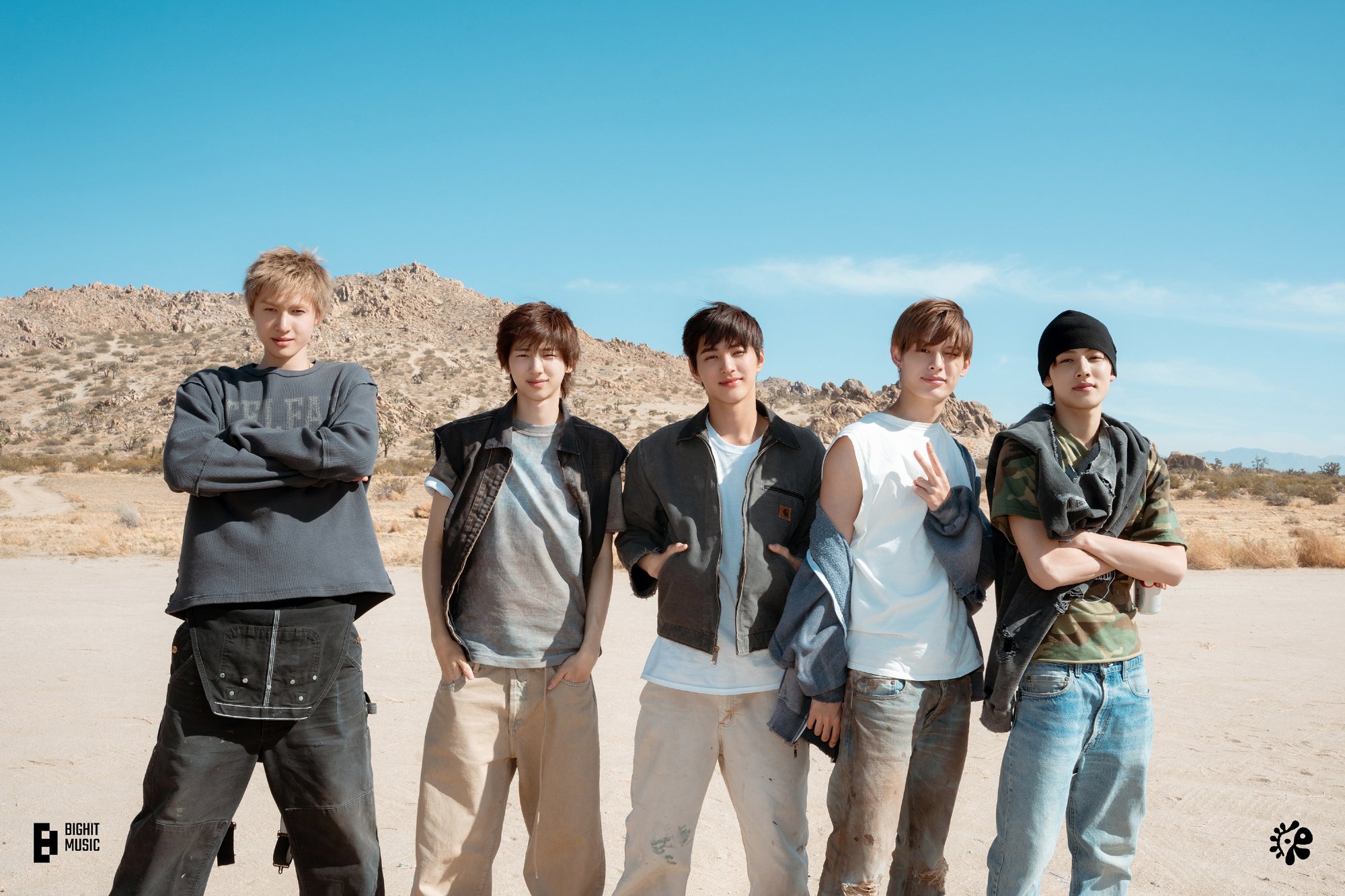
In K-pop, perfection has always been the product. Idols train for years to master choreography, diction, and stage presence, their every move filtered through an agency’s idea of what sells. Music often comes pre-written, concepts pre-approved, and personalities trimmed into digestible archetypes. The result is precision so sharp it leaves little room for accident — or for authorship.
CORTIS emerged with a different agenda. When BigHit Music introduced Martin, James, Juhoon, Seonghyeon, and Keonho, they didn’t call them idols at all. The group was labeled a “young creator crew,” a deliberate reframing that places them closer to a collaborative workshop than a managed act. Every member contributes to writing, production, choreography, and visual direction. The goal isn’t to perfect a formula but to build a practice — a living, evolving process that treats creation as something communal rather than commanded.
This approach draws more from the spirit of creative collectives like Odd Future or Brockhampton than from the lineage of K-pop agencies. A “crew” implies shared ownership, cross-pollination, and equal footing. Within that framing, mistakes are allowed, individuality is encouraged, and polish no longer defines professionalism.
“Celebrate the Cringe”
They said they never understood why people hate being awkward. They want to “celebrate the cringe.” They don’t mean it ironically. To them, embracing awkwardness is part of honesty. They said, half-joking but wholly sincere. That refusal to homogenize is the heart of their ethos.
K-pop has long been an industry obsessed perfecton. CORTIS operates on a different axis: individuality as collaboration. They are a crew precisely because they like doing things regardless of what the outcome may be. That adventure creates the spark.
For global listeners, this resonates immediately. Western media outlets have been quick to highlight the group’s “good kind of weirdness,” recognizing in them a kind of honesty that speaks the same language as YouTube creators, bedroom producers, and DIY filmmakers. The appeal is not in their flawlessness, but in the freedom they represent.
DAILY LIFE AS CREATIVE MATERIAL
CORTIS’s work starts from proximity — the things they feel, see, and think about every day. In interviews with Zane Lowe and iHeartRadio, the members described their lyrics as reflections of “what we feel, encounter, or experience.” Their songs unfold like journal fragments stitched into rhythm.
That perspective shapes their sound as much as their stories. Hip-hop and trap meet psychedelic rock, boom-bap, and R&B, often in the same track. Lullaby, a song Martin built from a jazz rhythm he had never tried before, carries the kind of off-balance warmth that only experimentation produces. Their debut EP Color Outside the Lines feels like a scrapbook of moods rather than a curated concept. The edges are intentional — music that still has fingerprints on it.
The emphasis on daily life also explains their rapid exposure to international audiences. Within two months of debut, CORTIS was already performing at iHeartRadio Theater in Los Angeles and appearing on The Zane Lowe Show. BigHit’s decision to push them into global circuits early wasn’t only a marketing play. For artists whose writing depends on lived experience, immersion in different cultures expands the material itself. The world becomes a studio, and every encounter has the potential to turn into a song.
Their songs unfold like journal fragments stitched into rhythm. Their debut EP Color Outside the Lines feels like a scrapbook of moods rather than a curated concept. The edges are intentional — music that still has fingerprints on it.
LIVE PERFORMANCES AS A LABORATORY
Most rookie acts debut with tightly controlled showcases — choreographed perfection, pre-recorded backing, and minimal improvisation. CORTIS went the other way. From their first stage appearances, they performed live.
The result wasn’t seamless, and that’s what made it compelling. Live delivery reveals where instincts take over once the choreography ends. Each member’s background in dance and production gives them a technical foundation, but their value onstage lies in spontaneity — how they recover from slips, how they connect, how they turn a crowd’s noise into rhythm.
That looseness fits their creative identity. A “creator crew” doesn’t just rehearse a product; it experiments in public. The energy may be rough, but it’s unmistakably theirs. Over time, this cultivates individuality — not assigned roles, but evolving stage personas grounded in instinct rather than instruction.
BUILDING FOR LONGEVITY
From the start, CORTIS resisted the visual logic that drives most idol promotions. Their music videos rarely fixate on desirability or perfect framing. GO! looks like a film project born from friends testing a camera. JoyRide is chaotic and self-aware, more short film than beauty reel.
CORTIS JOYRIDE MUSIC VIDEO ANALYSIS: WHAT THE MANUAL REALLY MEANS
The production process itself reverses the usual hierarchy. The members shot their own versions first, mapping storylines and visuals before the label’s team built the final edit around those foundations. BigHit didn’t hand them a storyboard — it refined theirs. This is what long-term identity looks like in practice: young artists learning to direct themselves.
That decision has a structural benefit. When creative vision belongs to the group, the fan connection deepens. Support shifts from image to authorship. Fans invest in the creators, not just the characters. It’s the difference between following a brand and following a body of work.
CORTIS may not have music-show trophies or the traditional milestones of success, but the numbers are quietly persuasive: over 100 million Spotify streams in their first month and a Billboard 200 entry at #15. Those achievements arrived through organic reach and repeat listening — signs of a group that builds gradually, not one engineered for flash peaks.
PROCESS OVER PERSONA
CORTIS’s behind-the-scenes content mirrors their creative ethos. Instead of stylized reality shows, they post vlogs that feel accidental — studio clips, candid banter, days spent experimenting with sound or film. These fragments echo the DIY energy of early BTS footage, when imperfection made the process tangible.
The effect is twofold. It humanizes them in an industry built on distance and proves that their “creator” label isn’t promotional theater. Fans see the work, the trial runs, the revisions. They watch the group make something rather than simply appear with it. That transparency builds a sense of proximity rare in idol culture. The crew doesn’t project mystique; it builds rapport.
For a generation raised on creators who livestream their process, this openness feels natural. CORTIS operates in that language — the rhythm of digital creators who share before they finish, who let audiences grow with them. It’s a kind of authenticity that can’t be manufactured through fan service.
PROOF OF CRAFT
The “creator” label would ring hollow if it weren’t backed by skill. CORTIS’s pre-debut credits filled that gap. Martin composed for TXT (“Beautiful Strangers”) and ILLIT (“Magnetic”), while James choreographed for both acts. Those credentials matter less as resume points and more as proof of internal fluency — an understanding of how production, perf ormance, and storytelling intersect.
It also reshapes the group dynamic. In CORTIS, expertise circulates among peers rather than flowing downward from management. The studio becomes a conversation, not a command chain. When members bring finished ideas to the table, the label’s role shifts from author to amplifier. The group holds the narrative authority, and BigHit provides the scale to broadcast it.
This equilibrium gives the project resilience. Trends can change, but skill and authorship endure. CORTIS functions as a creative ecosystem that can evolve without reinventing itself every comeback.
THE COMFORT OF CHAOS
In their interview with IHEART, CORTIS described their process to be reflective of their line. They simply don’t like doing the same things. It’s an acknowledgment that vulnerability is part of creation. “We don’t even like being similar to each other,” one member said, and it sounded less like rebellion than honesty.
That desire to be different, loud, messy, or off-key — is what distinguishes the group from their peers. They don’t treat experimentation as a gimmick; it’s the baseline condition of their work. Each track feels like a conversation among five creators testing limits rather than a polished product chasing uniformity.
Western audiences respond to that tone instinctively. The shift in fame has already happened — creators have replaced traditional celebrities as cultural mirrors. The ones who thrive today aren’t those who seem untouchable, but those who stay visible while figuring things out. Their value lies in unfilteredness — in letting people watch the process, not just the product.
That’s the same dynamic driving CORTIS. Their art doesn’t hide the seams; it highlights them. Each song, vlog, or live performance feels like an ongoing draft of who they are becoming. They aren’t performing perfection for an audience — they’re performing growth in real time.
DONE OVER PERFECT
James summed it up best in his Forbes interview: “Everything is at the tip of your fingers. You can create anything in a minute.” The statement captures how CORTIS approaches art — not as a monumental act, but as an everyday practice.
They live in a world where ideas flow faster than they can be refined, where tools are immediate and feedback is global. “Done over perfect” is less a motto than a creative reality. To make something genuine, they have to move before the thought hardens. That speed doesn’t diminish their work; it keeps it alive.
CORTIS’s process mirrors the rhythm of their generation — instinctive, collaborative, and perpetually in motion. The outcome might lack the sheen of legacy K-pop, but it carries a different kind of precision: the kind that comes from people who understand exactly what they’re trying to say, even if they haven’t figured out the cleanest way to say it yet.
CORTIS’s rise redefines what it means to be a Kpop idol. They’re proof that creativity doesn’t need permission, that experimentation can coexist with structure, and that individuality can strengthen, not fracture, a group’s identity.
By building their artistry through process rather than perfection, CORTIS expands the boundaries of what an idol group can be.
