

V has always had the natural ability to surprise people, but in his debut album, the surprise didn’t come in the form of an impossibly unexpected falsetto or innocently witty punchlines.
It came through the incredibly slow and extended immersion in pain that V didn’t allow us to be free from. It’s so sadistic, V delivered it so softly that you don’t even realize the anguish that could overtake you.
Here are 10 things I picked up from V’s debut album, Layover.
WARM AND UTOPIAN
Almost every setting used in all the so-far-released music videos has a specific kind of finish that is too smooth and sophisticated to be contemporary. There’s a touch of old gold. Everything is so spotless that it feels eerie. In fact, if you let it settle in you, it could feel uncomfortable—like it’s an artificial world created to your liking. Nothing is organic, nothing is real.
But the warmth of V’s voice, the gentleness of the melody and the beat, and V’s languid movement can distract you from the tragedy unfolding.
It’s incredibly smart and undoubtedly cinematic. It feels like it could be the setup of an epic HBO series. It’s very V; he never gives what you expect. He always has a deeper layer at work, often an unsettling one.
That’s exactly what he did with Layover. It’s never what you would initially think—which leads me to my next point.
“Everything is so spotless that it feels eerie — like an artificial world created to your liking, where nothing is real. It’s very V; he never gives what you expect. There’s always a deeper layer at work, often an unsettling one.”
EMOTIONAL NARRATIVE
The narrative the songs lay down forms a pretty clear story: from reminiscing to wishing for reconciliation, to trying to get yesterday back, to begging, to a slow surrender, to acceptance of loss.
V reminisces about something in “Rainy Day,” wishing he could bring the past back. The mood is light, the tone is light, and the beat is light.
He maintains the same tone in “Blue,” but there is more force and urgency in his voice—actually asking for the past to come back instead of just thinking about it.
“Love Me Again” is the peak of his desperation, publicly declaring the longing he feels. He finally starts to let go in “Slow Dancing,” succumbing to a faster beat, though not by much.
“For Us” is when he completely surrenders to his loss and leaves himself with nothing, moaning to relieve the pain.
VISUAL NARRATIVE
It wouldn’t have been V if it didn’t keep something torturous under the sheets. While the lyrics talk about longing for someone or something—a desire to take it back—the music videos, still incomplete with a couple more to go, seem to hint at some desperate attempt at relief through a futuristic manifestation of that desire.
In “Rainy Days,” V was creating sculptures of himself. In “Slow Dancing,” when he took a photo of himself and his friends inside the van, the polaroid showed only him, wearing different clothing.
He was also shown trying to come up with some codes in “Rainy Days,” and by “Slow Dancing,” one of his friends opened a laptop revealing some matrix-like code.
Almost every element in his room in “Rainy Days” and “Slow Dancing” also manifested on the beach. Once this idea becomes more concrete in your head and you rewatch V’s chill, almost nirvana-like stability, he could seem terrifying—like you know he would never hurt people physically, but that he could control the world and everyone with his fingers.
He once said he wanted to play a villain. When he does, he may cause nightmares.
NOSTALGIA AND MODERNITY IN VISUALS AND SOUND
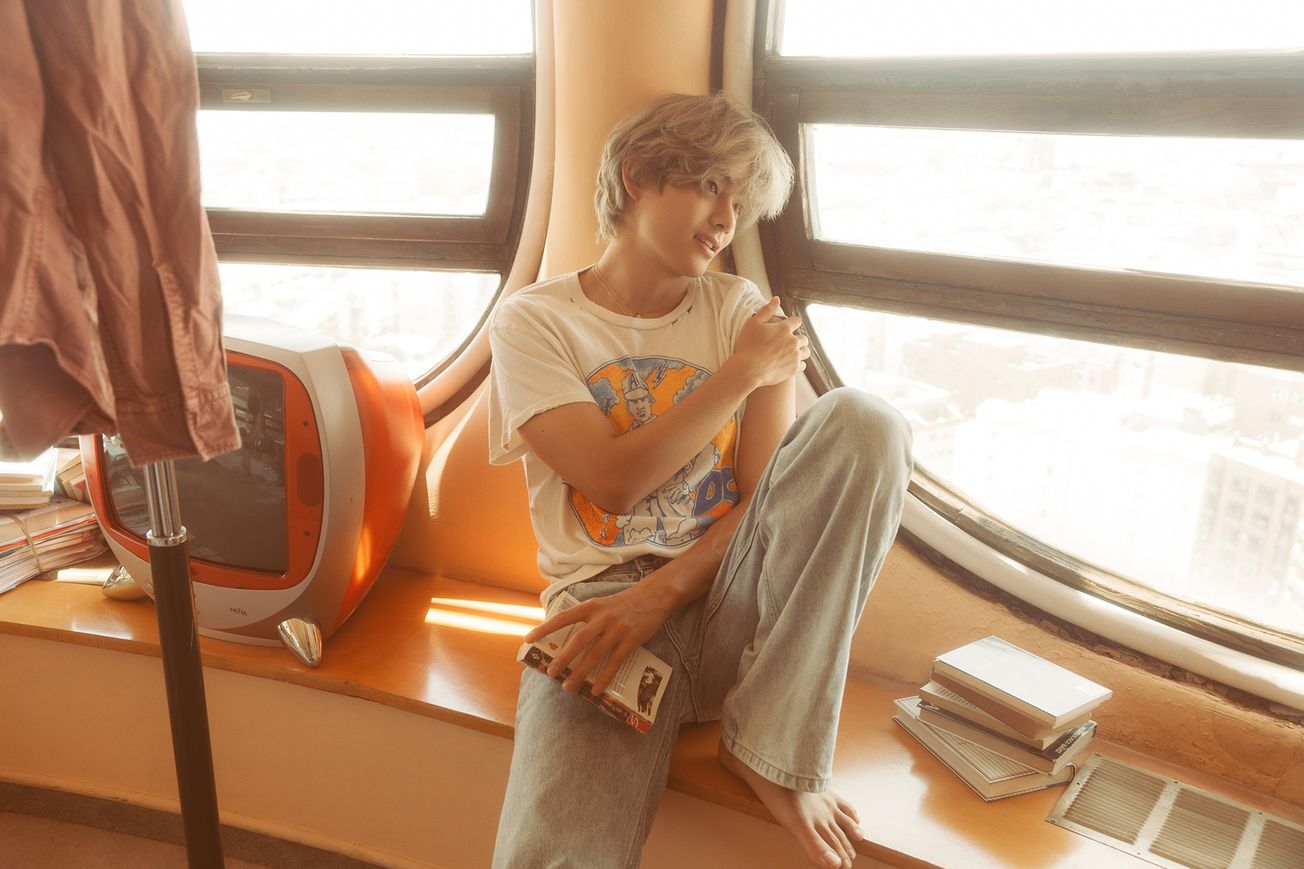
The desaturated color finish of “Rainy Days,” the sound of the rain, and the gigantic windows in a circular room give it a futuristic feel… until his phone starts dinging.
It’s those little touches that show a conscious effort to combine nostalgia and futurism. There are more in “Slow Dancing.” The van itself is crafted in a classic minivan style, but the silver coating gives it an almost dystopian feel. They are surrounded by nature, but V keeps coding everything we see on their little island.
The combinations are so subtle and aesthetically pleasing that you don’t even notice the merging of the two worlds.
ALL ELEMENTS TO A SINGLE COHESIVE STORY
Each element of the songs—the beat, the melody, the lyrics, V’s voice—and the music video—the cinematography, the direction, the production design—form one cohesive story. To grasp the totality of the narrative, you cannot take a single element out. It’s like a puzzle: take a piece out, and it’s incomplete.
Take the dinging of the cellphone out in the intro of “Rainy Day,” and you’ll miss the futurism hidden within nostalgia. Had V decided to hit high notes instead of staying in baritone, you would have lost the eerie, almost psychopathic, feel of his character.
Each element is a piece of the grand puzzle that is V’s art.
UNCONVENTIONAL STRUCTURE
V has never been one to take the conventional route, but it was still surprising to witness him ditch the tried-and-tested formula for commercial success.
For one, he decided to stay in the baritone range instead of hitting the high notes we all know he’s capable of. He didn’t speed up significantly in any part to create a highlight.
In fact, the entire genre he chose is almost never used in K-pop—certainly not for an entire song.
Even his music videos are laid back. They lack the explosive colors, complicated choreography, or special effects commonly seen in K-pop music videos. V counted on the story he wanted to tell. To truly appreciate his artistry, you can’t afford to be lazy in your analysis.
SLOW DEATH
The visuals, the beautiful melody, and the even more beautiful voice of V feel like a lullaby. It’s actually torture. The whole album starts with such sweet reminiscing of the past that you don’t realize he’s slowly pulling you deeper into his sadness before it ends in madness.
You don’t even realize you’ve willingly walked into a prison decorated with roses and lit with fireflies.
From bad to sad to desperate to madness.
SCREEN IS A CONSISTENT COMPONENT
In the so-far-released videos, the screen and Yeontan seem like consistent components.
To me, the screen serves as a door to the other world he longs for. In “Rainy Days,” V was watching animations before they morphed into a flower that became real. In “Slow Dancing,” the TV showed him on his out-of-town trip. In “Love Me Again,” the TV displayed the lyrics—his emotions made visible through words.
Yeontan, however, is a red herring. While he seems to be V’s constant companion, the way V keeps setting up a table for two, and the way he keeps looking at who we can assume to be Yeontan, feels too human-like for his gaze and actions to truly be for a dog.
A BROKEN ENDING — THERE IS NO RESOLUTION
“For Us” is so broken, and I think it was intentional for him to leave a broken resolution instead of relief. Instead of talking about letting go and moving on, he remains trapped in his longing—and the listener is trapped there with him.
It’s uncanny and certainly risky for a pop star to leave things unsettled.
INTRO TO V’S JOURNEY
This feels like an introduction to V’s journey as a solo artist. He has always been influenced by jazz and classical music, and it shows. It feels as authentic as he could get.
