

Some of the most common complaints about K-pop are familiar refrains: the songs lack substance, the hooks are catchy but generic, and the vocals are buried under too much production.
Park Jimin didn’t just sidestep those pitfalls—he aimed higher. The songs on FACE carry an actual message, and “Like Crazy” in particular is polysemous: layered enough to hold multiple meanings without collapsing under them.
FACE traces Jimin’s journey through the pandemic—how an international celebrity found himself in an emotional oblivion and fought his way out. But he wrote with enough poetry to leave space between the lines, room for listeners to sit with their own lives and let his words simmer. The circumstances may be uniquely his, but the emotions feel raw and universal. The point isn’t to flex perfect melismas or linguistic acrobatics; it’s to express something deep enough to connect.
A Word to the “It Didn’t Hit Me” Crowd
This review isn’t about the song’s chart stats or U.S. radio spins. If you want to debate popularity, this isn’t that video/article.
You’re absolutely free to say “it didn’t speak to me,” “the GP doesn’t know it,” or “it’s not catchy.” Opinions are allowed. But opinions aren’t absolute truths. What’s catchy to you might be nails-on-chalkboard to me—and vice versa. Unless we agree on a universal metric (numbers can be universal; taste isn’t), “catchy,” “impact,” and “GP” remain subjective.
If you want to be more objective, bring receipts. If you think it’s bland, tell us why: Is the melody static? Is there no dynamic development? Does the tempo, key center, or arrangement stay flat?
If you don’t want to substantiate, that’s fine too—just recognize you’re stating a personal preference. Adding “period” or “that’s the truth” doesn’t make it so. Otherwise you just sound like a bitter hater—and if you’re okay with that, great. I’m okay with it, too.
Also, a catchy song is not automatically a good song. Plenty of earworms are disposable. Substance is a huge part of what makes art endure. That’s where Jimin lands: he pairs substance with style.


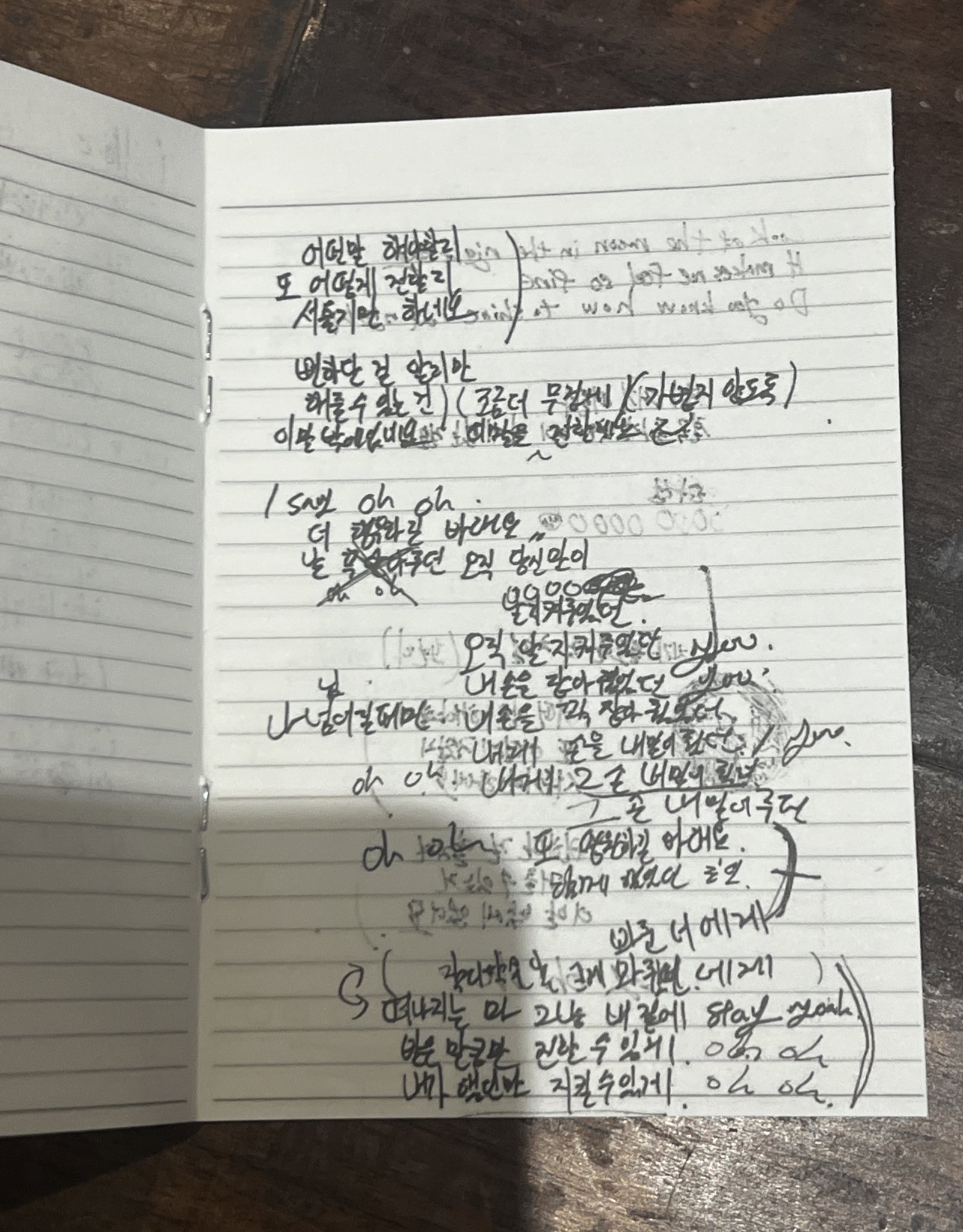
Images of Jimin’s handwritten lyrics to the songs in “Like Crazy”.
What the Song Is About (And Why It Feels Personal Even If You Don’t Know the Backstory)
Jimin has talked about the soul-searching behind this track. “Have I come too far to find the me you used to know?” he sings—both a question to himself and to anyone who loved an earlier version of him.
On a personal level, it’s about the version of Jimin pulled away from music, stage, and ARMY, trying to survive isolation. He evolves, changes, and then wonders whether the old fight is still the right fight—and whether he can go back to who he was.
If you ignore the behind-the-scenes context, the song becomes even more intimate. Like the 2011 film that shares its title, “Like Crazy” explores how life’s natural chaos forces us to evolve—and how we fight to keep an old self alive so the life attached to it doesn’t crumble. There’s comfort in familiarity; losing it can feel like grief.
We’ve all been there. You grind toward a goal—love, career, family—and somewhere along the way you change. Then the questions arrive: Am I still the person who wanted this? Do I still want it? It’s terrifying to spend years climbing a ladder and, at the top, realize it’s leaned against the wrong wall.
That’s the core of “Like Crazy”: change is natural and often necessary, but it can dismantle everything you built your life around.
Lyrical Style: Narrative → Interior Monologue → Imagery (and Back Again)
Jimin shifts among three modes:
- Narrative description. The opening verse positions him in a scene with reassurance at the edges: someone telling him it will be okay.
- Interior monologue. He dives into the headspace—“Watch me go, drenched all night and morning too.” It’s the sound of someone taking themselves apart to understand what’s left.
- Image-driven evocation. In what functions as a pre-chorus, he paints a picture instead of merely telling you how he feels. Loud music, a drama-like story—he’s getting used to it. By shifting to imagery, he pulls you into the room rather than reporting from it.
Structurally, this mirrors a classic story’s Act II: complications escalate, the hero crosses a point of no return. After that threshold, he toggles back to self-interrogation—
“Have I come too far to find the me you used to know?”—before surging into the chorus where the language becomes metaphor:
Lost in the lights, I’m outta my mind…
Every night, you spin me up high… The moon that embraces you…
The net effect: storytelling as collage. “Like Crazy” isn’t a diary entry; it’s a film reel cut across perspectives, which is why different listeners can live different truths inside the same lines.
Beat & Instrumentation: Order Emerging From a Beautiful Mess
The story begins before the first lyric. The opening textures (detuned keys / slightly frayed strings) feel disjointed—like someone idly plinking at an old piano or guitar with no clear direction. That’s not sloppiness; it’s character.
As the verse progresses, he fractures notes and space, matching the self-dismantling in the lyrics.
When he dives deeper into his head, percussion takes over, and a heavy bass becomes the spine.
The pre-chorus is bass-led, giving it weight and inevitability—consistent with the emotional drag he’s describing.
In the chorus, new textures bloom. Elements fuse rather than pile up; the sound widens to mirror the metamorphosis he’s experiencing.
Crucially, the track resists overproduction. Even at peak sections (chorus/bridge), it doesn’t drown in layers. Everything’s intelligible, like a well-mixed cocktail where you can taste each note. He doesn’t need maximalism to tell a complex story.
Melody: Threading the Needle Between Cohesion and Change
Melody is one of Jimin’s natural strengths, and here it behaves like a living motif. Each section introduces change but carries a trace of what came before, so transitions feel earned, not abrupt.
He plays a slow/fast/slow/fast game line-to-line, shifting from staccato to legato phrasing in quick turns.
That push-pull adds dynamism without shredding the song’s mood. It’s the sonic equivalent of anxiety waves: advance, retreat, advance again.
This call-and-response between phrasing styles echoes the theme: evolving under pressure while trying to keep something essential intact.
How the Elements Talk to Each Other
Underneath, the beat is heavy—bass and percussion drive. On top, the melody is restrained and the vocal delivery deliberately understated, almost lullaby-soft. That irony—muscular rhythm vs. gentle line—creates the track’s sensual pull.
But that sensuality is a decoy. Getting lost, breaking, and evolving hurts. There might be surface pleasure—the lights, the spin, the embrace—but the core is disorientation and grief. “Like Crazy” captures that contradiction perfectly: a song you could put on for a late-night vibe that, if you actually listen, might wreck you a little.
That irony—muscular rhythm vs. gentle line—creates the track’s sensual pull.
But that sensuality is a decoy. Getting lost, breaking, and evolving hurts. There might be surface pleasure—the lights, the spin, the embrace—but the core is disorientation and grief.
Why This Works (Even Without Music-Theory Deep Dives)
I’m not here to litigate modal interchange or compression ratios. From an ordinary listener’s perspective, the craft serves the story:
Simple in the right places, complicated where it counts.
Hooks that seduce, lyrics that sting later.
An arrangement that progresses section to section without showboating.
Plenty of tracks flood the airwaves with catchy beats and melodies. Catchy isn’t rare. Meaning is. Jimin aims for meaning—and lands it.
What It Did to Me (Your Mileage May Vary, That’s the Point)
“Like Crazy” made me ask ugly questions: Am I happy? After years of doing the “right” thing, where did it lead? Do I still want what I said I wanted?
It forced me into corners I didn’t want to sit in. It didn’t let me leave with a tidy answer.
When a pop song can do that—when it can be club-playable and quietly devastating—you’re not just dealing with a hook. You’re dealing with art.
And remember: this is just one track on an EP of five. Layer after layer, “Like Crazy” is arguably one of the most multidimensional, carefully constructed K-pop single in recent memory—sexy on the surface, sorrow in the marrow.
Musicians like Park Jimin—artists who bother to write substance to accompany their beats and melodies—are beyond welcome in the industry; they’re necessary.
