

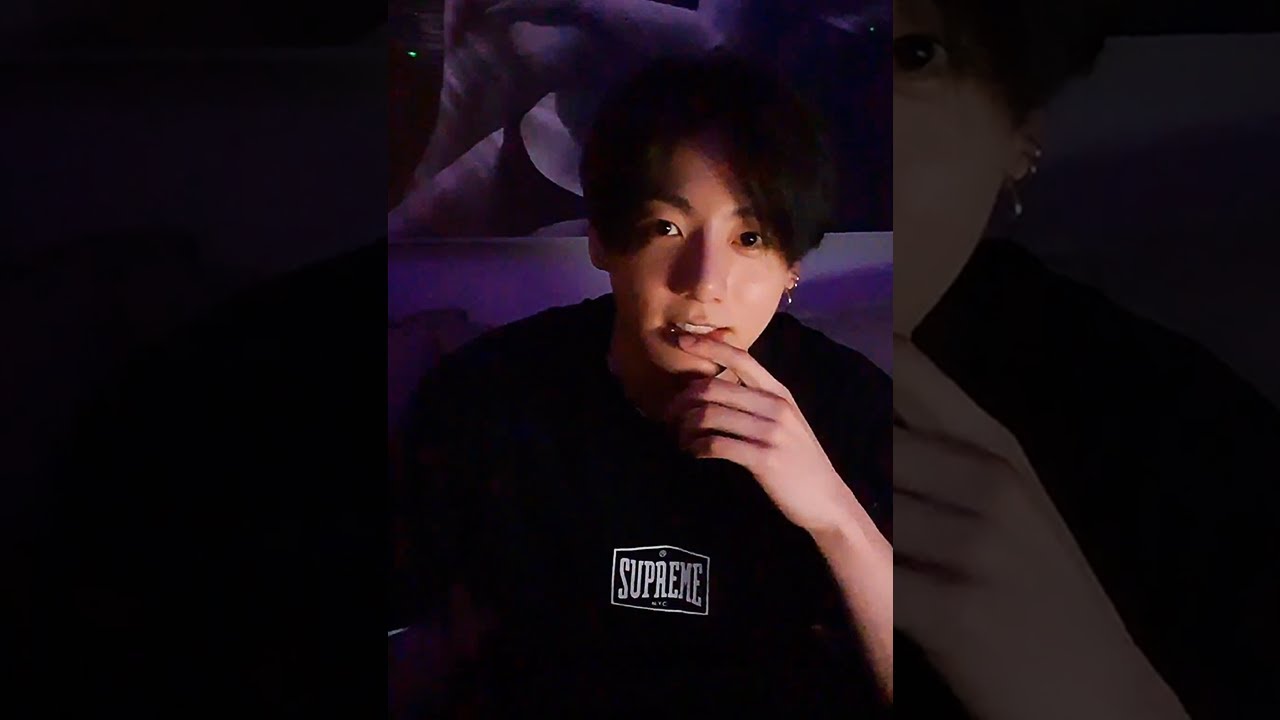
Jungkook’s deleted livestream sparked widespread claims that he was “silenced” or afraid to speak freely. But a closer look at what he actually said — about HYBE, ARMY, expectations, and creative freedom — tells a far more nuanced story. Here’s a full breakdown of the most misrepresented moments and why the victim narrative doesn’t hold up.
Korean media has been running with a particular angle on Jungkook’s last livestream. The dominant narrative paints him as an “oppressed” artist — someone who wanted to speak freely but held back out of fear of company punishment.
Ironically, Jungkook himself predicted this reaction. He even said during the live that people might misinterpret it, and that he might end up deleting it — which he eventually did.
I had already addressed this in my own livestream and didn’t plan to revisit it since the video was removed. But between then and now, Western media outlets and content creators have picked up the same victim framing. So this breakdown is primarily for them — to clarify the most misinterpreted moments and to unpack why fans so quickly default to positioning their favorite idols as company victims.
And yes, that includes BTS — and Jungkook — who renewed their contracts early, twice.
Let’s walk through what actually happened.
1. How It Started
Jungkook turns on the live show around 4 AM KST. He’s with his biological older brother and his close childhood friend from Busan. The vibe is simple: Karaoke. Late-night energy. No set agenda.
This isn’t unusual. He’s always preferred showing himself as-is — not hyper-polished, not separated neatly from his stage persona.
Several times in the first half, he repeats, “I don’t know,” when talking about what’s expected of him on livestreams — what’s considered “okay,” what crosses a line. But the tone wasn’t fearful. He’s thinking out loud.
He even says he thinks it’s fine for ARMY to see him authentically — confusion included. He’s processing in real time.
2. Jungkook and the Cigarettes
At one point, his Busan friend lights a cigarette off-screen. Jungkook playfully nags him to put it out and sing instea.
Later, Jungkook brings up that he used to smoke. He says he quit after significant effort so he can continue singing.
This is where some of the dramatic interpretations began.
Remember: he’s sitting with his brother and childhood friend. He’s comfortable. Relaxed.
When he mentions his past smoking, it’s not rambling or sloppy. Yes, he’d had a few drinks — but this was deliberate. He speaks in a matter-of-fact tone, saying he wants ARMY to know who he actually is — including past mistakes — and that he takes accountability for them.
He isn’t saying smoking is some scandalous secret, just something he did and has stopped doing for his health and his art.
3. Jungkook & “The Company” (HYBE / Big Hit)
This is the section most aggressively misquoted.
At one point, Jungkook says to his friend, “If it weren’t for the company, I’d probably just blurt out everything…”
Then he immediately pauses and goes, “Oh — does that make the company sound terrible?!”
And he corrects himself almost instantly:
“I don’t mean the company is bad. Actually, they neutralize a lot of things. I’m really grateful. They catch things I miss all the time. Please don’t hate our company. Our company is very nice.”
He continues:
“What I’m saying is, if it were just me, I’d say [whatever comes to mind]. But I’m a singer, an idol, at the center of K-pop-related things… so the company brings me back when I’m about to veer off somewhere. But if I was on my own…”
That’s the full thought.
There’s this online culture that constantly pushes the idea that “people should be allowed to say whatever they want.” That sounds principled in theory. In reality, it’s not how adult life works — especially not when you’re broadcasting to millions.
Not every thought needs to be spoken out loud. Not every emotion needs to be livestreamed.
Words can hurt people.
They can be misinterpreted.
They can escalate fandom wars.
They can create legal issues.
They can put the speaker — and others — in danger.
And most people aren’t fully aware, in the moment, when they’re crossing into territory that could cause unintended consequences.
That’s the filter Jungkook was referring to.
The reality is that having a company means having advisors, PR staff, legal teams, managers — people whose job is to think five steps ahead. To catch things you might miss.
My Opinion
Let me be clear — this next part is my opinion.
No company is perfect. Not HYBE. Not Big Hit. Not any entertainment corporation on the planet. But Jungkook renewed his contract early. Twice.
He did not wait until expiration to test the market. He did not shop around publicly. He recommitted.
Jungkook is one of the most commercially valuable artists in the world. If he wanted to leave, major U.S. labels would line up instantly. He has leverage. The fact that he chose to stay — and to renew early — says something.
Insisiting him as trapped removes his agency.
4. Jungkook & Circulating the Live
Jungkook openly acknowledges during the live that he’s probably going to “hear about this” from the company — and from the members — because this was unplanned.
Then he says, very clearly and very directly:
“I should delete this live… I shouldn’t have done this live… Ugh. But it’ll probably circulate on YouTube… dang it…”
There’s no ambiguity there.
He apologizes for starting the live without collecting his thoughts first. He thanks the ARMY who are leaving supportive comments. Then he adds, almost amused:
“But I guess some of them might be malicious comments too…”
He chuckles. And then he says something important:
“Well anyway, all of you — even those hating — thank you. It’s your attention.”
He knows how the internet works.
He understands that once something is online, it spreads. Deleting the live wasn’t an admission of wrongdoing. It was him recognizing that he’d gone on without structure, spoken freely in a vulnerable state, and decided it didn’t need to live forever.
5. ARMY Is the Reason He Wants to Keep Improving
This is another section that’s being misinterpreted.
Here’s the core of it:
Jungkook says he feels overwhelmed. He’s frustrated because he can’t quite articulate what he’s feeling. Then he says something he’s actually repeated for years in interviews:
“If there was no one watching me, why would I sing and dance? Why would I write songs? Why would I put in effort? It wouldn’t make sense.”
Some people are interpreting this as:
“He only performs because of fame.”
Or worse: “He has no identity outside ARMY.”
That’s not what he’s saying.
He’s not claiming he would be incapable of happiness without fans. He’s not saying his existence depends on public validation. In fact, earlier in the live he makes it clear he can be fine on his own.
What he’s describing is purpose.
Art is relational. Singing, dancing, songwriting — these are communicative acts. They are meant to be received. If no one hears a song, if no one watches a performance, the motivation to refine it, polish it, push it further naturally changes.
He’s saying the presence of an audience sharpens his drive.
6. “Nothing Will Replace ARMY”
At one point, Jungkook says that nothing will replace ARMY.
That line, predictably, has already been weaponized in two opposite directions — either as proof of unhealthy attachment or as romanticized fan service.
It’s neither.
He is saying ARMY holds a specific, irreplaceable space in his life and career. That doesn’t mean ARMY is the entirety of his world. It means that the relationship between artist and fandom — especially one that has lasted over a decade — is foundational.
There’s a difference between:
“You are my whole life.”
And
“You have a place in my life no one else can take.”
He’s clearly expressing the second.
7. Expectations — Creative Freedom vs. Public Anticipation
Jungkook also briefly touches on something much more ordinary — but equally important.
They recently filmed a music video. There are concerns. There are worries about how things turned out. But nothing has been finalized yet, so there’s nothing concrete to review.
Then he says, simply:
“Either way, we’ll be sure to put out our absolute best. You may have expectations… but this time it’s about what we want to do. So it may or may not meet your expectations. But I don’t think you’ll be disappointed, because we’re all giving our best.”
That statement alone contradicts the idea that he feels creatively suffocated.
He’s openly saying this project reflects what they want to do. At the same time, he acknowledges that fan expectations exist. That tension is real — especially for a group operating at BTS’s scale.
Now, to anyone tempted to roll their eyes and say, “They’re adults. Who cares? Why does any of this matter so much?”.
There are two sides.
Western values center the individual. Personal boundaries. Personal comfort.
But Korean society is communal.
In many Korean contexts, the collective is prioritized over the individual. Choices ripple outward — to family, to team members, to company, to industry. There’s an implicit social contract: we yield, at times, for the whole.
That doesn’t mean people don’t have autonomy. It means autonomy exists inside a network of shared consequence.
So when Jungkook speaks carefully — when he self-corrects — when he worries about expectations — that isn’t necessarily fear. It can also be responsibility.
The Victim Narrative
This brings us to the bigger pattern.
Jungkook is actually one of the more transparent artists at his level. He shows his casual life. He goes live spontaneously. He admits to past habits. He struggles in real time to articulate his thoughts.
At the same time, he keeps certain things private — intentionally.
He has repeatedly said he does things the way he wants to do them. He says what he wants to say.
Yet a portion of fandom insists on interpreting vulnerability as victimhood.
Why?
Part of it is projection. Fans sometimes map their own frustrations with authority onto idols. If you’ve felt stifled in your own workplace, it’s easy to assume your favorite artist must be, too.
Part of it is moral positioning. Defending someone against a perceived oppressive force feels righteous. It creates a clear hero–villain structure. It’s emotionally satisfying.
Part of it is attachment. If your bias is constantly under threat, supporting them feels urgent and meaningful.
And part of it is misunderstanding the scale. BTS are not rookies navigating their first contracts. They are shareholders. Global earners. Creative contributors with established authorship. They have negotiated renewals early — twice.
Have they faced pressure in their careers? Of course. Every global act does.
But the consistent framing of them — especially Jungkook — as powerless puppets doesn’t align with observable reality.
BTS have set boundaries repeatedly. They’ve taken hiatuses. They’ve publicly addressed burnout. They’ve pursued solo projects on their own timelines. They’ve openly discussed creative disagreements.
The irony is this: constantly framing them as victims can actually undermine the very autonomy fans claim to defend.
Jungkook’s livestream showed frustration, reflection, responsibility, and gratitude. It showed someone thinking out loud about expectations — artistic and cultural.
What it did not show was captivity.
And sometimes the most respectful thing we can do as observers is let complexity exist without forcing it into a rescue narrative.
