

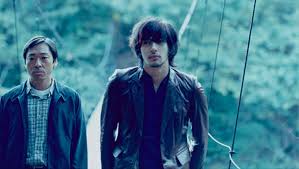
When I first heard that Jo Odagiri briefly considered retiring from acting after this film because he believed he would never encounter another script with this level of depth and emotional excavation, I knew I had to watch it. I wanted to understand what it was about this story that pushed a passionate actor to that conclusion — what could make him feel he had reached the peak of what he could contribute on screen.
To this day, Odagiri still says he has not taken on a project that surpasses Sway. He didn’t retire, and he continues to deliver strong work, but after seeing this film, I understand why nothing else feels comparable to him. Very few films released after Sway even come close to its precision, its insight, or its quiet devastation.
Synopsis
Takeru Hayakawa (Jo Odagiri) is a successful photographer living in Tokyo. He returns to his rural hometown for his mother’s funeral, arriving late and dressed in the kind of polished city style that immediately irritates his stern father. There, he reunites with his older brother, Minoru (Teruyuki Kagawa), who has stayed behind to run the family’s gas station and shoulder the responsibilities Takeru abandoned.
Takeru also sees his ex-girlfriend Chieko (Yôko Maki), who is now with Minoru. The three decide to revisit a place from their childhood — a narrow wooden suspension bridge hanging above a deep river. Neither brother crossed it when they were young.
As they walk through the familiar landscape, the truth comes out. Takeru once asked Chieko to join him in Tokyo, and she regrets not going. He crosses the bridge first, leaving her behind, and eventually she gathers the courage to follow. Minoru rushes after her, demanding to know whether she still has feelings for Takeru. She denies it. Takeru hears the argument and turns back — only to find that Chieko has fallen from the bridge.
Symbolisms
The most striking feature of this film is its deliberate, intelligent use of symbolism.
Even the title, Sway, functions as a symbolic anchor. As Takeru recounts the events leading up to Chieko’s death, his memories drift between two timelines: his boyhood in the countryside and his adult life as a celebrated photographer in Tokyo.
His past is where resentment first took root — a quiet, dull repetition of daily life that made him long for escape. His dreams of something bigger fueled a kind of bitterness toward everything ordinary around him. His present, meanwhile, is the fulfillment of the life he once imagined: independence, artistry, success, and distance from the past he left behind. Yet this idealized life is also where he became untethered, unsure of what he truly wanted or what his ambitions ever meant.
These two emotional landscapes — past and present — begin to blend. Not the facts, but the feelings attached to them. What happened, what could have happened, and what never happened at all start to blur. This emotional confusion makes it nearly impossible for him to determine whether his brother is guilty.
The death of the girl also mirrors the tragedy of their individual fates.
The bridge they feared as children represents everything they were too afraid to face — the risk, the instability, the possibility of falling. Takeru is the one who ultimately “crossed the bridge” into a new life. He took the path that terrified them as kids, while the others stayed behind. He asked Chieko to go with him; she couldn’t give up her familiar world long enough to confront the uncertainty waiting beyond it.
When the three return to that bridge as adults, the symbolism sharpens. Takeru walks ahead and leaves her behind — just as he walked away from their relationship years before. He reaches a vantage point where he sees new beauty, a small garden he never noticed as a child — a direct parallel to the unexpected joys he discovered in Tokyo. The bridge stands as the divide between his past and the courage he had to leave it behind. It is also the divide that distances him from his brother and from Chieko in every possible way.
Narrative
The symbolic layering extends into the narrative structure. Almost everything after Chieko’s death takes place inside a courtroom. It should have been monotonous, but the writing and direction maintain a tight, deliberate pace — shifting between questions, answers, reflection, and doubt. Even long scenes filled with dense dialogue remain absorbing because the emotional stakes rise with every recollection.
At the start of the trial, Takeru is overwhelmed — grieving the woman he truly loved and shaken by the possibility that his brother had something to do with her death. He’s also lost, pressured by everyone around him to provide clarity he doesn’t have.
As he sifts through his memories, pain shifts into determination. He begins mining every detail he previously dismissed, searching for motives and explanations that align with what he believes he saw. His interpretations are compelling — until past emotions intrude, challenging the memory he has constructed. This tension between logic and emotion pulls the viewer into his confusion.
When these doubts emerge, the truth about his relationship with Minoru reveals itself — complicated, bruised, and profoundly sad.
The film initially paints a simple dynamic: Minoru resents being the one left behind while Takeru lives out a glamorous life elsewhere. But as Takeru’s memories unravel, it becomes evident that resentment moves in both directions. Takeru’s departure wasn’t driven purely by ambition. It was also an escape from a life he couldn’t face and a future he wasn’t sure he deserved.
Acting
The casting is perfect. Odagiri and Kagawa play their characters with a naturalism that dissolves the line between performance and embodiment.
Odagiri begins the film with a cold, almost regal exterior — the polished city man returning to a place he outgrew. What’s remarkable is how slowly and subtly he sheds that façade. Every scene strips away another layer of his emotional armor. By the end, he is nearly unrecognizable from the man we first saw. It feels less like character development and more like a psychological excavation.
Kagawa, often overlooked because of Odagiri’s presence, delivers an equally impressive performance. His strength lies in his ability to disappear into the role — becoming the overlooked, underestimated, invisible older brother. His anonymity isn’t just a character trait; it becomes the source of his pain and ultimately the root of the film’s tragedy.
Recommendation
Watch Sway — and watch it soon. It will almost certainly end up on your list of the greatest Asian films of all time.
Movie Info
Directed by Miwa Nishikawa
Produced by Kiichi Kumagai
Written by Miwa Nishikawa
Starring Jo Odagiri, Teruyuki Kagawa, Masatō Ibu, Hirofumi Arai, Yōko Maki
