

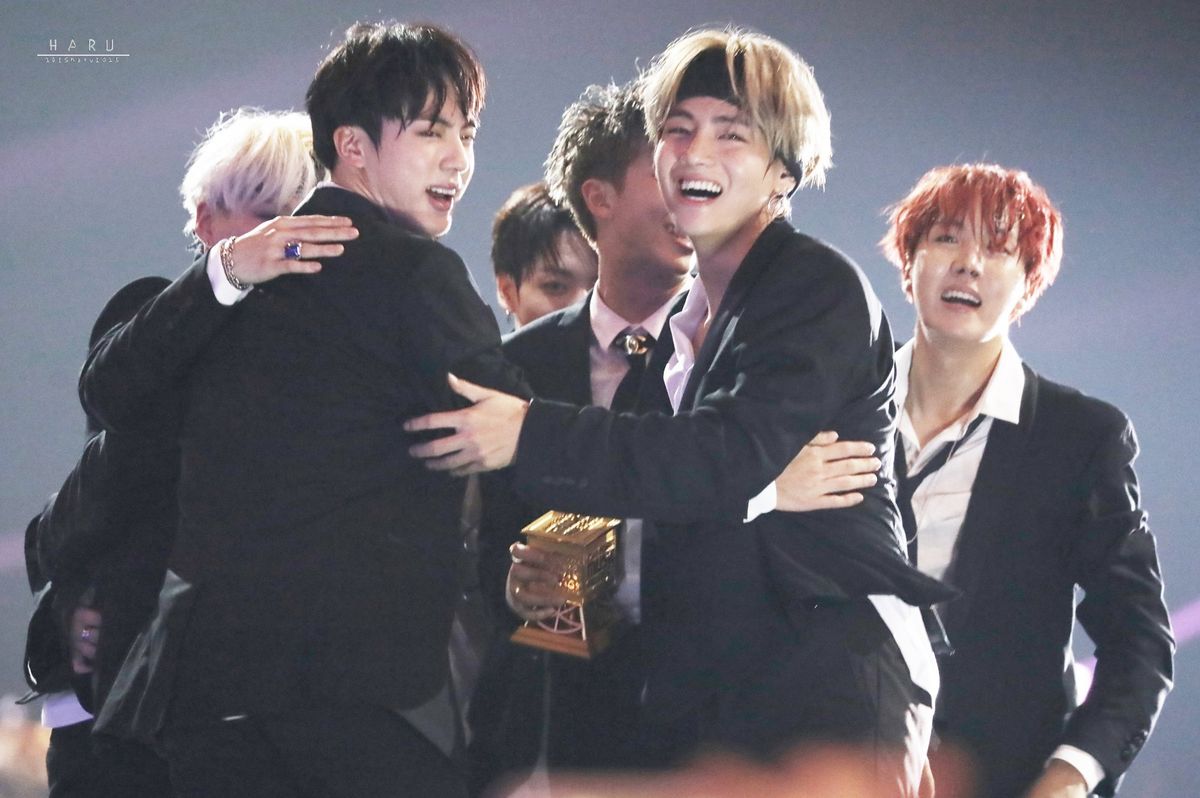
There is a long-running tension in how Western audiences or audiences outside of Korea interpret the relationship of Korean idols amongst each other, specifically male ones. And perhaps, the most speculated one is BTS because they are the most popular figure to have come out of Korea, and they are all guys. There is a fandom behind every possible duo, also known as ‘ship’, in BTS and many of them get invested, and when I say invested, I mean they are ready to fight, curse, voodoo and lie their way into making people believe their ‘ship’ is real.
Admittedly, if you have absolutely no idea or only have a superficial understanding of Korean culture, seeing Kpop idols hug, hold hands, share the same spoon, and have such emotional and open way of conversing, it’s way too easy to misunderstand. Western lens tries to define it as romance, queerness, “shipping,” or something that must fit a familiar category. But categories are cultural, and emotional expression is shaped by the values you grow up learning.
That being said, there is alternative explanation worth considering, rooted in something that does not translate neatly into English. It is shaped by a cultural logic that developed over centuries in Korea — a relational grammar that Western audiences or audiences from outside Korea were never taught to read – the JEONG.
THAT EMOTIONAL FRAMEWORK IS JEONG (정).
Jeong is one of the most significant, untranslatable concepts in Korean culture. It is not romance and not friendship. It is not family but feels like family. It is not an obligation but often outlives the obligation. It is a bond formed by time, routine, shared burdens, and accumulated trust.
Is it love?
Not in the western way we define love. In the west and even many other Asian countries, we categorize love in different but specific boxes: romantic, platonic, sexual, familial, friendship, spiritual, and self.
Each box has rules. And mixing boxes — for example, romantic behavior in a friendship — can create confusion or suspicion. Western emotional logic requires boundaries to define the nature of the relationship.
This is why non-Korean audiences misread jeong. Because jeong:
- grows without confession
- crosses categories
- feels intimate but not romantic
- includes loyalty without exclusivity
- is durable without needing labels
- blends affection, closeness, familiarity, memory, and mutual care
When I first heard about Jeong, my first thought was “soulmates”. Soulmates don’t have to be romantically linked. No, not quite. Soulmate has the element of destiny, Jeong doesn’t. Jeong is built and strengthened through time.
Western, or non-Koreans languages simply do not have a category for that. That’s the entire root of the confusion. Jeong grows quietly through the ordinary — and once it forms, it is remarkably difficult to break. It transcends commitment, time, contact, or even relationships.
Trying to understand idols without understanding Jeong is like watching a film with the sound turned off. You can see what’s happening, but the emotional meaning slips away.
WHERE JEONG COMES FROM: A CULTURAL HISTORY THAT BUILT A DIFFERENT KIND OF BOND
Jeong did not come from a single source. It emerged from centuries of communal living, Confucian social structure, and the way Korean children grew up surrounded by peers, cousins, and extended network caregivers rather than isolated nuclear families.
Traditional Korea relied on village-level caregiving. Children spent their days with cousins, neighbor kids, and cohort groups. Especially during the Joseon Dynasty, the family was strongly patriarchal and Confucian. Sons were given prominence because of lineage and carrying on the family name.
There was a spatial separation of gender in the household: e.g., the “sarangchae” (male/family-guest space) and “anchae” (women’s quarters) in the traditional Korean house. Boys in certain historical contexts — for example the Hwarang in Silla — did receive specialized training in a peer-group setting outside the regular family.
This is why bonds were formed horizontally — among peers — rather than vertically with one primary attachment figure. Scholars describe this as a system where emotional ties were “distributed,” not concentrated. It encouraged relational bonds that weren’t defined by category: neither purely family nor purely friendship.
Confucianism added its own layers. A child’s emotional expression upward (toward elders) was restricted by hierarchy. Respect was formal, quiet, and controlled. Emotional openness moved sideways instead — toward siblings, cousins, classmates, and same-age peers. Korean boys especially formed their closest bonds with other boys because hierarchy discouraged intimacy with authority figures. Peer groups were where vulnerability could exist.
Historical youth structures reinforce this. The Hwarang of the Silla dynasty — elite male youth trained and raised together — left behind records of fierce loyalty, emotional closeness, and lifelong bonds forged through shared training. Korean boys in Confucian academies, labor apprenticeships, and martial instruction developed the same emotional habits: expressing loyalty, tenderness, protectiveness, and companionship toward each other.
Jeong survives because it is not tied to a role. You can feel jeong for a neighbor you saw every day growing up, for a colleague you spent years working beside, or for a friend you argue with constantly but would still protect at a moment’s notice. It’s a bond created by time and consistency, not labels.
JEONG BETWEEN BTS MEMBERS
This is the cultural DNA that shaped BTS long before they were trainees. When people try to interpret BTS in general using Western emotional codes, they reach for the closest familiar explanation. Skinship becomes flirtation. Closeness becomes romance. Emotional openness between men becomes “evidence” of something else.
But BTS grew up in a culture where the strongest emotional bonds among boys were formed with other boys.
Add to that, they did not just grow up as ordinary peers — they became trainees, idol hopefuls, and eventually a group that survived years of scarcity, exhaustion, and shared ambition. They spent their formative years together in dorms, practice rooms, cramped living quarters, and nights where the only people who understood their fears were the six others in the room.
They reached an unimaginable amount of success, it was almost impossible. What they went through is something no one else in this world will understand. The people that helped them to get there like the producers, road managers, assistants, and even Bang Si Hyuk or their parents might have an idea but no one else in this world, and I mean no one, knows how hot it feels to be them except the seven of them.
That environment is perfect for Jeong to form. It creates attachment built on shared routine, shared suffering, shared dreams, and shared survival.
What you’re watching with BTS is not confusing or ambiguous in a Korean cultural context. It’s expected. While many will say that they are still extraordinarily closer, that’s probably because, as I’ve said, their experiences have also been extraordinarily different.
It is the natural outcome of spending over a decade inside an emotional ecosystem that rewards loyalty, softness, teasing, caregiving, and mutual reliance.
And that’s why Western attempts to analyze BTS’s bond collapse: they insist on a definition that Korean emotional culture doesn’t use.
Western culture insists on labels. Jeong never needed one. Jeong grows quietly through the ordinary — and once it forms, it’s remarkably difficult to break.
WHY WESTERN INTERPRETATIONS GET IT WRONG
Western cultures or any culture outside of Korea emphasize emotional boundaries, individualism, and clear relationship categories. A person is a friend, a lover, a sibling, or nothing. Touch is coded as sexual unless explicitly defined otherwise. Male affection, unless framed as comedic, is often scrutinized with suspicion.
Korea descended from a completely different emotional lineage. Bonds are layered. Touch is contextual rather than sexual. Affection between men has historical precedent. Emotional reliance on peers is normal. Friendship does not need to distance itself from intimacy to remain socially acceptable.
Jeong makes emotional closeness culturally coherent. The relationship exists because the relationship exists — not because it fits a category.
That is the piece Western critics miss entirely.
THE JEONG BETWEEN BTS AND ARMYS
People inside fandom understand this instinctively. ARMY’s relationship with BTS is often dismissed by outsiders as delusional devotion — “seven men who don’t know you.” You hear things like “they won’t ever f you” or “stop your delusions.” But this accusation misunderstands the emotional logic at play.
ARMYs, REAL SANE ARMYS, not those that are living out fantasies, do not act as if BTS belongs to them; ARMYs act as if they have a bond built on years of accumulated presence, shared meaning, and mutual care. That is exactly the emotional architecture of Jeong.
The relationship is not transactional. It’s not infatuation. It’s not romantic longing. It’s a slow, steady accumulation of trust, gratitude, memory, and shared life stages. It’s the feeling of growing up with someone who shaped your world even if you never exchanged a private word.
You don’t need possession or reciprocity to justify it. You don’t need to be known individually to feel connected. You don’t need to label it for it to be real.
That is why ARMY struggles to explain this bond when confronted by people who only know Western emotional grammar. There isn’t a category for what they feel. There isn’t a term outside Korean culture that maps onto it.
But there is a term inside Korean culture.
It’s jeong.
THE BEAUTIFUL UNTRANSLATABILITY OF THE BOND
And if ARMYs can feel this towards BTS, imagine how BTS feels towards each other.
Jeong is a cultural phenomenon that doesn’t promote itself. It doesn’t need to be defined to be lived. And that’s why it works so effortlessly inside BTS — and so confusingly outside it. Their bond simply is. It doesn’t need a category.
And maybe that’s the point.
The bond we’re watching is the one that helped them survive, create, and thrive. It shaped music that feels intimate without being possessive. It built a decade-long partnership that produced art millions of people rely on. It created an emotional space where vulnerability doesn’t need to justify itself.
Western audiences may never fully understand it. Even Koreans debate its contours. Jeong isn’t a rule; it’s a rhythm. It’s the emotional consequence of time well spent and lives intertwined.
There is no need to label it.
There is only the privilege of watching it play out — the closeness, the affection, the teasing, the comfort, the shared silence, the unshakeable attachment that built one of the most significant musical partnerships of the century.
And as ARMY, we feel our own version of it. We don’t need to defend it. We don’t need to explain it. We don’t need to prove that our devotion is rational. It just is. And it’s enough.
