

This is an update of the article first published August 2, 2026.
HYBE’s second-quarter filing, released July 28, contains almost every number a company could want in an earnings report. Revenue hit ₩1.45 trillion ($967 million), up 105.5 percent year over year and 107.6 percent from the prior quarter — the company’s first time ever crossing the ₩1 trillion ($667 million) mark in a single quarter. Operating profit came in at ₩170.9 billion ($114 million), up 159.3 percent year over year and a full reversal from Q1’s operating loss of ₩196.6 billion ($131 million). Even stripped of Q1’s one-time stock compensation charge, adjusted operating profit still grew 192.4 percent quarter over quarter. First-half revenue reached a record ₩2.1483 trillion ($1.43 billion).
HYBE’s stock fell anyway — sharply, over two trading sessions, wiping out roughly ₩2.8 trillion ($1.87 billion) in market value. July 28, the day HYBE reported, was also the day the KOSPI plunged nearly 11 percent in a historic, back-to-back circuit-breaker crash driven by a semiconductor sell-off tied to Samsung and SK Hynix — a shock that had nothing to do with entertainment stocks at all. This wasn’t a HYBE-specific story: in the same week, JYP, SM, and YG — none of which had just reported earnings — were all down similarly steeply for the year, with JYP off more than 44 percent, SM down nearly 50 percent, and YG down over 47 percent. All four of Korea’s major entertainment stocks were getting pulled down together by the same rotation out of entertainment and into chip stocks, regardless of which of them had good news to report that week.
Some analysts did publish notes specifically flagging HYBE’s margin mix as a separate concern, independent of the broader crash — that’s a real, documented theme in the post-earnings commentary. But every major Korean entertainment stock was falling together for reasons that predate and have nothing to do with HYBE’s Q2 numbers, so the stock’s move that week isn’t good evidence, on its own, that the market was reacting to HYBE’s earnings specifically.
BTS Did Exactly What Everyone Expected. That Was Kind Of the Problem
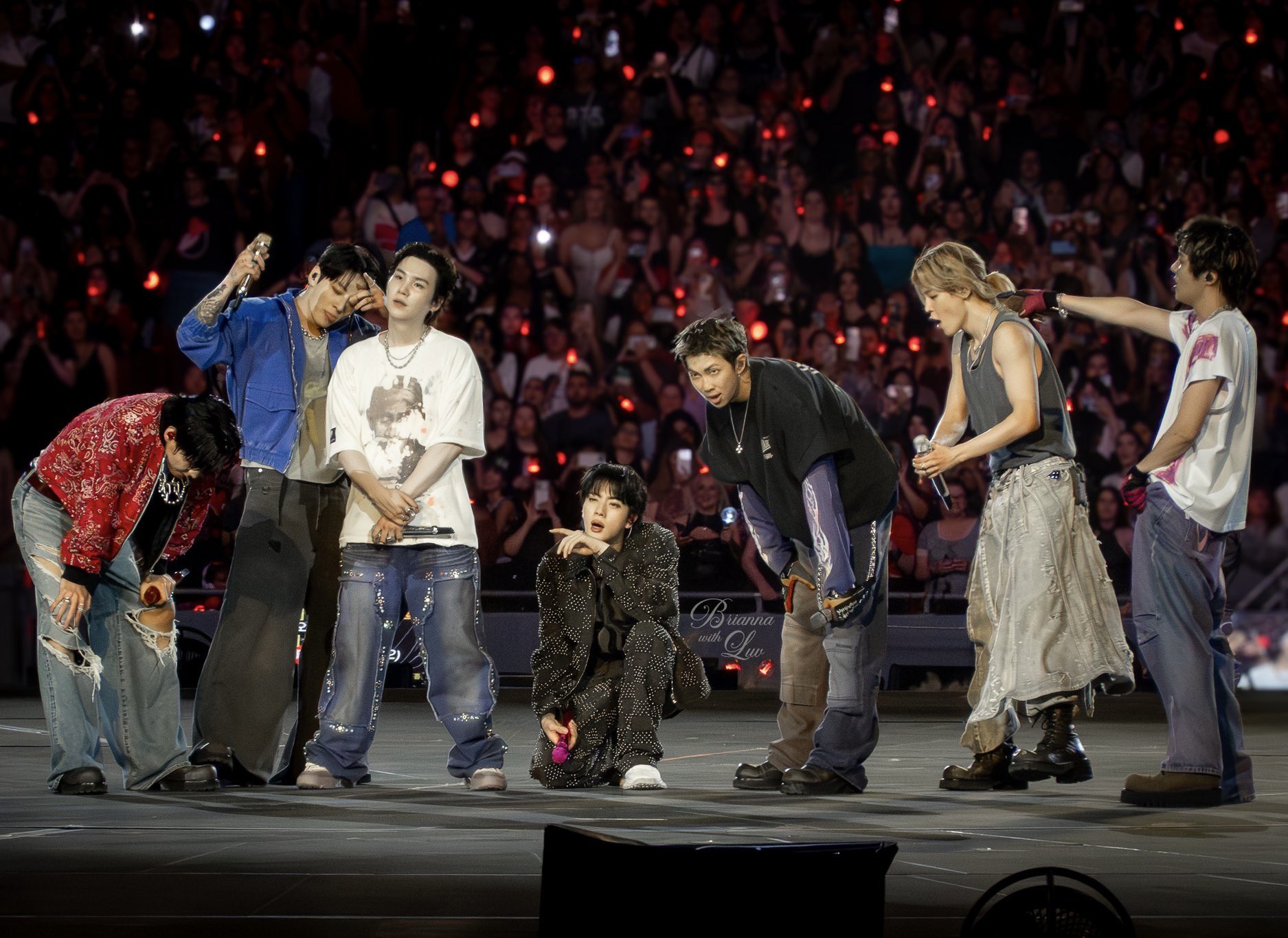
The record quarter has one obvious source: BTS, back as a complete seven-member group for the first time since the members completed military service, releasing the album “ARIRANG” and launching the accompanying world tour in April. Concert revenue exploded to ₩647.7 billion ($432 million), up 630 percent from Q1 and 243.3 percent year over year, while recorded music revenue hit a record ₩326.8 billion ($218 million) on the strength of “ARIRANG,” which Luminate’s 2026 midyear report ranked No. 1 in U.S. vinyl and CD sales for the first half of the year.
But the market had also been pricing in a specific kind of comeback — one driven by higher-margin merchandise and licensing rather than touring itself — and several analysts said the mix fell short of that expectation. Concert revenue carries lower margins than most of HYBE’s other business lines, because a large share of ticket revenue flows back out the door as venue rental costs and artist settlements. When the mix leaned this heavily on concerts, operating margin only came in at 11.8 percent — solid, but short of what some analysts wanted to see given how enormous the headline growth numbers were.
HYBE itself acknowledged the dynamic on its earnings call, telling analysts that Q1’s unusually light concert mix tripled in Q2, and that venue and artist-settlement costs rose right alongside it. Whether that specific concern was the actual driver of the stock’s move that week, versus simply a theme analysts wrote about while a much larger, unrelated market crash was also underway, isn’t something the numbers alone can settle.

A Trillion-Won Quarter Is Still, Underneath, a Very Expensive Machine
A bigger tour doesn’t translate cleanly into bigger margins. A world tour of BTS’s scale isn’t a series of one-off shows; it’s closer to a continuously running logistics operation — trucking, crew, venue costs, and production infrastructure that has to move with the tour whether or not a show is happening that night. That’s a dynamic touring economists have pointed to going back to stadium-scale tours like U2’s 360° run, where the production itself became a cost center nearly as large as the business it was built to support.
HYBE’s own numbers reflect a version of that same pattern: the bigger the concert revenue share gets, the more the underlying cost structure scales with it, which is exactly why a company can post record revenue and still miss on margin.
Personnel costs added to the squeeze. Even excluding the one-time stock compensation charge from Q1, labor costs rose quarter over quarter, driven by performance-based incentives and the cost of global hires — plus, HYBE said, some costs likely to hit in Q3 or Q4 that the company chose to book conservatively in Q2 instead.
MD and Licensing Hit a Record
HYBE’s merchandise, licensing, content, and fan club revenue — grouped as “indirect participation” — told a more mixed story than the concert business. MD and licensing revenue hit a record ₩310.6 billion ($207 million), boosted by tour merchandise and by “The City Project,” a licensing initiative built around Arirang-themed landmarks in the tour’s host cities. Fan club revenue grew a healthy 67.1 percent year over year to ₩57.9 billion ($39 million).
Content Revenue Went the Other Way
Content revenue fell to ₩41.6 billion ($28 million), down 60.7 percent from Q1 and 40.7 percent year over year — a reminder that content revenue depends heavily on having a major event or release in the pipeline, and this quarter simply didn’t have one beyond catalog streaming and existing games.
The Concert Is the Traffic Generator for Everything Else
It’s easy to read concerts, MD, and licensing as three separate line items when they’re really one system. BTS’s tour isn’t just generating ticket revenue in isolation — it’s functioning as the traffic generator for nearly everything else in this quarter’s results: the merchandise sold at each stop, the city-branded licensing built around tour locations, the livestreaming and live-viewing revenue, the renewed catalog streaming that comes with a group back in the spotlight. The concert line and the MD line move together because one is largely creating demand for the other; a tour this size doesn’t just sell out venues, it pulls the rest of HYBE’s business along with it.
HYBE Is Selling More Merch, But Most of It Still Rises and Falls With the Tour Calendar
The MD and licensing line in this quarter’s results is still mostly tour-adjacent — hoodies, photocards, pop-up stores tied to specific tour stops, all boosted by the sheer volume of BTS activity this quarter. That’s real growth, but it’s the kind of growth that’s structurally tied to whether a group is actively touring in a given quarter. When BTS isn’t on the road, or when the tour calendar thins out, this line contracts along with it — the same seasonality problem that shows up in the concert revenue itself.
ARIH Is a Level Up From Ordinary Merchandise
A more interesting test case sits just outside this quarter’s numbers, and it’s a genuinely different kind of business than tour merchandise. ARIH is a Western-Korean fusion food and beverage brand that Paldo and hy (formerly Korea Yakult) launched with BTS earlier this year, covering instant noodles, postbiotic energy drinks, and probiotic sodas. BTS was involved from the planning stage — the name, the flavors, the packaging — and the brand launched exclusively at Walmart across the U.S. in April before expanding toward Korea and other markets.
The ownership structure underneath ARIH is what makes it different from ordinary merchandise. U.S. distribution runs through HYH America, a joint venture that isn’t just HYBE licensing out the BTS name for a fee — HY, Paldo, and HYBE are all actual stakeholders in the venture itself. That’s the meaningful difference from a t-shirt with a tour date printed on it: a grocery-aisle product doesn’t need a stadium show to sell, doesn’t carry venue or artist-settlement costs, and keeps generating revenue in the years BTS isn’t actively touring at all. It’s a fixed, year-round revenue stream sitting next to a business that’s otherwise inherently seasonal. If HYBE can replicate that model — real equity in consumer brands built around artist IP, rather than one-off licensing checks — across more of its roster, that’s a genuinely different kind of scalability than anything in this quarter’s MD and licensing line, and one that doesn’t require another BTS-sized tour to keep growing.
The Question Analysts Are Actually Asking
The core question hanging over HYBE isn’t whether this was a good quarter — it obviously was. It’s whether the level of profit BTS just delivered is sustainable once the group’s tour cycle eventually slows, particularly with BTS’s world tour currently expected to keep going through at least the second quarter of next year. One BNK Investment Securities analyst put it plainly: this could be a profit peak this concentrated in BTS touring, and given how high market expectations were already set, a simple earnings beat wasn’t going to be enough on its own. The same analyst noted that maintaining the current profit level past 2027 will require HYBE’s younger, non-BTS artists and its Weverse platform business to become genuine profit contributors, not just supporting acts.
That’s a strikingly similar problem to the one now facing HYBE’s domestic rivals, several of whom are grappling with how much their own earnings depend on one or two flagship acts. What sets HYBE apart is the sheer size of the number tied to a single artist: BTS alone moved a company generating nearly $1 billion a quarter, and one earnings call was enough to make investors ask how repeatable that really is.
BTS Keeps Moving Its Own Goalposts
It’s not obvious HYBE has been slow to build acts that could collectively rival BTS’s economics. The bigger issue is that BTS itself keeps raising the bar it would need to be matched against. By the end of May, ARIRANG had already grossed $204 million from roughly 24 shows, according to Billboard Boxscore data — a pace that puts it on track to be the first K-pop tour to cross $700 million, and some industry estimates put the ceiling closer to $800 million by the time it wraps in 2027. For comparison, BTS’s previous record-holder, the “Love Yourself”/”Speak Yourself” tour, took a full 62 shows across 2018 and 2019 to gross $213.9 million — the tour ARIRANG is now closing in on in roughly a third of the dates. BTS isn’t just still the company’s biggest asset; on a per-show basis, it’s becoming a bigger one every cycle.
Seven Solo Careers Might Add Up to Something Close to BTS
There’s also a case, rarely made explicitly by HYBE itself, that the company has been deliberately restrained about how much it leans on the BTS name beyond the group’s own activities — probably because doing so would undercut the message that HYBE has other engines. But each individual member has demonstrated real commercial weight on their own. Jungkook’s “Seven” became the first song by a Korean solo artist to debut at No. 1 on both the Billboard Hot 100 and the Global 200. Jimin’s “Like Crazy” was the first Korean solo song ever to debut at No. 1 on the Hot 100, and he became the first Korean solo artist to top the Artist 100 chart. J-Hope’s “Hope on the Stage” tour is now the highest-grossing tour ever by a Korean soloist — $84.7 million from 33 shows — a record it took directly from Suga’s D-DAY tour, which had held it despite playing arenas only, never a stadium. Jin has also toured as a soloist since finishing military service. None of that means any single member could replicate BTS’s group-level economics alone. But it’s genuinely an open question whether the combined earning power of all seven, pursuing individual projects in parallel, could eventually approximate what the group generates together — which would be a very different, and considerably less concentrated, version of “the next BTS” than the market seems to be waiting for.
HYBE Is Trying to Monetize Rookies Much Faster
HYBE’s own framing of its broader strategy is telling. Rather than treating diversification as “produce another artist as big as BTS,” the company is leaning on HYBE Labels Solutions — its shared infrastructure for distribution, marketing, touring logistics, and licensing across all of its labels and artists. The logic: if that infrastructure is expensive to build once but reusable across every act on the roster, then growing the number of artists running through it can lift margins without matching new infrastructure spending to each new group.
HYBE pointed to CORTIS, KATSEYE, and Latin American act Santos Bravos as early proof, saying these acts have started generating profit within their first year — in some cases inside of a year. That’s a meaningful break from the traditional K-pop sequence, where a group typically has to build a fandom over several years before touring and merchandise become real revenue lines. HYBE is explicitly trying to compress that into debut, global exposure, infrastructure, monetization — with KATSEYE in particular built from the outset around a global audience rather than a Korean fanbase that later expands abroad.
A HYBE representative also argued that as top-tier artists mature, their contract terms typically shift in ways that reduce the company’s take, but the scale those same artists build gives HYBE real leverage when negotiating infrastructure costs down the line — meaning HLS should get more efficient, not less, as it carries more volume. Whether that scale effect shows up in margins quickly enough to satisfy a market already pricing in a post-2027 slowdown is the actual test ahead, not this quarter’s headline numbers.
Replacing BTS’s Revenue Isn’t the Same as Replacing BTS
HYBE doesn’t need any of these acts to become “the next BTS.” It needs artist A, plus artist B, plus artist C, plus Weverse, plus merchandise, plus licensing, plus HLS efficiency, to collectively produce the revenue investors currently associate with one group. You don’t replace a billion-dollar asset with another billion-dollar asset — you can replace it with ten hundred-million-dollar assets instead, if the infrastructure underneath them is efficient enough to make that math work. That’s a fundamentally different, and probably more achievable, target than “manufacture another cultural phenomenon.”
Where This Leaves HYBE
None of this makes HYBE’s quarter anything other than a genuine record. The stock’s rough week complicates any clean story about what the market thinks of it — a chip-sector crash unrelated to HYBE swept through Korean equities at the exact moment the earnings landed, and it’s not possible to fully separate that from the margin questions analysts were separately raising.
What’s clearer is the substance behind those analyst questions: how much of HYBE’s current scale is BTS-shaped, and how much of it is actually structural. CORTIS, KATSEYE, TXT, ENHYPEN, LE SSERAFIM, and the rest of the roster posted real, broad-based growth this quarter too — HYBE artists accounted for half of the top 10 best-selling CDs in the U.S. in the first half of the year, and seven non-BTS teams hit million-seller status domestically. That’s a genuinely deep bench by industry standards. The real question isn’t whether that bench exists. It’s whether it can grow fast enough to matter economically before BTS’s current tour cycle — the thing carrying this quarter’s entire story — eventually slows down.
