

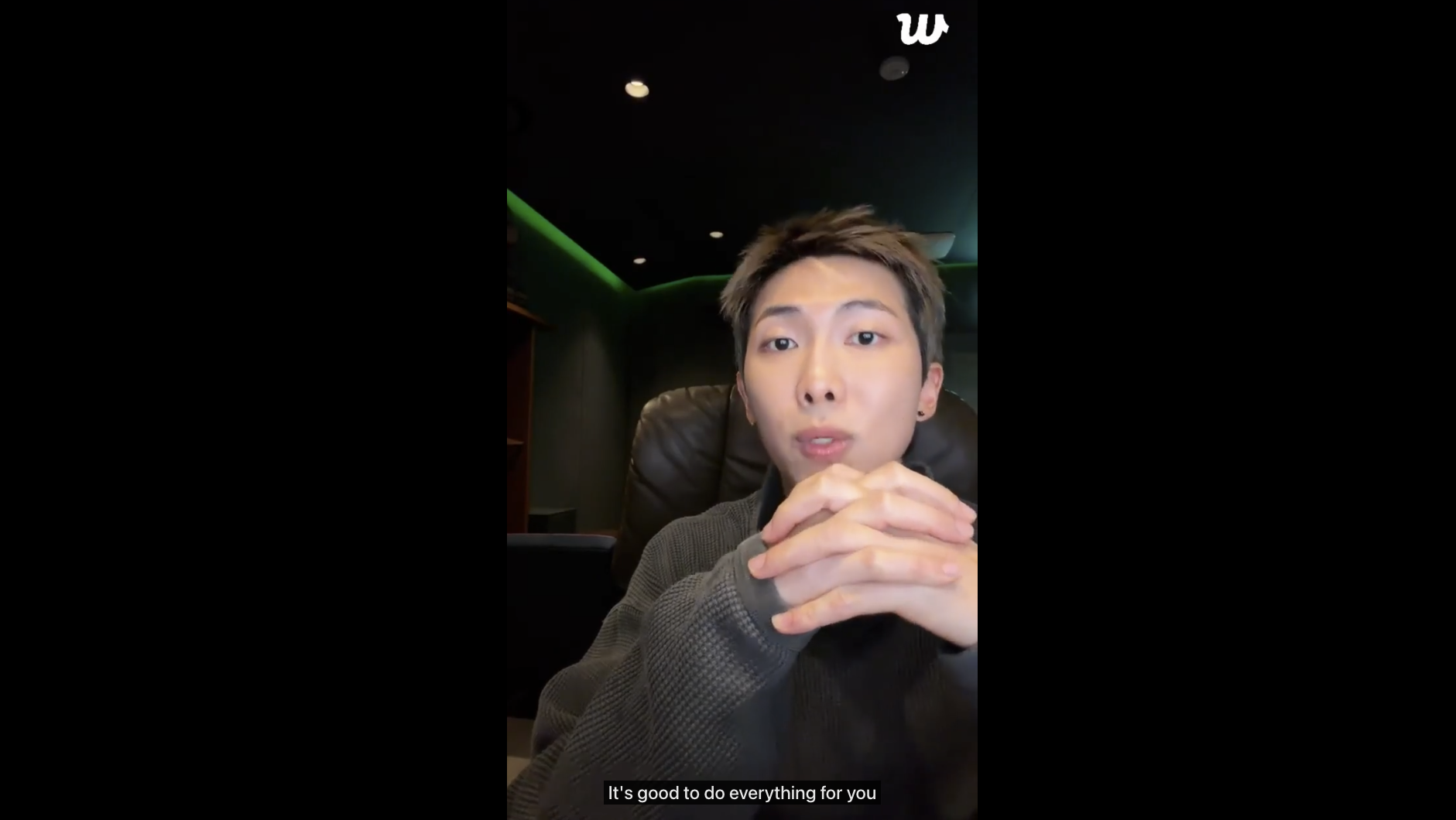
Let me start with the obvious: the loudest message in that livestream was that he loves ARMY, and that he and the members are working hard for the comeback. The scale is big, it can’t be rushed, and they want to put out something they’re proud of. They always have. We honestly didn’t need him to spell that out, but he did anyway.
The second biggest message: he loves BTS, and he’s deeply grateful that after everything they’ve gone through—publicly and privately—they’re still together because they choose to be together. Not out of obligation, or fear, or inertia, but because they genuinely want to.
If you walk away from that livestream with nothing else, I hope you hold on to that. Next, he didn’t say anything new. Everything he said in this live show has been said before.
That said, it’s RM. He keeps insisting he isn’t that smart, but you don’t get to this level of articulation by accident. It takes a different kind of commitment to really listen to him. One of the worst things anyone can do with someone like that is to chop an hour of layered, vulnerable talking into bite-sized outrage clips. That’s exactly what happened: headlines and posts slicing his words into something salacious and convenient.
It’s unfair—to him, to BTS, and to ARMY. Because what he’s offering in that livestream are some of the most thoughtful, honest insights you’ll ever hear from an artist who helped build one of the most influential acts in modern pop, and a lot of people are trying to twist that into yet another “trapped artist / evil company / greedy idol” narrative.
So this is my attempt to explain how his words landed on me. No malice, just a lot of respect for his mind and a belief that he’s a good, flawed, human person—because he has never shown us any reason to think otherwise.
CHANGE
Right after the livestream, watching partly with subtitles and partly with my very limited Korean, I’ll be honest: it felt heavy. A bit uncomfortable. There was a strange, dull kind of pain in it that I tried to brush off at first. It was only after a long dinner with a Korean friend, who helped unpack more of the nuance, that I realized how central change is to what he was trying to say.
He said they’ve changed as artists and as people. That’s normal. We all do. When something shifts internally, it affects everything externally. The members grew up—personally and artistically. They branched out, which is healthy. Naturally, each of them developed their own ideas, limits, visions, and boundaries. That means the group’s dynamics have evolved too.
In the beginning, when he took on the role of leader, he—along with J-Hope and SUGA—had the most musical experience. It was natural that his role in their professional life would be bigger and more central. So when he says now that he “can’t represent the team anymore,” I don’t hear that as something tragic or resentful.
His leadership was a huge part of why BTS took off. It’s not wild to say the way he worked and led shaped how the others learned to think about music, career, and possibility. Every member is successful now in their own right. At the very least, he was one of the people who opened doors for them: making their own music, expressing their own stories, thinking globally.
The way I heard it, he’s telling ARMY: Stop acting like I can press a button on the members’ lives. Don’t come to him asking him to “make them do” anything. They make their own decisions now.
They grew up well. They found their own voices. He’s asking us to respect that.
If you want to know something about a member, you wait for that member to say it. You don’t demand someone else speak on their behalf.
EVERYTHING ALL AT ONCE
He also said that we—the fans—changed too. He didn’t elaborate, so this part is my interpretation based on the context of everything he shared.
BTS has been through a lot, both as individuals and as a team. The military alone leaves a mark; anyone who’s served will tell you that you don’t walk out of that experience as the same person. His tone, when he talked about change, wasn’t sad or ominous. It was factual. Matter-of-fact in the way people in their thirties tend to be when they’ve lived enough to understand that change isn’t optional.
And honestly, it would be more concerning if they hadn’t changed.
Change affects everything.
It affects the way they make music, how they plan, how they execute, how involved each member wants or needs to be in certain parts of the process. That naturally trickles down into their output. They aren’t the same group they were from 2013 to 2022, and it would be strange if they were. Add in solo albums, military service, personal growth, therapy, relationships, and the simple passing of time—they’ve evolved.
And I’ll admit this part openly: maybe that’s why the livestream felt heavy at first. Even though I’ve always said I embrace their evolution, there’s a part of me that is attached to the version of BTS I first fell for. I’m attached to who they were to each other, how they moved as a unit, how they made decisions in those early years. Hearing him talk about the shift in his role—how he can’t represent the team the same way anymore—confirmed something I already knew but didn’t fully confront.
They are different now.
And there’s a sadness in that, but it’s a selfish sadness. It’s the sadness that comes from realizing I shouldn’t expect the same patterns, the same dynamics, the same structures from them anymore. And that expectation has nothing to do with them. It’s mine. It’s rooted in nostalgia, not reality.
“Change is the twin of time, and we are all under their mercy.”
And it’s not just them who changed. ARMY has changed. The industry has changed. Trends have changed. And so has the company—the one they built from the ground up. HYBE isn’t nine people in a shared office anymore. It’s a company with 800 employees in Korea alone. All of those people have families who depend on their salary. Their livelihood is tied to the stability of the company BTS helped create.
RM said it without bitterness: he can’t just do whatever he wants.
BTS can’t do whatever they want.
Not because “executives control them,” but because they are part of an ecosystem that includes hundreds of families, hundreds of breadwinners whose jobs exist because of the success BTS fueled.
If someone wants to call that “selling out,” that’s their interpretation. I call it humanity. It’s choosing to recognize that your actions affect more than yourself.
And that’s part of what makes this new chapter more complex. They’re navigating growth—not just artistically, but structurally, ethically, legally, emotionally. And he is asking us to grow with them.
“WOULDN’T IT BE BETTER TO DISBAND?”
This part has been translated two different ways.
“Is it better to disband? Is it better to just stop? I have thought about that tens of thousands of times.”
“We have gone through things that could have broken up the group. We’ve been through this 10,000 times.”
He wasn’t just talking about the 2018 “we almost disbanded” era. There were other times.
I don’t understand why it’s shocking to people. Think of couples who are very much in love and solid in their commitment. Even then, there are days when they go through things that make it seem like it would be easier if they just split? That would hurt less than trying to keep fixing things forever. If that happens even in a two-person marriage, why wouldn’t a seven-member team—full of strong-willed, wildly talented and successful solo artists —have similar thoughts? Maybe not all of them, maybe not all the time, but at least some of them, sometimes.
They were raised differently. They think differently. They want different things at various points in their lives. That’s reality.
I think it’s just people expect them to be flawless, a sculpture molded by a machine. They are humans, imperfect ones at that, living in an even more imperfect world.
But that’s not the point of the sentence.
The point is what he said next: they stayed together because they love each other. They chose each other. Not because of contracts, or money, or obligation. Because they love one another and they love ARMY.
CHOICE. Of the thousands of options laid out in front of them, they choose each other.
The disbandment line wasn’t a foreshadowing. It was contrast. He brought it up to show how much more powerful it is that they didn’t walk away—even when that would’ve been the easier option.
That’s the highlight, that’s the point. If people bother to listen, that’s what they would take away and maybe even apply in their own lives. In relationships, even the best one, there will be a lot of times when it’s easier to walk away, you have to make a decision to stay. If we understand what they understand, maybe this world will be less effed up.
REMEMBERING WHO THEY ARE
He talked about being in the practice room, exhausted, struggling with sleep and personal issues, and then watching Hobi and the others mess around, chat, joke, just…be themselves with each other. He could see the way they look at one another, and it reminded him who they are.
He’s tired. He’s overwhelmed. He said that plainly. But being with the members balances him out. It grounds him, pulls him back from that overthinking edge.
He was so moved by that feeling that he said he wanted to tell us everything right away—but he can’t, because it would spoil what they’re preparing.
That matters. As much as he acknowledges his own struggles and mental weight, he also makes it clear that being with the members makes him feel better. That’s not a group that’s on the verge of falling apart. That’s a group that knows how to pull each other back from the edge.
“They’re not the same group they were from 2013 to 2022—and it would be strange if they were. Our sadness about their evolution is real, but it’s ours. It’s nostalgia, not their obligation.”
THINGS HE CAN’T TALK ABOUT
He said they also wanted to do activities sooner after discharge, but they couldn’t, and there are reasons he literally cannot say.
The way some haters jumped on that, you’d think HYBE is a tiny, broke company blocking its only cash cow from making money out of pure spite. As if companies wake up in the morning thinking, “How do we lose revenue today?”
What he said connects back to his earlier point: he is just one member of BTS. He can’t spill everything because there are six other people whose boundaries, opinions, and rights over this team matter as much as his. He can’t unilaterally announce internal stuff on a livestream. He isn’t the only person in the band. There are six other people who share that brand, that legacy. They have as much of a right to it as he does.
On top of that, Big Hit/HYBE is now a huge listed company that they themselves helped build. As a group, they’re one of the biggest individual shareholders. There are legal obligations, disclosure rules, business strategies, and entire teams of specialists whose jobs exist because the company is that large. No single artist—even one as central as RM—can casually share sensitive details.
So no, “things he can’t talk about” does not automatically equal “the company is gagging him.” It also equals:
- Six other members with an equal stake in the BTS brand.
- A large corporation they helped grow, where careless words could actually damage the value of what they built.
That’s part of what comes with success at this scale. You gain power, but you also gain responsibility and limits.
“I AM NOT IN THE POSITION TO TALK”
A lot of people latched on to that line and spun it into “HYBE won’t let him speak about corporate issues.” As if he’s the default spokesperson.
But he’s an artist first. He’s never been HYBE’s communications director. He’s RM—a writer, rapper, producer, and performer who has always built his life primarily around creating.
He said himself: he doesn’t know everything. No one at that level does, not even a CEO. That’s why companies hire legal, PR, and strategy departments. Saying “I’m not in the position to talk” is partly about hierarchy and role, but it’s also about responsibility. He’s aware that one misplaced sentence could get them sued, blocked in a market, or misquoted endlessly.
Other people—fans, smaller artists, random accounts—can be reckless online and get away with it. He can’t. And he knows that.
LONG FORM VS SHORT FORM
This part is more my personal reaction.
My hope is that in all those meetings, they remember why so many of us fell for BTS in the first place. They built a universe across years: layered eras, long content, albums you have to sit with, storylines that require homework. They succeeded by building depth, not quick hits.
When everyone else went for the untouchable cool-guy aesthetic, they leaned into poetry, vulnerability, mental health, the complexity of self-love. When others chased surface-level confidence, they turned inward and talked about shame, fear, and growth.
I know they’ll adapt in whatever way they think is best and I trust their instincts. This part is just my reaction as someone who loves their narratives. I don’t doubt they’ll find their own path through it.
HE IS LEARNING HOW TO LOVE
He recommended a book about how we practice everything—dance, work, skills—but rarely practice the thing we’re supposedly here for: loving people.
He said he’s trying to be a better person while acknowledging he’s still flawed. He’s learning how to love others and himself in ways that actually reach the other person—so that the love is not just a feeling but something the other person can hear and feel.
That feels very connected to where BTS is now. They said they’ve changed. They’re all in their thirties now, Jungkook included in Korean age. The way RM treated the members in their teens and early twenties won’t work the same way in this chapter. His role in their lives is evolving, so he’s learning how to love them again—in the sense of learning how to express that love differently.
He said love needs substance. For him, the expression of love—the “content” of it—is just as important as the feeling itself.
ARMY NEEDS TO LEARN HOW TO LOVE THEM AGAIN, TOO
I think this part is on us as well.
They’re evolving, and as they continue their careers, the way they communicate and the art they release will change. We can’t expect the exact same beats, content, or structures we’re used to. We can’t freeze them at 2016, 2018, or 2020 for our own comfort.
We need to get to know them again. Learn how to support them in this chapter, beyond just streaming and buying albums. Understand what kind of legacy they’re trying to build now and how we can participate in that.
We also need to ask ourselves some honest questions. If they change, is this still the band for me? Do I still find joy here? Loving them as they are now might look different from loving them as they were then. And that’s okay. But we should be honest about it, with them and with ourselves.
HE IS GETTING HIS DRIVER’S LICENSE
This was the first moment he really smiled in the livestream, and I hope we don’t downplay how meaningful that is to him.
We’ve known for a long time that he didn’t want to drive, and now he’s learning. He framed it as one of the ways he’s trying to change and expand his life—doing something that most people do at nineteen, but he’s doing in his thirties because of the life he’s had.
And instead of keeping that to himself, he chose to share it with ARMY, with visible excitement. These are the little details that show his trust. It’s personal, and he still offered it to us.
THE MOST IMPORTANT MESSAGE
Under all the overthinking, the worries, the exhaustion, and the corporate complications, one message kept coming back: he loves ARMY. Some people may not feel that in the way they want to, and he knows that, but he said he’ll keep loving us in the way he can.
He’s complicated. He’s brilliant in a way that clearly weighs on him sometimes. Intelligence and sensitivity carry their own heaviness. But if you strip away the noise, what remains steady is this: he loves BTS, and he loves ARMY. He’s trying to protect both.
And one last reminder he made very clear: he was not speaking for the members. These were his thoughts. His feelings. His way of processing where they are now. The others will speak for themselves, in their own time and in their own language.
Our job, if we choose to stay, is to listen with the same care he showed when he switched that live on.
