

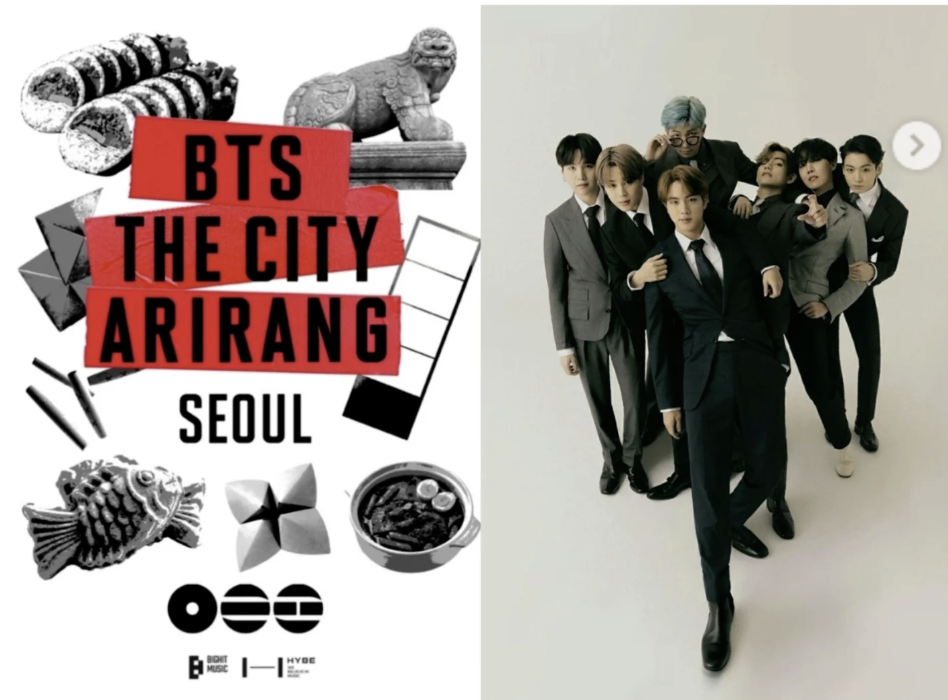
From March 20 to April 12, BTS will roll out BTS THE CITY: ARIRANG SEOUL, a city-wide cultural project designed to coincide with the release of their fifth full album, ARIRANG.
BTS The City isn’t a single venue or pop-up. It’s a coordinated transformation of Seoul’s public spaces into music- and media-based experiences that unfold over 23 days.
On March 20, the album’s release day, major landmarks—including Sungnyemun and N Seoul Tower—will be illuminated with large-scale media facades. These installations blend BTS’s music with light, video, and visual motifs that place contemporary media directly onto cultural heritage sites.
From March 20 to March 22, Yeouido Hangang Park will host a lounge-style program built around shared listening and communal music experiences.
Throughout April, everyday elements of central Seoul—stone walls, staircases, sidewalks, street trees—will be treated as exhibition surfaces. BTS lyrics will appear through light and video installations, turning ordinary routes into walkable media spaces.
The project is produced by BigHit Music in collaboration with the Seoul Metropolitan Government, with additional partnerships across food, beverage, and mobility. After Seoul, BTS THE CITY: ARIRANG is scheduled to expand to major cities worldwide.
BTS previously tested this model with THE CITY projects in Las Vegas (2022) and Busan (2022). Seoul is the most expansive version to date.
Beyond the Obvious Impact
At a surface level, THE CITY does what large-scale cultural projects usually do. It brings tourism. It pulls international media into Seoul. It creates economic activity across hospitality, transportation, retail, and local businesses.
None of that is surprising. They have done this many times and consistently.
What’s worth paying attention to is how deliberately BTS avoids making that the headline.
Korean Identity as the Entry Point
BTS isn’t drawing people in through a music festival or a spectacle designed to travel easily. The entry point is Korean identity, clearly and without hedging.
That starts with ARIRANG itself. The title isn’t metaphorical or aesthetic shorthand. Arirang is a living cultural thread—passed down, reinterpreted, carried through history as both song and sentiment. Choosing it as the name of their comeback signals intent before anything is staged.
They are also choosing historical landmarks and everyday spaces but being careful not to turn these places into empty platforms. They are maintaining their integrity, maybe even purity.
They will use their music, lyrics, art as a connector, a thread that visitors can follow.
They are putting lyrics on stone walls, staircases, and streets that are daily witnesses of everyday life in Korea.
Music will appear where people wait for buses, cross bridges, and walk home after work—inside the rhythm of daily life.
They are also staging their return in front of the historical seat of power in Korea, rather than in a neutral global venue. It reinforces the point. This isn’t about scale. It’s about origin. BTS is situating their comeback inside the places that shaped Korean language, governance, and identity—then opening that context to the world.
Korean landmarks never lost their meaning. Everyday life in Korea has never been superficial. BTS is simply telling those stories to the world. They are translating history, continuity, and cultural inheritance into something legible without flattening it.
In that sense, their music and performance aren’t positioned as the center of the moment. Identity is.
This is not just tourism, packaging culture for consumption. This is cultural stewardship— using their reach to safeguard, articulate, and pass forward the context that shaped them. Not freezing it in time, not diluting it for ease, but letting it exist in public, living space.
The message is gentle but firm: Korean language, history, and everyday environments aren’t barriers to global connection. They’re the reason this connection exists at all.
From a Private Universe to a Shared Place
In their early years, BTS built what fans came to know as the Bangtan Universe: layered narratives told through albums, music videos, short films, books, and live performances. It was immersive, but largely private.
Fans entered that world alone—through headphones, phone screens, late-night YouTube sessions, long commutes, school breaks, quiet moments carved out of ordinary life. The connection was intense, solid and fun… but inward.
This chapter elevates it.
Instead of inviting fans into a fictional universe, BTS is inviting people into a real place. A city with weather, crowds, detours, exhaustion, beauty, and inconvenience. A place you have to physically navigate.
Slowing the Pace in a Hyper-Accelerated Era
Ten years ago, when the industry rewarded speed, trend-hopping, and short attention cycles, BTS committed to long-form storytelling and continuity. That instinct hasn’t changed—it’s just showing up differently now.
As music consumption shifts further into algorithms, AI tools, and frictionless digital space, BTS is creating reasons to step away from screens. To walk. To look up. To notice surroundings. To stand still in public.
THE CITY is an encouragement to not rush. It unfolds over weeks. It asks for presence, not clicks.
That’s a quiet counterstatement to where the industry is heading.
Koreans First, Global by Extension
There’s no ambiguity about how BTS positions themselves here. They are Koreans first—rooted in language, history, and place—and they’re saying that without apology.
At the same time, they’re making a broader point: every city they expand into carries its own meaning worth paying attention to. Seoul isn’t treated as a template to be exported wholesale. It’s a starting point.
What follows isn’t cultural extraction. It feels closer to reciprocity.
They were shaped by cities, audiences, and cultures far beyond Korea. Now they’re returning that attention—asking fans to experience places as places, not just backdrops for content.
In earlier chapters, BTS asked the world to listen closely—to lyrics, to stories, to emotional through-lines.
Now they’re asking something simpler, and harder: to be there.
