

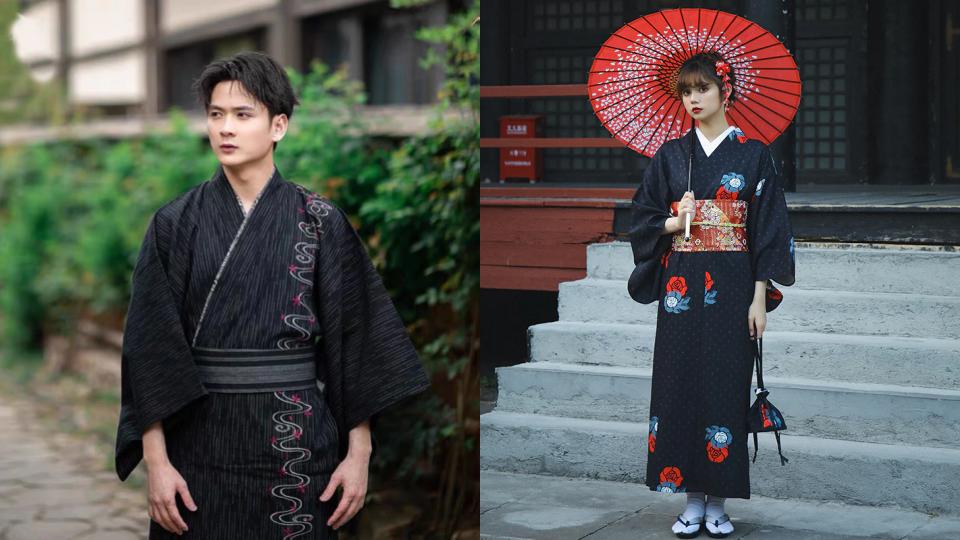
Like many enthusiasts of Japanese culture, I’ve long been captivated by its songs, music, food — and, of course, the timeless allure of samurai tales. (Rurouni Kenshin, if we’re being specific — though as a manga character, he’s safely fictional, sparing me a lifetime of hopeless pursuit.) But one piece of traditional Japanese clothing has stolen my heart more than any other: the yukata.
I began collecting them when I started working. Whenever friends traveled to Japan or Japanese visitors came my way, I’d request a yukata. Many of my Japanese friends were initially puzzled — “Why a kimono?” they’d ask. Only about five years ago did one gently correct me: what I’d been calling a kimono was actually a yukata. That moment sparked a deeper curiosity about the garment I’d grown to love.
Yukata vs. Kimono: Related, Yet Distinct
The kimono represents the full traditional Japanese attire — the “whole nine yards” of layered elegance you see in classic imagery. The yukata, by contrast, is a lighter, more casual evolution. Its roots trace back to the Edo period, when people wore simple, unadorned cotton robes to walk from home to public bathhouses. These early versions were practical: designed to get wet without issue.
Over time, aesthetics took center stage. People wanted to look good even on the way to bathe, leading to beautiful designs and patterns. Modern yukata have become stylish everyday (or festival) wear — essentially an elegant cotton bathrobe or summer robe. It’s approachable, breathable, and perfect for warm evenings or special occasions.
A Brief History of the Kimono
The kimono’s story stretches back centuries. Chinese historical documents from around the third century described Japanese clothing, referring to men’s garments as something like “kanfomi” and women’s as “kantovi” — wrapped and draped styles. The true ancestors of the modern kimono emerged during the Heian period (794–1185), evolving from the kosode (a garment with smaller sleeves at the time).
There’s some friendly debate about when the iconic wide sleeves became prominent — some sources point to the Heian era, others to the Edo period. Either way, the straight-cut, loose silhouette was designed for versatility across body types. Early layers (like the shitagi inner garment) added complexity, especially for women.
During the Edo period (1603–1868), samurai values emphasized utility, simplifying men’s wear into crossover styles for daily use. Women retained more intricate layering. Society was stratified, with warriors as nobility and merchants gaining economic power. Fabric choice, patterns, colors, and techniques became powerful social signals — cherry blossoms for poets, bolder motifs for warriors. Nobility enjoyed luxurious silks; lower classes wore garments until they were threadbare.
Two key concepts shaped this era: omote (public face) and ura (private face). Men’s clothing aligned with the public sphere — simpler and more comfortable. Women’s reflected the private, often more elaborate. When social classes eventually equalized, the kimono became a unifying force. Everyone wore it. In a time of relatively “pure” Japanese culture with limited Western influence, it symbolized shared identity.
Beyond unification, the kimono served as an identity marker — a wearable reflection of status, profession, personality, and season. It’s far more than fashion; it’s cultural storytelling in fabric form.
Wearing It Respectfully
At first, I embraced yukata purely for style — the way it drapes, the vibrant patterns, how effortlessly chic it feels. I asked Japanese friends if cultural appropriation concerned them. Their response was generous: wear it, they said, as long as you do so respectfully. That encouragement pushed me to learn more. I never wanted to disrespect a tradition that wasn’t originally mine.
Maturing in my appreciation meant moving beyond aesthetics to understanding. I’m no expert — far from it — and I welcome corrections or deeper insights from those who know more. But this journey has enriched my collection and my connection to Japanese culture.
The kimono and yukata bind history, identity, class, and everyday life into something beautiful and enduring. Whether for festivals, relaxation, or quiet reflection, they remind us that clothing can carry stories across centuries.
If you have favorite yukata designers, brands, or personal stories about kimono culture, I’d love to hear them. Recommendations for authentic pieces are always welcome too. What’s your favorite traditional Asian garment and why?
This piece reflects personal experience and research. Traditions evolve, and perspectives vary — share yours in the comments.
