

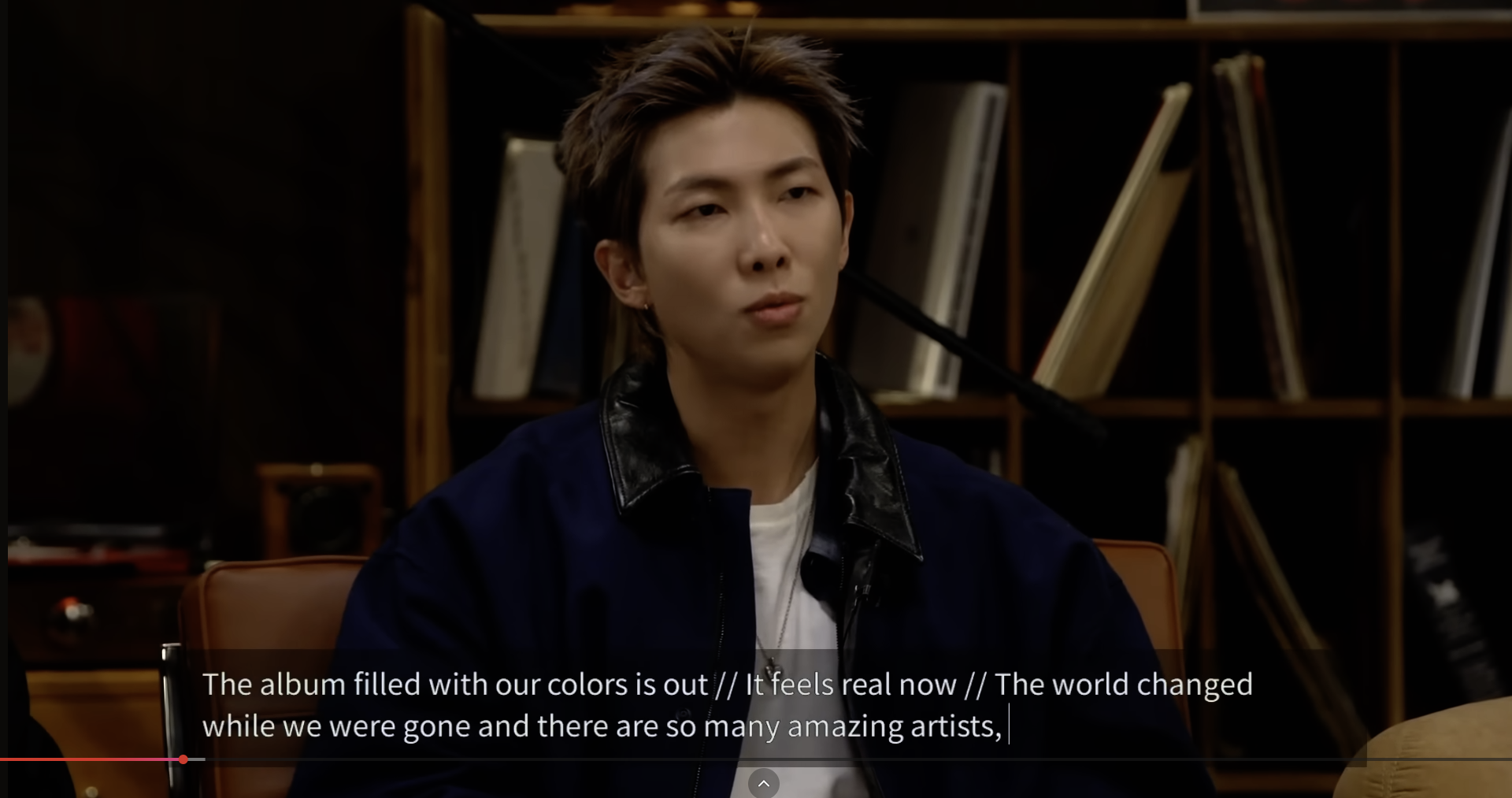
After watching BTS: The Return, going back to The Notes almost feels necessary.
The documentary captures fragments of the process—moments of tension, flashes of clarity, pieces of a much longer journey. But on its own, it doesn’t fully explain how ARIRANG came together. The Notes fill in some of those gaps. Not completely, but enough to sharpen the picture.
Together, they don’t give a full account. What they do offer is perspective—how BTS understood their work after it was finished, and what they chose to emphasize once the noise of creation had settled.
And within that, there are details that are easy to miss.
1. EVERY SONG WAS BUILT AROUND A QUESTION
One idea surfaces repeatedly: they were searching for who BTS is now.
This wasn’t implied—it was stated directly. Across interviews, the livestream, and the documentary, each member returned to the same question. It is even embedded in the framing of BTS: The Return. RM opens with a clear premise: they need to find out what makes BTS, BTS.
That context changes how the album should be understood.
They entered the song camp without a fixed direction. Not because they lacked ideas, but because they chose not to anchor themselves to a previous version of the group. After Chapter 1, after military service, after individual careers that gave them both clarity and independence, returning as seven required a reset.
The discussions they shared in the livestream reflect that uncertainty. They weren’t just choosing songs—they were trying to define what kind of songs should exist under the name BTS now.
That’s why the album doesn’t follow a rigid narrative structure. It moves instead—testing, adjusting, arriving. What holds it together is not a predefined concept, but a shared attempt to answer the same question.
2. THE ALBUM WAS AS MUCH ABOUT LEARNING AS IT WAS ABOUT MAKING MUSIC
They return to this idea constantly: learning.
Some of that growth is technical. Jimin mentioned learning new production tools and software. SUGA continued developing his musicianship, including guitar work. Jungkook took a more active role in light mixing and vocal direction.
But what stands out more is how they describe learning new processes.
They observed collaborators who would enter sessions with nothing prepared and build ideas from scratch—moving through multiple sounds before settling on something usable. Others would take a loose concept and reshape it in unexpected ways. BTS paid attention to how different producers approached structure, pacing, and arrangement, and how those strengths could be combined.
They also experimented internally—working in different units, testing how certain members function together, and in some cases creating without any fixed starting point.
This wasn’t just about finishing songs. It was about expanding how they think about making them.
That distinction matters. The most lasting impact of this phase is unlikely to be tied to a specific sound. It will show up in their process—how they approach sessions, how they evaluate ideas, and how they build future work.
3. DISAGREEMENT WAS CONSTANT — AND NECESSARY
There was no universal agreement on almost anything.
Not on the album title. Not on specific songs. Not on arrangements or samples. The idea that BTS operates with complete internal alignment doesn’t hold up when you actually listen to them talk about the process.
Jimin didn’t like two of the songs “FYA” and “2.0”.
RM and Suga didn’t like the “Arirang” sample.
Jhope AND JUNGKOOK didn’t like “One More Night”.
V didn’t want to include “Into The Sun”.
But that’s precisely the point.
Seven artists, each with their own careers and creative instincts, were never going to arrive at identical conclusions. What stands out is not the presence of conflict, but how consistently they stayed in the conversation.
They emphasized this clearly: all seven members participated across all 14 tracks.
That level of involvement doesn’t happen by accident. It reflects a system where disagreement is expected, and resolution is part of the work.
4. THE PROCESS WAS HARD — EVEN WHEN IT LOOKED ENJOYABLE
One of the most revealing comments comes from RM, describing their reunion as something that felt almost improbable.
That context matters.
After years of individual success and a complete pause as a group, coming back together required more than scheduling. It required alignment—creative, emotional, and practical.
The difficulty is visible throughout both the documentary and The Notes. What is just as important is that they also describe the process as fulfilling, even enjoyable at times.
Those two realities exist at the same time.
Creative work at this level rarely moves in a single emotional direction. Friction and satisfaction tend to coexist. Treating one as proof that the other didn’t exist misses how the process actually unfolds.
5. THEIR COMMUNICATION STYLE IS MORE DIRECT THAN PEOPLE ASSUME
Another detail that becomes clearer: how they talk to each other.
Most of their discussions weren’t about praise. They were about decisions—often difficult ones. Members openly expressed when they disagreed with a song, a direction, or a structural choice.
That level of directness suggests a high degree of trust.
It also complicates a long-standing perception that the rap line primarily drives their creative decisions. The vocal line, especially in this project, demonstrated equal agency in shaping outcomes.
The emphasis shouldn’t be on who disagreed with what. It’s on how they reached a decision anyway—and how consistently they did so.
6. COMPROMISE IS BUILT INTO THEIR PROCESS
The clearest example of this is the inclusion of the Arirang sample in “Body to Body.”
Initial reactions were divided. RM, SUGA, and V were against it. J-Hope, Jimin, and Jungkook responded positively from the start.
The reasons weren’t arbitrary—they came from different creative priorities.
SUGA focused on musical structure. He felt the sample might overpower the vocals. RM described it as sounding like multiple songs combined into one. V was concerned about tone, questioning whether it leaned too heavily into patriotism.
On the other side, J-Hope and Jimin reacted instinctively. They described an immediate physical response to the track—an energy they could feel. J-Hope saw its potential in performance. Jimin leaned into its emotional and cultural resonance.
Those positions held. They didn’t disappear after a single conversation.
They shared that it took around six meetings to decide whether the song should even be included.
What changed was not the initial disagreement, but how each member reassessed it. Over time, perspectives shifted. The final decision didn’t come from one side overriding the other—it came from multiple members revisiting their own positions.
The outcome is telling. Two of the strongest initial opponents, RM and SUGA, ultimately recognized the value of including it.
That sequence—resistance, sustained debate, reassessment, acceptance—is not an exception in their process. It’s a pattern.
7. THEY MOVED AWAY FROM HEAVY LORE — BUT NOT FROM STORYTELLING
Earlier BTS eras often relied on structured narratives—clear arcs that guided the music.
ARIRANG changed course.
There is no overarching storyline in the traditional sense. Instead, the album presents fragments—observations, emotions, states of mind. The narrative is less constructed and more immediate.
That shift removes a layer of separation. In previous eras, storytelling could act as a buffer between the artist and the message. Here, that buffer is thinner.
What you hear is closer to where they are now—not a fully mapped concept, but a series of perspectives in motion.
8. THE ARIRANG SAMPLE WAS NOT AN EASY DECISION
The inclusion of ARIRANG feels inevitable when you hear the final version. It wasn’t obvious at the time.
RM was uneasy about the cultural implications—how it might be perceived if handled incorrectly. SUGA focused on whether it worked musically. V shared similar reservations.
Others responded differently. J-Hope and Jimin immediately recognized its performance potential—the scale, the energy, the way it could translate in a live setting.
What changed wasn’t the sample itself. It was their understanding of it.
That journey—from skepticism to acceptance—mirrors the broader creative process behind the album.
9. THEIR GROWTH IS MOST VISIBLE IN HOW THEY WORK
They spoke less about changing their sound and more about changing their process.
Jimin mentioned learning new production tools. RM described gaining insight from watching how J-Hope evaluates songs with performance in mind. Across the board, they referenced exposure to different creative systems.
The long-term impact of this era is unlikely to be tied to a single sonic direction. It will show up in how they approach future work—the decisions they make, the risks they take, the structures they build.
10. THEY ARE SATISFIED — BUT NOT FINISHED
They were clear about one thing: they are proud of this album.
Not because it met a predefined goal, but because all seven of them can stand behind it. They described how their favorite tracks shift over time, even after release.
That kind of relationship to their own work suggests something deeper than completion.
At the same time, they framed ARIRANG as the beginning of Chapter 2—not a conclusion. There’s no claim that they have fully defined this next phase.
What exists now is a starting point.
WHAT THE PROCESS TELLS US
If there is one idea that runs through the Studio Notes, it’s this:
The album sounds the way it does because the process demanded it.
Not in a vague sense of effort, but in how decisions were made. Every direction had to be argued, tested, and reconsidered. No single perspective carried the process on its own.
That pressure is visible across everything they described—how they questioned their identity, how they learned new ways of working, how they disagreed, and how they arrived at decisions.
ARIRANG reflects that change.
Not as a polished endpoint, but as the result of a group that chose to stay inside a difficult process long enough to make something coherent out of it.
Not as a polished endpoint, but as the product of a group that chose to keep working through the difficult parts rather than avoid them.
