

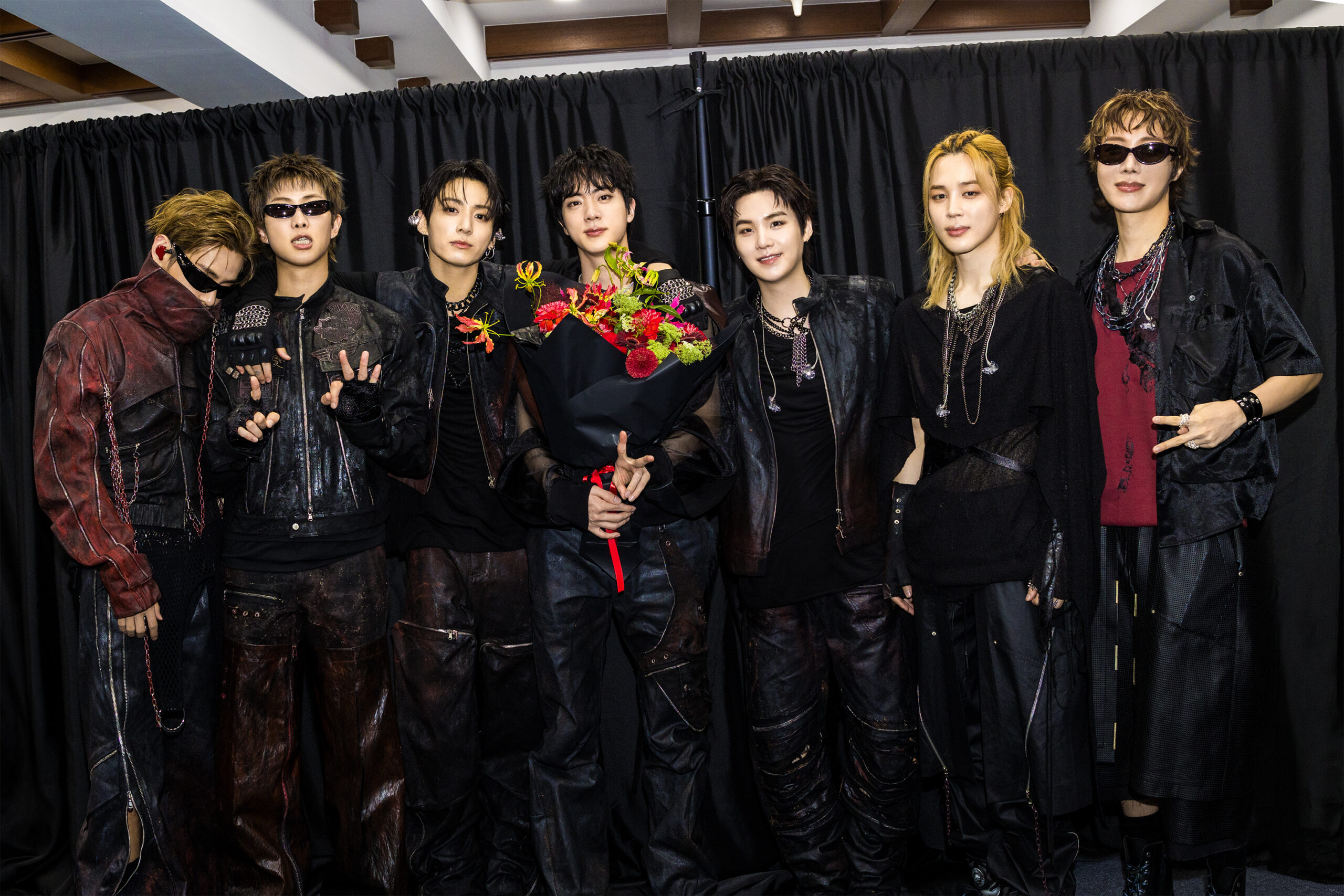
At first listen, “Hooligan” sounds exactly like what its title promises.
It’s loud. It’s chaotic. It’s built around heavy bass, manic laughter, and repeated references to losing control. On the surface, it feels like a celebration of disorder—a song about throwing caution aside and embracing pure instinct.
But BTS rarely writes songs that operate only on the surface.
The deeper I looked into the lyrics, especially the Korean phrases scattered throughout the track, the more I realized that “Hooligan” is full of contradictions. The song repeatedly presents chaos, then quietly introduces structure. It invokes madness, then follows it with coordination. It borrows from global hip-hop culture while grounding itself in distinctly Korean expressions and performance traditions.
What initially sounds like a song about losing control slowly reveals itself to be something else entirely.
This is my interpretation of “Hooligan,” the Korean cultural references hidden inside it, and why I believe the song is ultimately less about rebellion than it is about self-possession.
[Verse 1: J-Hope]
Man, I’m ’bout to blow a fuse (Yeah)
통제불능, 머리 춤 (tongje-bulneung, meori chum) (Yeah)
English Trans: Out of control, my head’s dancing (Yeah)
뛰어 미친놈인 듯 (ttwieo michin-nomin deut) (Uh)
English Trans: Jumping around like a crazy person (Uh)
Me everywhere, 얼쑤 (eolssu)
English Trans: Me everywhere, that’s it! / let’s go!
Somebody move (Move), somebody move (Move)
다들 모여 하나 둘 (dadeul moyeo, hana dul) (dul)
English Trans: Everybody gather, one, two (two)
I can never ever choose (Yeah)
Every one o’ you a muse
통제불능, 머리 춤 (tongje-bulneung, meori chum)
This literally translates to ‘Out of control, head’ dancing but it’s often used in Korean to describe something that has surpassed normal limits—emotionally or physically.
머리 춤 (meori chum) is not a standard phrase. It’s a slang—“my head is dancing,” implying you’re so overwhelmed by the beat your mind is moving, not just your body.
Together, it’s not just “I’m going crazy.” It’s saying the music has overridden rational control—your whole system is reacting.
뛰어 미친놈 (Dweo michin-nom)
English Translation: “Jumping like a crazy person”
미친놈 (michin-nom) is blunt. It’s harsher than “crazy guy”—it can feel reckless, even socially disruptive.
But in performance or even sports contexts, it pertains to someone who’s fully uninhibited. In essence, J-HOPE is saying “I’ve let go of social restraint—on purpose.”
얼쑤 (eolssu)
This is one of the most important cultural cues in the song. It’s a traditional Korean exclamation used in pansori and folk performances—a shout of encouragement, like “yes!” or “that’s it!”
Its presence here links the song to Korean performance heritage, even inside a hiphop-heavy, global sound.
So the “hooligan” energy isn’t purely Western chaos—it’s layered with Korean communal celebration, almost like a modernized folk stage.
다들 모여 하나 둘 (Dadeul moyeo, hana dul)
“Everyone gather, one two”
The song has been leaning towards chaos and rebellion until this point. So this line feels like an attempt at starting a collective movement, not individual chaos. The “madness” becomes organized chaos—a crowd moving as one. That’s reinforced by the last bar of the same verse.
[Verse 2: SUGA, Jung Kook, Jin, Jimin]
I go cuckoo crazy, loco, save me, woo
English Trans: I go cuckoo crazy, loco, save me, woo
Like El Cucuy, 굳이 말 안 해도 알잖아 (guji mal an haedo aljana), woo
English Trans: Like El Cucuy, you already know without me having to say it, woo
Hooligan, like hooligan, 때려 부숴 (ttaeryeo buswo) like hooligan
English Trans: Hooligan, like a hooligan, smash it up like a hooligan
시간 됐으니 좀 비켜 좀 (sigan dwaesseuni jom bikyeo jom), all clear 이상 무 (isang mu)
English Trans: It’s time, so move aside a bit, all clear, nothing to report / all clear, no issues to report**
Take you out, take you out
What’s the future? Where’s the now?
This is international
Make it unforgettable
I go cuckoo crazy, loco, save me, woo”
“cuckoo,” “crazy,” “loco” — three ways of saying the same thing, from different linguistic spaces (English slang + Spanish).
It feels excessive on purpose, almost like the language itself is spiraling but then it shifts with —“save me”. He is saying I’m losing control …but I’m also aware of it
So it doesn’t sound like a real cry for help. It sounds like he is enjoying the edge of chaos.
In the next bar, Suga mentions ‘El Cucuy’, it comes from Spanish/Latin American folklore—a shadowy figure used to scare children into behaving.
It’s often formless or unseen. It is more presence than body.
굳이 말 안 해도 알잖아 (guji mal an haedo aljana, woo)
This is very Korean in tone.
“You already know without me having to say it”
This is a very Korean way of expressing shared understanding. Korean communication often values implicit meaning over explicit statements.
Tthis might be one of the most complicated parts of the song. It is a double entendre.
I think they are hinting at how they were demonized by haters, constantly targeted and hated. They were accused of everything and hated for everyone and for nothing. So, he addresses the same line to two types of people.
To haters, he is saying, ‘I don’t need to tell you who I am, you already made up your mind.’
But it can also address fans, those who know their level of dedication and energy on stage. To them, he is saying, “I don’t need to explain, you understand me.”
So what he is saying:
I don’t need to define what I am at this moment—you already recognize whether you are a hater or a fan.
There’s confidence in that. No explanation, no justification.
“Hahahahahahhaha”
Now the famous line of the song.
The song suggests that whatever they represent in this moment—chaos, intensity, disruption—has already been defined by the people watching them.
There’s a hint here that BTS is aware of how they’ve been projected —sometimes exaggerated into something unruly, overwhelming, and even “dangerous.”
So when they say “you already know,” it can carry an edge:
you’ve already made up your mind about us – fan or hater.
But the line doesn’t lock itself into one direction. It can just as easily turn toward fans—the ones who understand their performance style, the level of energy they bring, the way they command a stage without needing explanation.There’s confidence in that. No explanation, no justification.
That’s where the laughter clicks into place.
The “hahahaha” may be sarcastic—aimed at detractors, the kind of laugh that says “you thought you had this figured out.” There’s a light mockery in it, a sense that the narrative around them isn’t something they feel the need to correct.
But it doesn’t stay confrontational. As the song unfolds, that same laughter blends into the crowd energy, the shared release, the collective movement.
Then there’s the rhythmic function. The way the “ha” repeats turns it into a percussive layer rather than a lyric.
It’s like a chant and a hi-hat pattern—filling space, driving momentum, and giving the drop something to bounce against. In a song built on bass and movement, that matters. It keeps the energy from collapsing between sections.
It also reinforces the song’s central idea: controlled chaos. Laughter is usually spontaneous, but here it’s measured, looped, almost mechanical. That tension—something that sounds wild but is actually structured—mirrors the Korean lines you pointed out earlier: “out of control,” but counted; “crazy,” but coordinated. The laugh becomes part of that design.
So it ends up carrying a double meaning:
- Toward critics: a knowing, slightly dismissive laugh — the joke’s on you
- Within the performance: a release of energy — we’re in this together, just ride it
That duality is what makes this work. It never fully declares its target. It just sits there, confident that whoever’s listening will recognize themselves in it.
Conceptual Layer: What “Hooligan” Means Here
In English, hooligan suggests disorder, maybe even violence but BTS reshape it through Korean linguistic and cultural cues. It’s not a mindless rebellion or an intentional loss of control. It’s performance as release. It’s collective participation, not individual destruction
They did so by running ironies throughout the songs:
- chaos 통제불능 (out of control) vs. counted movement (하나 둘)
- 미친놈 (madman) vs. shared rhythm (얼쑤)
- destruction (때려 부숴) vs. structured timing (시간 됐으니)
“Drop it lower than chopped and screwed”
The phrase points directly to Chopped and Screwed, a style pioneered by DJ Screw in Houston. That sound is defined by:
- Slowing the tempo way down
- Lowering the pitch of the vocals and beat
- Repeating (“chopping”) parts to create a hazy, almost hypnotic feel
It’s heavy, dragged-out, and physically felt in the bass.
So when they say, “Drop it lower than chopped and screwed” there are two meanings.
The first refers to the musical style. They’re talking about the beat:
- Make it hit deeper
- Slow it down, stretch it out
- Push the bass to a level that feels almost exaggerated
It’s a flex about production intensity.
The second layer reers to an urban slang. “Drop it lower” is also common in hip-hop/R&B contexts:
- Refers to dancing—getting low to the ground
- Associated with bass-heavy club movement
So now the line becomes:
- The beat is so deep and heavy, it makes you move lower than even the slowest, heaviest hip-hop sound.
- That long stretch of laughter looks throwaway on paper, but in this track it’s doing more work than a typical “ad-lib.”
The Intro
The song opens with a violin—measured, almost classical, as if it’s about to settle into something refined, even traditional. And then it pivots.
It sets up a contrast rather than a continuation. The expectation of something polished is interrupted, redirected into something louder, more volatile.
In that sense, “Hooligan” introduces itself through disruption. They position themselves as the ones who step into the “classic” and unsettle it—not to reject it entirely, but to reshape it into something more immediate, more kinetic. The tension between refinement and chaos is established before a single lyric lands.
The Consistent Beat and the Shifting Elements
Underneath everything, there’s a steady, almost unshakeable beat. It runs through the entire track, anchoring it.
Around that, elements keep entering and leaving—textures, ad-libs, vocal shifts, bursts of energy that appear and dissolve just as quickly.
There’s a steady, almost unshakable beat. It runs through almost the entire track. It’s like an anchor or a bed, a foundation. Around that, elements keep on entering and leaving. Texture, adlibs, vocal shifts, explosive sounds, burst of energy, and they appear and then they dissolve just as quickly.
The song is constantly moving, constantly changing on the surface, but it never loses its core. And you can read that into something that mirrors the foundation of BTS. In their career, there are fluctuations. The noise, the spectacle, the reactions. People will like it, not like it. They will be used for headlines and then ignored. They will be recognized and then invalidated. Their stadium tours, great stylists, awards, money. But they themselves are grounded like the eye of a storm.
While everything is chaotic around them in that center is BTS. It suggests that beneath everything, whether it’s the attention and the criticism or the shifting dynamics around them, there’s one thing that’s constant. It’s that the music remains the center even when everything else is in motion.
Hooligan is not really about doing illegal things, being a rebel, causing disturbances, or glorifying violence. I think it’s more about contrasts. It’s about ironies. It’s about being global while remaining deeply local, grounded in their culture and identity. It’s about tradition and disruption. It’s about structure and freedom. It’s about perception and reality. Yet through all of those tensions, they never lose their center.
They have always been grounded in their Korean identity. There are certainly global elements throughout the song—the production, the hip-hop influences, the references—but in the two songs I’ve analyzed so far, their Korean identity is expressed most clearly through the phrasing, the lyrics, the word choices, and the cultural cues embedded in the bars.
Even a line like “you already know” carries a distinctly Korean sensibility. Korean communication is often highly contextual. Many things do not need to be stated explicitly because the surrounding context already communicates the meaning. As long as you understand the situation, you understand what is being said.
I also think BTS are acutely aware of how they are perceived and how narratives about them are created—both by fans and by critics. What stands out to me in this song is not that they are trying to change those perceptions. It’s that they no longer seem interested in arguing with them.
Their career has always been under their control. What feels different now is their reaction to the noise around them. There is a sense of peace in this song, even beneath all the chaos. It’s almost as if they’re saying: you’ve already made up your mind. If you’re a fan, you’ve already made up your mind. If you’re a hater, you’ve already made up your mind. So we’re simply going to do what we do.
There is a tremendous amount of power in that confidence.
That’s why I don’t think Hooligan is ultimately about lunacy or rebellion. In many ways, I think it’s about the opposite. It’s about control. It’s about knowing exactly who you are and refusing to let other people’s perceptions define you.
The chaos is real. The energy is real. But underneath it all is complete self-possession. And that, to me, is what makes the song so compelling.
Check the BTS ARIRANG’s track by track analysis:
- ARIRANG TRACK-BY-TRACK ANALYSIS: “BODY TO BODY”LYRICS ANALYSIS AND BREAKDOWN
- ARIRANG TRACK-BY-TRACK ANALYSIS: BTS’ “2.0″ LYRICS ANALYSIS AND BREAKDOWN
- ARIRANG TRACK-BY-TRACK ANALYSIS: ‘INTO THE SUN’ LYRICS ANALYSIS AND BREAKDOWN
- ARIRANG TRACK-BY-TRACK ANALYSIS: ‘THEY DON’T KNOW ‘BOUT US’ LYRICS BREAKDOWN BREAKDOWN
- ARIRANG TRACK-BY-TRACK ANALYSIS: ‘INTO THE SUN’ LYRICS ANALYSIS AND BREAKDOWN
- ARIRANG TRACK-BY-TRACK ANALYSIS: ‘COME OVER’ LYRICS ANALYSIS AND BREAKDOWN
