

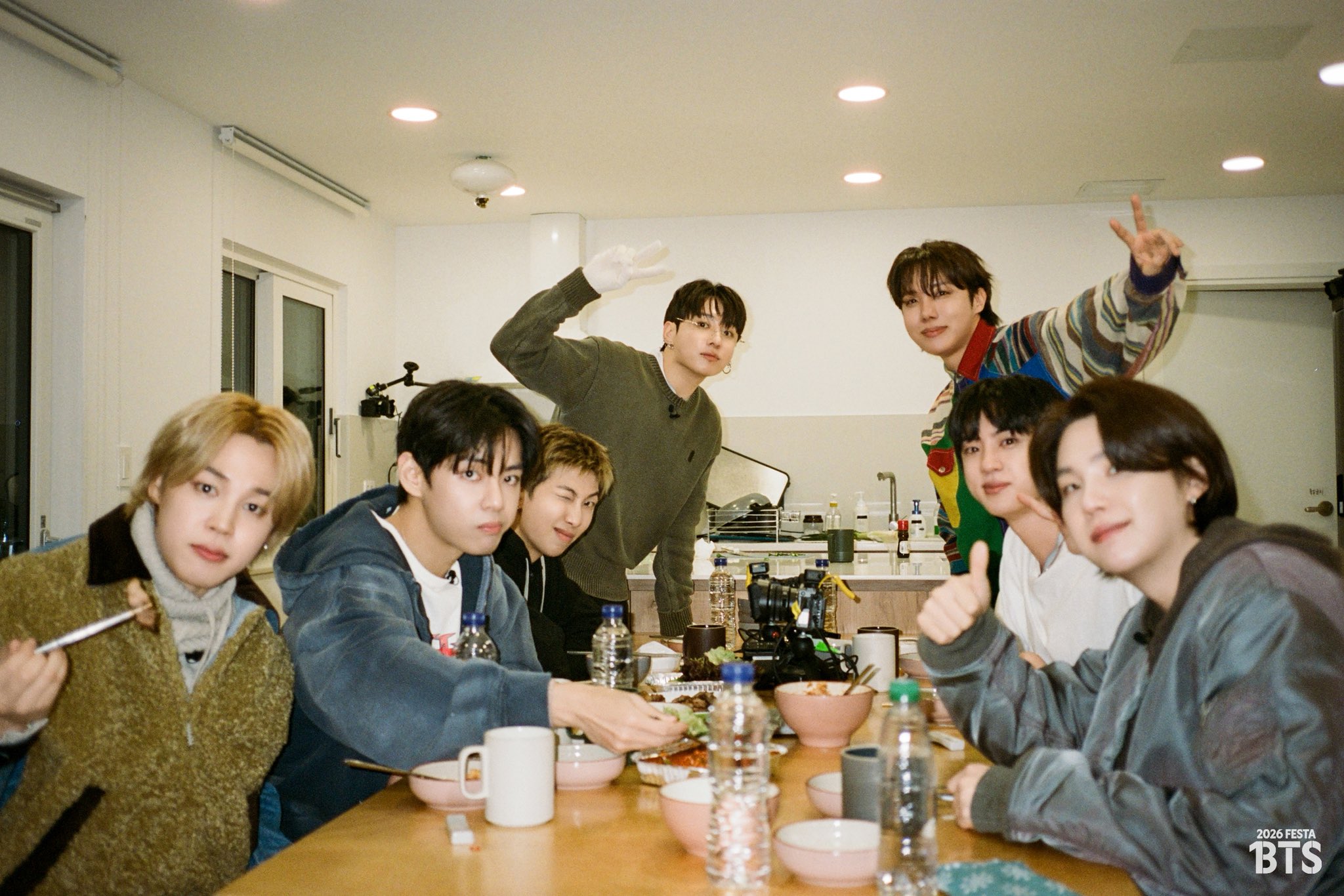
“NORMAL” is one of the three all-English songs on BTS’s ARIRANG album, alongside SWiM and Like Animals.
The song is basically about how abnormal their version of “normal” is. The things they deal with every day, the emotions they process, the kind of life they live—because BTS’s idea of ordinary is obviously very different from ours.
What even is “normal” for people whose lives have been extraordinary for more than a decade?
On the surface, the song actually sounds very simple. Calm even. But there are lines in here that cut much deeper than they first appear.
ALL THE WORDS IN THE WORLD AREN’T ENOUGH
[Verse 1: Jimin]
Heavy is the head when you chasin’ true
Will you color me red? Will you color me blue?
Two sides of a coin, and they both ain’t true
Is it different for mе? Is it different for you?
In Henry IV, Part 2, Shakespeare wrote the line: “Uneasy lies the head that wears a crown.”
And in the original context, Shakespeare was not really talking about fame in the modern sense. He was talking about the psychological burden of power and leadership.
At that point in the play, King Henry IV is exhausted, sick, politically unstable, and deeply anxious about rebellion, betrayal, and whether his reign will survive after him. He became king through conflict and bloodshed, so his rule is haunted by insecurity and guilt.
The line happens during a moment where he cannot sleep because the crown gives him authority over the country—but not peace.
So when Jimin says,“Heavy is the head when you chasin’ true”, it immediately adds another layer to that Shakespeare line.
I don’t think “true” here simply means factual truth. I think he means something sincere. Something real. Something authentic about themselves.
That has always been one of BTS’s biggest priorities from the beginning.
Even before the fame, before the charts, before the stadiums, the members—especially the rap line—kept talking about wanting the freedom to write about things that genuinely resonated with them. RM, SUGA, and j-hope have all discussed how important it was for them to be able to write from their own experiences instead of relying entirely on outside songwriters.
What’s interesting is that global success itself was never really the thing they were chasing.
They wanted to make music, perform, make art, and maybe just remain true to who they are as they evolve.
And somehow, while chasing that sincerity, they ended up with a crown.
Not just fame, but responsibility.
They became so globally influential that they actually contributed to the economy in South Korea with a proportion so big, they actually showed up in South Korea’s economic contributor chart, along with Korea Air, Samsung, Hyunai and others. That’s an insane amount of weight for one group of artists to carry.
It’s hard for ordinary people to fully understand what that must feel like because it’s such a rare experience. Most of us will never know what it feels like to have an entire country discussing your economic impact.
But I think there is a smaller emotional equivalent people can understand. If you’re a breadwinner in a family, there’s a moment where you suddenly realize: people are depending on you.
Something you originally started doing simply because you wanted to survive or pursue something meaningful slowly becomes something other people rely on emotionally, financially, even psychologically.
And when that realization fully lands, it can feel overwhelming.
I think that’s what this line captures so well.
The head became heavy not because they chased power, but because all they wanted was to chase something true to themselves, their music, and their artistry—and somehow that journey turned them into symbols much larger than themselves.
[Verse 1: Jimin]
Heavy is the head when you chasin’ true
Will you color me red? Will you color me blue?
Two sides of a coin, and they both ain’t true
Is it different for mе? Is it different for you?
This is one of the heaviest lines in the song. “Two sides of the same coin” is such an old and universally understood expression.
It’s one of those expressions humanity has collectively accepted for centuries as a way of describing complexity comprehensively.
But then the line twists it, “And they both ain’t true.”
That means there is nothing in this world, not even a global expression used by everyone to describe everything, applies to them. The praise, the criticism, the mythology, or the projections, don’t fully capture who they really are.
And if you really let that settle in you, it’s heartbreaking because the line almost suggests nobody in this world truly understands the life they are living. All the words of all the languages in the world, millions of expressions, millions of years of history, you can put them all together and will not be sufficient.
That’s such a lonely thought.
[Verse 1: Jimin]
Heavy is the head when you chasin’ true
Will you color me red? Will you color me blue?
Two sides of a coin, and they both ain’t true
Is it different for mе? Is it different for you?
This part feels incredibly lonely to me. Especially in the way Jimin delivers it. The last line sounds exhausted.
Almost like someone searching desperately for another person who might remotely understand what they’re going through. There’s something very sad about the uncertainty in it.
He sounds like someone asking whether other people feel the way they do, seeking community.
And because BTS’s experiences are so extreme and unusual, the question carries a sense of emotional isolation underneath it.
The delivery almost feels resigned. Like he has searched for commonality for a very long time and still cannot fully find it.
THE PRE-CHORUS IS DEVASTATING
[Pre-Chorus: V]
Got me feelin’ things unusual
And I livе ’em all
This pre-chorus is actually incredibly important to understanding the song.
Earlier in the track, BTS already established that their “normal” is fundamentally different from ours. Their world is built around extremes including overwhelming schedules, hypervisibility, pressure, and chaos.
That abnormality became their ordinary life. So when they suddenly say, “Got me feelin’ things unusual”, the irony is that the “unusual” here may actually refer to normal human experiences.
Things like: spending time with friends, being emotionally grounded, privacy, peace, genuine spontaneity, and ordinary emotional connection.
Those things may genuinely feel unusual to them now.
And when V says, “And I live ’em all”, it sounds like someone desperately trying to fully experience those fleeting moments while they still can.
But then immediately after that comes:
[Pre-Chorus: Jung Kook]
Got me and my feelings up on this wall
And my knees-ees
This sounds like emotional exposure.
The moment they experience something human, it immediately becomes public consumption again.
They spend time with their family. People know.
They go to a museum. People know.
They walk home. People know.
They visit a temple. People know.
Even their attempts at ordinary life become content.
The line “And my knees-ees” sounds playful sonically, but emotionally it almost feels like collapse. It felt like them realizing that any tiny moment of normalcy they tried to hold onto disappears before they can even have it.
[Verse 2: j-hope]
How I’m ‘posed to feel?
Used to think that I was built with a heart made of steel
Now I understand the truth, some pain don’t heal
If everything’s just happy, mm, that ain’t real (That ain’t real)
The second verse may actually be the emotional core of the entire song.
Because the whole track keeps circling around this idea that “normal” is not a stable state at all. It’s messy, contradictory, emotional, exhausting, fleeting.
And for BTS specifically, normal becomes even harder to define because their lives are so far removed from ordinary experience.
What makes this verse devastating is how calm it sounds. The emotions are huge, but the delivery is incredibly steady.
When he says, “How I’m ’posed to feel?”
He isn’t asking people to help figure out how he feels. He’s asking people how he is expected to feel. It sounds like someone who has spent so long living under public expectation that emotional reactions themselves start feeling performative.
At some point, achievement, pressure, success, criticism, performances, awards—all of it starts coming with invisible expectations attached to it. They are expected to react correctl.
And after years of that, maybe they stop trusting their own instinctive emotional responses entirely.
[Verse 2: j-hope]
How I’m ‘posed to feel?
Used to think that I was built with a heart made of steel
Now I understand the truth, some pain don’t heal
If everything’s just happy, mm, that ain’t real (That ain’t real)
At first, because of their youth and ambition, they probably believed they could survive anything no matter the cost, pressure, or pain. But now there’s this realization that they were never indestructible.
The saddest part is that the wounds themselves became the armor. They became so used to pain, exhaustion, criticism, and pressure that numbness itself started functioning as protection.
That’s devastating if you really think about it.
Because wounds are supposed to be things you heal from. But here, the wounds themselves became what protects them from the outside world.
[Verse 2: j-hope]
How I’m ‘posed to feel?
Used to think that I was built with a heart made of steel
Now I understand the truth, some pain don’t heal
If everything’s just happy, mm, that ain’t real (That ain’t real)
This line feels very emotionally mature. It rejects the fantasy that permanent happiness exists. BTS has increasingly spoken this way in recent years. There’s less obsession now with perfection or endless ambition and more acceptance that sadness, confusion, exhaustion, and contradiction exist.
Real life includes discomfort.
Permanent happiness would actually feel artificial.
[Verse 2: SUGA]
I breathe everything out like a thousand times
Normal and special, they are just some lines
One deep sigh, then it slips away, fades away
What I try to keep never want to stay
BTS exists in this strange space where they are simultaneously global icons, ordinary people, mythologized publicly, emotionally human privately.
So when they say, “Normal and special, they are just some lines”, it feels like they no longer fully believe those categories even matter anymore. Those labels became abstract concepts.
In their world, there is only constant movement, noise, schedules, expectations, emotion, chaos. When they experience something peaceful or special, it fades almost immediately because their lives move too fast for permanence.
[Verse 2: SUGA]
I breathe everything out like a thousand times
Normal and special, they are just some lines
One deep sigh, then it slips away, fades away
What I try to keep never want to stay
It feels applicable to almost everything including people, peace, privacy, moments, stability, youth, and happiness.
Even quiet moments feel temporary in their lives. And if the line refers to people, it becomes even sadder because maybe their world is simply too overwhelming for permanence.
Nothing stays still long enough to fully belong to them.
RM’S VERSE FEELS INCREDIBLY LOST
[Verse 2: j-hope, SUGA, RM]
Runaway, pushin’ me, pullin’ me, said you wanted all of me
But what is even all of me?
Suddenly, part of me is hauntin’ me, heard the things they callin’ me
What the hell you want from me? (Want from me)
There’s something deeply helpless about this line. Because usually when somebody demands too much from you, the instinct is to pull away or resist. But RM almost sounds willing to give everything—if only he actually understood who he is himself.
But he doesn’t know.
So the demands, projections, and expectations people place on him become emotionally disorienting because he himself no longer fully understands where the boundaries of “himself” even begin or end.
And that becomes especially tragic in the context of BTS’s lives because millions of people constantly analyze, define, interpret, or discuss them.
Yet the one person who should theoretically understand RM best—RM himself—is struggling to fully grasp who he is underneath all of it.
There’s a painful irony there.
[Verse 2:RM]
Runaway, pushin’ me, pullin’ me, said you wanted all of me
But what is even all of me?
Suddenly, part of me is hauntin’ me, heard the things they callin’ me
What the hell you want from me? (Want from me)
If someone already feels emotionally fragmented or uncertain about themselves, outside opinions become much harder to filter out.
And when RM says: “Heard the things they callin’ me”, you get the sense that those external voices start invading his internal sense of self.
So when somebody wants him, loves him, demands things from him, he almost sounds confused because if all these terrible things people say about him are true, then why would anybody even want him at all? That confusion feels very real in the song.
And again, there’s something helpless about it because he doesn’t even sound angry.
Just lost.
THE SONG IS DECEPTIVELY SIMPLE
What makes NORMAL fascinating is that BTS themselves described the song very straightforwardly. They said it was about how unusual and chaotic their version of “normal” has become.
But if you really listen carefully, there’s a lot happening emotionally underneath the simplicity.
The production and vocals are steady.There are no explosive vocal runs or dramatic emotional peaks.
The members flow in and out of each other’s lines constantly, which should sound chaotic because there are four very distinct vocalists alternating rapidly. But everything feels controlled, stable and even.
It may be intentional because musically, the song itself mirrors what they are describing emotionally, overwhelming chaos that has become ordinary to them.
This is their steady state now. That’s why the song feels sad sometimes, but strangely calm at the same time.
More importantly, the song never sounds resentful. They don’t sound like they hate fame. They aren’t complaining either.
They are just stating a fact, sharing their life. There’s something strangely vulnerable and generous about that.
Check the BTS ARIRANG’s track by track analysis:
- ARIRANG TRACK-BY-TRACK: “BODY TO BODY” AND BTS’S INVITATION TO COME CLOSER
- ARIRANG TRACK-BY-TRACK: BREAKING DOWN BTS’ “HOOLIGAN” LYRIC BY LYRIC
- ARIRANG TRACK-BY-TRACK: THE HUMOR AND DEFIANCE OF BTS’ “2.0”
- ARIRANG TRACK-BY-TRACK ANALYSIS: ‘NORMAL’ LYRIC BREAKDOWN
- ARIRANG TRACK-BY-TRACK ANALYSIS: ‘INTO THE SUN’ BREAKDOWN
- ARIRANG TRACK-BY-TRACK ANALYSIS: ‘THEY DON’T KNOW ‘BOUT US’ LYRIC BREAKDOWN
- ARIRANG TRACK-BY-TRACK ANALYSIS: ‘INTO THE SUN’ LYRIC BREAKDOWN
