

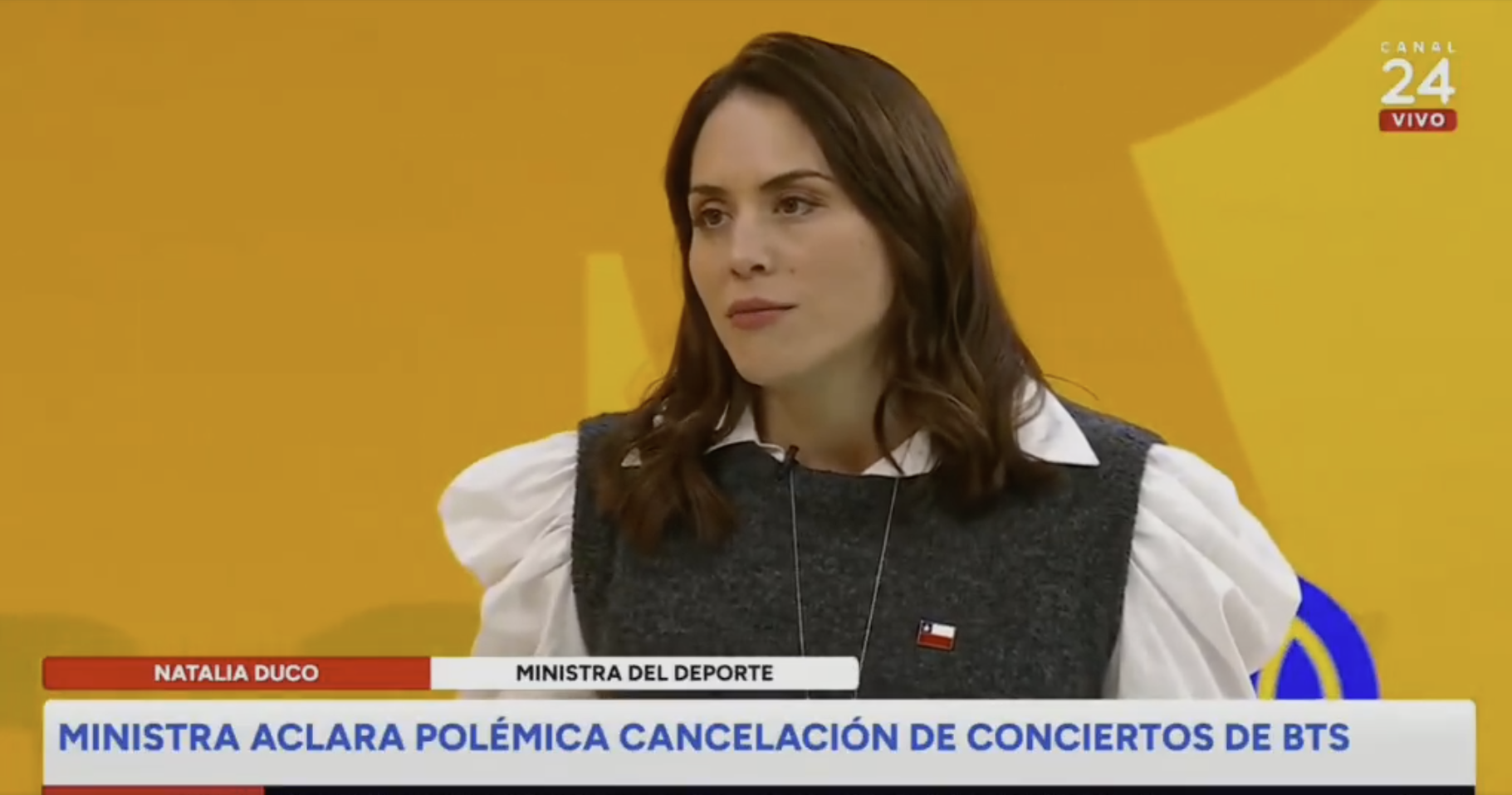
Chilean ARMYs woke up to disappointing news on July 2, 2026: the Instituto Nacional del Deporte (IND), under the Ministry of Sports, rejected the use of the main Coliseo Central at Estadio Nacional for BTS’s three sold-out ARIRANG Tour shows scheduled for October 14, 16, and 17. The technical reasoning centered on protecting the hybrid grass pitch from a demanding 360° central stage setup that requires days of installation and concentrated loads. Recovery timelines could clash with upcoming football matches, the Chilean national team schedule, and the all-important Teletón 2026.
An alternative space on the Explanada Sur (South Esplanade) of the Parque Estadio Nacional has been offered, but nothing is confirmed yet. Tickets sold out months ago, and fans who poured money and emotion into the dates are now organizing protests and flooding official channels with demands for accountability and creative solutions.
The decision has predictably dragged Natalia Duco—Chile’s Minister of Sports since March 11, 2026—back into the spotlight. In just a few months on the job, the former elite shot-putter has already accumulated a string of controversies that critics are now weaponizing. CNN Chile published a story laying out all the controversies.
Here’s a clear-eyed look at each one: what happened, how it unfolded, and where things stand.
The 2018–2019 Doping Scandal: The Shadow That Followed Her Into the Ministry
This remains the heaviest piece of baggage. In April 2018, ahead of the South American Games in Cochabamba, Bolivia, a Comisión Nacional de Control de Dopaje (CNCD) official collected a urine sample from Duco at her home. The Paris lab later confirmed the presence of GHRP-6, a growth-hormone-releasing peptide banned by the World Anti-Doping Agency (WADA). The substance stimulates the body’s own production of growth hormone, which can enhance muscle growth, recovery, and strength—exactly the kind of edge that violates the principle of fair competition.
Duco did not request the B sample. In a public statement she said she had “never ingested any type of substance with the intention of obtaining a sporting advantage, cheating, or violating any rule that goes against Olympism and my values as a person.” She accepted whatever sanction would come. In February 2019 the Tribunal de Expertos en Dopaje handed down a three-year suspension (some early reports mentioned four), effectively ending her hopes of competing at the 2019 Pan American Games in Lima and the Tokyo 2020 Olympics (later postponed). ODESUR also asked for the return of her gold medal from Cochabamba.
The ban ran until roughly April 2021. Her competitive career as Chile’s most decorated shot-putter (national record holder, Olympic finalist in London 2012 where she placed 10th and later moved up to 8th after doping disqualifications) was essentially over at age 29–30.
When President José Antonio Kast named her Minister of Sports in January 2026, the old case exploded again. Sports journalists and figures like Juan Cristóbal Guarello called it a “bad signal” for the anti-doping fight. Duco responded by saying she accepted all opinions and was focused on working for Chilean sport. The episode still colors perceptions of her leadership: can someone who once tested positive credibly oversee the very rules she once broke?
Support for Rodeo: “It’s a Sport by Law”
Early in her tenure Duco voiced support for Chilean rodeo, a traditional discipline that animal-rights groups have long criticized for involving stress and potential harm to horses and calves. Her quoted stance, given to LUN and later referenced widely: “El rodeo es un deporte por ley y la ley está por sobre nosotros. Luego hay otra cosa que quiero decir con mucha sensibilidad: no estoy de acuerdo con el maltrato animal.” (“Rodeo is a sport by law and the law is above us. Then there’s something else I want to say with great sensitivity: I don’t agree with animal mistreatment.”)
Animal-rights organization Animal Libre responded by delivering 250,000 signatures demanding that rodeo lose its official sport status and state support. The comments divided public opinion—traditionalists defended the cultural practice; critics saw the minister’s legalistic defense as tone-deaf or insufficient. Duco has since reiterated that she personally opposes mistreatment while standing by the legal recognition of the sport. The debate continues to flare whenever the topic returns to the news cycle.
The “Ropa Linda” Comment: Priorities Under Scrutiny
In April 2026, during the ITTF World Para Future Santiago event and while speaking with long-time athletes from Team ParaChile, Duco said the Ministry’s number-one priority would be to “entregarle ropa linda a los deportistas” (“give athletes nice/pretty clothes/uniforms”). She elaborated that representing Chile is like a superhero’s costume: “si uno va fea, con la polera mala, ya perdiste po” (“if you show up ugly, with a bad shirt, you’ve already lost”).
A video clip (later deleted from the Team ParaChile account) went viral. Critics, including national gymnast Makarena Pinto, pushed back hard: para athletes and many others need proper medical teams, gender-equitable conditions, decent travel support, and basic dignity—not primarily aesthetic upgrades. The remark was widely seen as superficial or out of touch with the real structural needs of Chilean sport, especially for para athletes.
Duco later apologized, explaining she had been speaking casually with friends and athletes she has known for years, that she understood the controversy, and that she did not take it personally. The episode nonetheless added to the perception that her communication style sometimes lands poorly in a high-visibility political role.
Why These Stories Are Back in the Headlines Now
The BTS rejection is being framed by the IND as a purely technical and operational call to protect a valuable sports asset and honor prior commitments. Officials have stressed they are not against large cultural events and are actively exploring the South Esplanade alternative. Duco herself has reportedly emphasized that the production did not provide the guarantees the pitch required.
Yet in the age of social media, personal history travels fast. Chilean ARMYs—already frustrated and mobilizing—are resurfacing Duco’s dossier as they demand transparency, faster answers, and a viable path for the October shows. For many fans, the issue is bigger than one minister: it’s about whether Chile can host major global pop-culture moments without the infrastructure or political will catching up.
The Bigger Picture for Fans and the Industry
BTS’s planned Santiago dates were expected to be a major cultural and economic moment for Chile, drawing regional fans and generating significant tourism and local spending—much like previous high-profile K-pop or international acts. When stadium access becomes a political or bureaucratic flashpoint, it affects not just one tour but the broader perception of how welcoming (or complicated) a market is for Asian entertainment.
Duco’s story is a classic case of a high-achieving athlete transitioning into politics: past mistakes (even acknowledged ones) are never fully erased from the public ledger, and every new decision gets filtered through that lens. Whether the controversies ultimately shape the outcome for the BTS concerts remains to be seen—the technical issues with the pitch are real, and solutions will require coordination between the production, IND, and the venue.
For now, Chilean fans are doing what they do best: organizing, trending hashtags, and refusing to let the conversation die quietly. The coming weeks will show whether a compromise venue or revised plan can still deliver the shows ARMYs have been waiting for—or whether the weight of old controversies and new logistical hurdles will force a postponement or relocation.
This piece was expanded and contextualized for Asian Entertainment and Culture with a focus on clarity, fan impact, and the intersection of sports governance and pop-culture events. Sources include official statements, contemporary reporting from Chilean outlets, and public records of the doping case.
