

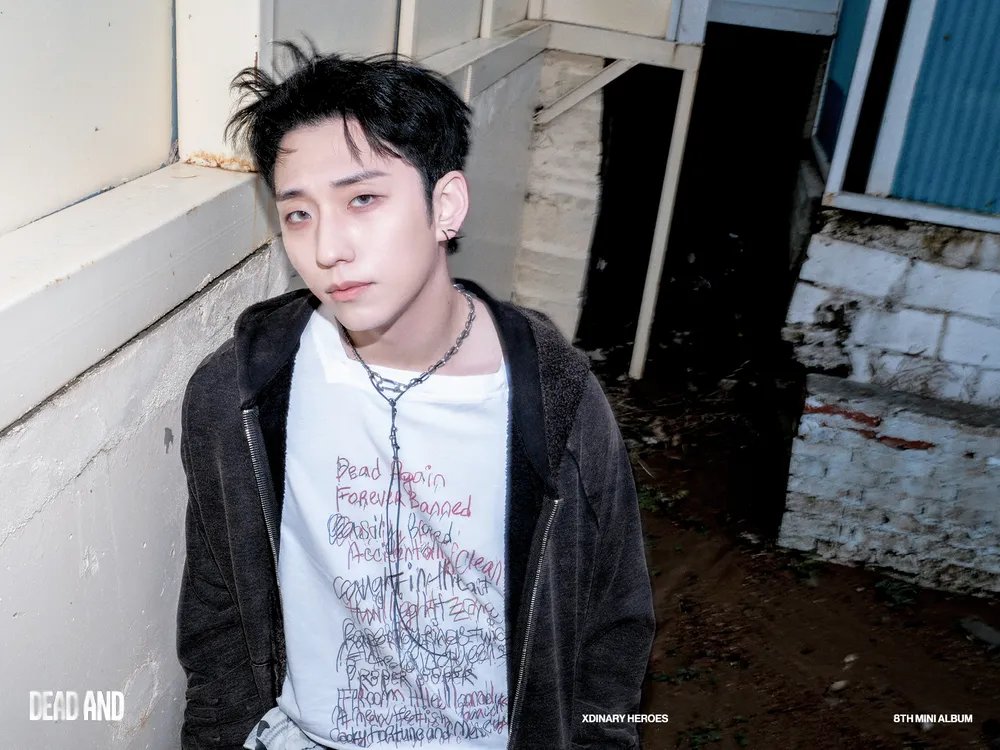
Xdinary Heroes drummer Gunil left the band this week after JYP Entertainment terminated his exclusive contract, following a viral post from a woman claiming to be his former girlfriend. She alleged he frequently insulted fans in private, in ways starkly at odds with his public persona, and said she went public after watching him perform as though nothing had happened. JYP didn’t specify the allegation in its statement but confirmed the mutual termination, and said the remaining five members would continue as Xdinary Heroes. Gunil then posted his own apology, admitting he’d made “inappropriate remarks toward fans” in a phone call that had since leaked. He framed the context — not as excuse, he insisted, but as explanation — around being mentally drained by rumors and carrying leadership burdens alone, and specifically cited sasaeng fans who had trespassed on his residence and planted a tracker on his car as fueling his resentment. He said the words were never meant for the fandom as a whole, and closed with a farewell message saying he wanted to stay but would respect the agency’s decision.
However, Gunil is not actually the interesting part of the Gunil story.
A drummer said something ugly about fans in a private phone call, an ex-girlfriend posted about it, the agency terminated him within days, and he wrote an apology that was equal parts contrition and context — sasaeng fans trespassing on his property, tracking his car, months of being “mentally drained” by rumors he carried alone because that’s apparently what being “the leader and oldest member” gets you. All of that is true, and none of it is the point. The point is the machine that made this inevitable, and the fact that everyone arguing about whether Gunil deserved it is arguing about the wrong layer of the problem.
The Whataboutism, Addressed and Dismissed
Let’s clear the easy objection first, because it’s the one that always shows up fastest and does the least work: isn’t this just rewarding a toxic ex for leaking private stuff, and doesn’t that hand power to every sasaeng who wants leverage over an idol?
In the abstract, sure. That’s true of almost any private disclosure about someone with public power — it’s the same argument used to discredit whistleblowers, exes, assistants, anyone with access. The existence of a bad-faith version of a disclosure doesn’t tell you anything about whether this disclosure was bad-faith, and in this case it doesn’t matter anyway, because Gunil didn’t deny it. He confirmed the substance. “I did make inappropriate remarks toward fans in a phone call that has since been made public,” he wrote, no equivocation. Whatever the poster’s motive, whatever we don’t know about the relationship (JYP never confirmed its length or nature; the “few weeks” figure comes only from the poster’s own account and should be read as claimed, not established), the core fact isn’t in dispute. So “we don’t know the whole story” is true and also mostly beside the point. We know enough of the story that matters.
What is worth taking seriously, separately, is the sasaeng detail — the trespassing, the GPS tracker, the sustained harassment Gunil says curdled into contempt he voiced to the wrong person. If accurate, that’s a real structural failure the industry has been sitting on for years, and it deserves its own reckoning independent of whether Gunil handled his resentment well. He seems to know this too, which is more self-awareness than his apology gets credit for. Both things are true at once: the sasaeng behavior is a genuine abuse he experienced, and venting contempt at fans broadly — rather than the specific people harassing him — was still a firing-worthy breach of the one job idols are actually contracted to perform, which is maintaining the fiction that the audience is loved back.
The Line Was Always There. It Just Tilts the Wrong Way.
The instinct in this discourse is to say the industry needs to “draw a line” between public and private, borrowing — consciously or not — from the Japanese concept of tatemae and honne, the public face versus the private true feelings. Worth being precise here: that’s not an idol-industry doctrine, it’s a general cultural framework that predates and outsizes entertainment by centuries. Korean idol contracts don’t formalize a public/private split the way, say, dating-ban culture in Japanese idol management does. So the comparison is aspirational, not descriptive. It’s not “K-pop is failing an existing standard,” it’s “here’s a framework K-pop could import if it actually wanted one.”
But here’s the part that gets missed: the industry already has a line. It just isn’t where people think it is, and it isn’t drawn for the idol’s protection. The current line demands total availability — fan-service calls, “honest” vlogs, confessional segments engineered to feel individually addressed — precisely because the illusion of accessible private selves is the product being sold. A paid one-on-one video call where an idol says your name and reacts to you specifically isn’t incidentally personal. Intimacy simulation is the entire transaction. There’s no version of that content that isn’t manufacturing a felt bond, because manufacturing the felt bond is what was purchased.
That’s different from a vlog about a comeback, or members needling each other in a studio, or documentation of the actual grind of promotion. Content can be honest and revealing about the work without being structured to make a viewer feel relationally entangled with the person doing it. The parasocial charge doesn’t come from the camera being on someone’s real day — it comes from content built to manufacture felt address: direct-to-camera “I miss you guys,” manufactured vulnerability beats, anything implying the idol’s off-camera feelings are being handed specifically to the viewer. Which means the redraw isn’t “less personality, more corporate distance.” It’s “stop engineering intimacy as a deliverable, and let work-content actually be about the work.”
That still leaves a residue no editing choice can fully manage: watching someone’s real effort and personality accumulate over years builds a one-sided sense of knowing them, regardless of intent, because that’s inherent to sustained parasocial media exposure and not just to content designed to exploit it. A fan can parasocially attach to a guitar tutorial if that’s where their attachment need is pointed, and no agency or idol can engineer content immune to projection. But that’s precisely where responsibility should end. Once content is genuinely constructed around craft rather than constructed for maximum felt closeness — camera treated as documentation rather than confidant, an arc that isn’t edited to manufacture investment, a member narrating their own process rather than a producer narrating a relationship to the viewer — what a given fan does with that psychologically is their own interpretive act, shaped by their own needs and history. That’s not a failure of the content. That’s just what audiences do, and it was never anyone’s job to prevent.
What Actually Broke
Gunil didn’t break the illusion. He was the illusion’s cost center — the place where the gap between “total availability” as a business requirement and “a person with a limit” as a biological fact finally showed its math. The industry’s response to that gap has never been to close it. It’s been to terminate whoever gets caught standing in it, restock the group at five members instead of six, and keep selling the same manufactured closeness to everyone still willing to buy it. Which means the actual scandal here isn’t a drummer’s phone call. It’s that the business model requires there to be no stable private sphere for the people generating its revenue, and every few months, it produces a casualty who confirms that on the record and then apologizes for it anyway.
