

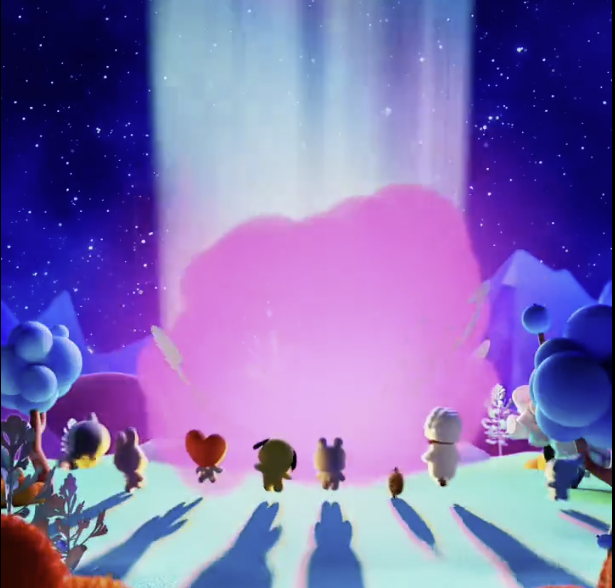
When McDonald’s announced its BT21 Happy Meal collaboration, most fans saw another cute licensing deal.
It was much bigger than that.
McDonald’s sells more than a billion Happy Meals every year. Every collaboration gives a character franchise access to one of the largest consumer platforms in the world, reaching children, families, and casual customers who may have no prior connection to the original brand.
McDonald’s didn’t license BTS. It licensed BT21. That tells us something remarkable about how far the franchise has come.
Nearly eight years after its launch, BT21 is no longer simply “BTS merchandise.” It has evolved into what may be the world’s most successful celebrity-created original character franchise—a case study in how an artist’s popularity can be transformed into a long-lasting intellectual property.
But the question is whether or not BT21 could survive without BTS. Would it have the sales and demand it has now if BTS retires now? How much of its success is coming from ARMYs who are always craving for anything BTS-related?
Is the franchise genuinely sustainable on its own merits, or is its success artificially sustained by an intensely loyal fandom buying everything within the BTS orbit?
Not Every Celebrity Brand Is an IP
The entertainment industry is packed with successful celebrity brands.
Michael Jordan has Jordan Brand.
Cristiano Ronaldo has CR7.
Rihanna built Fenty.
Taylor Swift sells millions of dollars in merchandise every tour.
KISS arguably created one of the greatest merchandising empires in music history.
But all of these businesses still revolve around celebrities and they are certainly not characters.
BT21 is different. It is built around original fictional characters.
The characters have their own names, personalities, stories, relationships, and visual identities. They can appear in animations, books, games, apparel, cafés, and licensing partnerships without BTS appearing alongside them.
People will ask why haven’t celebrities created Character IP Franchises?
While most celebrity ventures are designed for immediate monetization, the mechanics of character IP require a entirely different operational mindset.
Most celebrities don’t think like IP creators.
They think like brands. A celebrity usually looks for ways to monetize their popularity. So they launch perfume, make up, shoes, clothing, and others.
A character IP product is also a much longer game.
A celebrity brand can launch in six months. A character franchise might take a decade.
Think about Hello Kitty. Sanrio didn’t build Hello Kitty through one collaboration. They spent decades:
- refining the characters
- licensing strategically
- creating stories
- expanding globally
- building retail
Disney did the same. Pokémon did the same. These companies think in decades, not product cycles.
If you’re Taylor Swift, Beyoncé, or LeBron James, your name already sells products.
Why create an entirely new fictional universe?
The return on investment is uncertain, and the work is enormous. It’s often more efficient to keep leveraging your own fame.
None of This Happens Without BTS
At the same time, none of this should diminish the role BTS played in creating BT21.
Without BTS, there is no BT21.
The group’s extraordinary popularity attracted LINE FRIENDS as a partner. Their global fanbase provided immediate demand. ARMY purchased the first products, shared them online, introduced them to new audiences, and gave the characters an emotional foundation that no marketing campaign could manufacture.
Just as importantly, BTS did not simply lend their names.
Each member helped create a character from scratch, contributing sketches, personalities, names, and backstories. Fans watched the creative process unfold.
Now, the creation is part of the art. It was important that people were not buying characters designed by a corporate marketing department. They were buying characters born from BTS’s own imagination.
Fandom Can Launch a Brand. It Cannot Sustain One Forever.
Many celebrity products sell well during their first few years. Very few remain relevant nearly a decade later. That is where BT21 separates itself.
The initial success came from BTS. The long-term success came from brand building.
Instead of producing endless BTS-branded merchandise, BT21 gradually developed its own identity.
Consumers stopped thinking of RJ simply as “Jin’s character.” They started thinking of RJ as RJ. The same happened with Cooky, Chimmy, Shooky, Tata, Mang, Koya, and Van.
That shift may seem subtle, but it represents one of the hardest transitions any character franchise can make.
The emotional relationship slowly moved away from the celebrity and toward the characters themselves.
Building a Universe Beside BTS
Perhaps BT21’s greatest strength is that it never tried to replace BTS.
Instead, it grew alongside BTS. The characters exist in their own universe. They have their own adventures, friendships, personalities, and emotional journeys. This became especially apparent during BTS’s military enlistment.
While the members temporarily stepped away from group activities, BT21 continued releasing animated content following each character’s individual adventures before eventually reuniting them as BTS completed military service.
The symbolism was obvious to longtime fans. Yet someone unfamiliar with BTS could still enjoy the stories.
That is exactly how a healthy entertainment IP grows. It remains emotionally connected to its origin while becoming accessible to entirely new audiences.
Every Partnership Builds Two Brands


BT21’s impressive list of collaborations tells another important story.
Over the years, the characters have partnered with brands including Converse, Skechers, Uniqlo, Olive Young, and now McDonald’s.
Most people think these collaborations primarily benefit the partner by attracting BTS fans.
But the relationship works both ways.
Every collaboration introduces BT21 to a completely new customer base.
A Converse customer may discover BT21 for the first time. A Uniqlo shopper may purchase a T-shirt simply because the design is appealing. An Olive Young customer may encounter the characters while shopping for skincare.
Now, through McDonald’s Happy Meals, millions of children and families who have never listened to BTS may meet RJ, Chimmy, Cooky, or Tata for the very first time.
That is exactly how independent character franchises are built.
Why the McDonald’s Collaboration is Different
While fashion collaborations are impressive, Happy Meals operate on an entirely different scale. They are a universal, global product.
For decades, McDonald’s has introduced children to some of the world’s most recognizable entertainment franchises.
Many people first encountered Pokémon, Disney characters, or other major brands through Happy Meals rather than through television or movies.
BT21 now joins that conversation. It is entirely possible that a child will recognize Cooky before ever hearing a BTS song. That possibility would have sounded impossible in 2017.
Today, it feels increasingly realistic.
Why BT21 Succeeded When Others Didn’t
LINE FRIENDS has created character collaborations with other artists. None has approached BT21’s longevity, retail presence, or breadth of global licensing.
That suggests BT21’s success cannot be explained by LINE FRIENDS alone. Nor can it be explained by BTS alone.
Its success came from the combination of several ingredients working together:
- BTS’s unprecedented global popularity.
- The loyalty and purchasing power of ARMY.
- Original character designs with genuine creative input from the members.
- Strong long-term brand management.
- Continuous storytelling through animated content.
- Strategic licensing partnerships that introduced BT21 to audiences beyond K-pop.
Take away any one of those ingredients, and BT21 likely looks very different today.
Can it Transcend BTS?
Unlike its early years, BT21 no longer depends on constant promotion from BTS.
The members still acknowledge the characters from time to time, but the franchise increasingly appears capable of operating on its own.
Whether this was an intentional strategy or simply a natural evolution is impossible to know from the outside.
Either way, it reflects the hallmark of a mature IP. The goal is no longer to remind consumers that BT21 belongs to BTS. The goal is to make people love BT21 because they love BT21.
But whether or not it will transcend BTS depends on certain things and the best lesson may come from the ones who already did it.
Mickey Mouse: about 1928–1935 (roughly 7 years)
Mickey debuted in 1928 with Steamboat Willie. But Mickey wasn’t immediately “Disney.”
He became a household name because Disney did something nobody had really done before. They licensed Mickey onto everything. Within just a few years there were:
- dolls
- watches
- school supplies
- books
- comic strips
- clothing
- toys
By 1932–1933, Mickey merchandise was everywhere, and demand for Mickey dolls was so intense that handmade production couldn’t keep up, leading Disney to mass-produce them.
Notice something important. People weren’t just watching Mickey. They were living with Mickey. That is when an IP becomes independent.
Barbie: about 1959–1965 (roughly 6 years)
Barbie launched in 1959. Within just a few years Mattel wasn’t simply selling dolls anymore.
They had created:
- Ken (1961)
- Dreamhouse (1962)
- friends
- siblings
- careers
- accessories
- vehicles
- furniture
Barbie stopped being “a doll” and became “a universe.”
By the mid-1960s she had become America’s dominant fashion doll and a fixture of children’s culture.
By all accounts, LINE and HYBE ARE doing both. They are licensing BT21 and building universes.
Scale is what will make a difference now. Can LINE and HYBE create narratives that will resonate with the wider market?
HYBE’s “Super IP” Philosophy May Have Started Here
HYBE isn’t trying to make BT21 “popular.” They’re trying to make BTS itself operate like a character franchise.
Think about Disney. Mickey isn’t Disney’s only IP. Mickey taught Disney how to build IP.
Everything that came afterward—Donald Duck, Winnie the Pooh (through acquisition), Pixar, Marvel, Star Wars—benefited from that playbook.
I think BTS and BT21 may play a similar role for HYBE.
In recent years, HYBE has spoken extensively about building “super IP”—intellectual property capable of expanding across platforms, media, products, and generations.
Today we see that philosophy in virtual projects, story worlds, original universes, and platform-based entertainment.
Looking back, it is remarkable that one of HYBE’s earliest and most successful experiments in this direction began with BTS.
Long before “super IP” became part of HYBE’s corporate vocabulary, BTS had already demonstrated what one could look like.
BT21 proved that an artist’s creativity could become something larger than merchandise.
It could become a character franchise. It could become a licensing business. It could become an entertainment property.
And perhaps one day, it could become a brand that introduces people to BTS instead of the other way around.
Whether BT21 eventually reaches the cultural status of Hello Kitty, Snoopy, or Mickey Mouse remains to be seen.
But after nearly a decade of sustained growth, one thing is already clear.
BT21 is no longer just one of the most successful merchandising projects in music.
It has become one of the most compelling intellectual property stories the entertainment industry has produced in the 21st century.
