

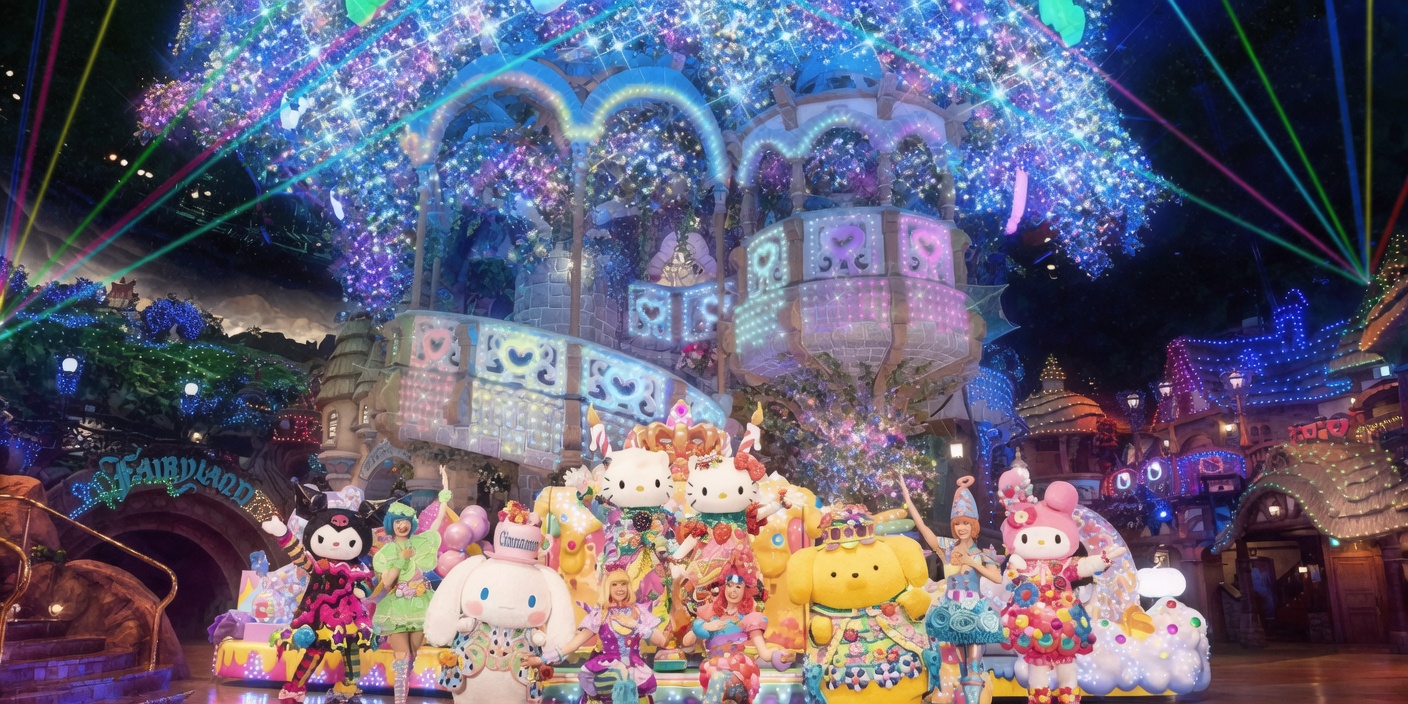
Halloween at Sanrio Puroland is about to get considerably more monstrous.
The Tokyo theme park has announced PUROMONSTER SCRAMBLE, its Halloween event scheduled to run from September 11 through November 3, 2026. This year’s celebration is particularly notable because it brings one of the world’s hottest newer character properties into the home of some of Japan’s most established ones: LABUBU.
Under the theme “KAWAII × MONSTER HALLOWEEN,” Hello Kitty, Kuromi, Cinnamoroll and Bad Badtz-Maru will appear in fluffy monster costumes alongside Pop Mart’s mischievous little monster.
And Sanrio isn’t treating LABUBU like somebody who has simply been invited over for a photo. The collaboration extends across entertainment, attractions, merchandise and food, effectively inserting LABUBU into the Puroland experience.
What is PUROMONSTER SCRAMBLE?
The centerpiece is PUROMONSTER SCRAMBLE PARTY, a new 360-degree immersive live show featuring Sanrio characters alongside LABUBU. Japanese voice actor Subaru Kimura voices an original monster character named Jack O’Happens, while music duo FAKE TYPE produces the theme song.
Puroland is also giving its Sanrio Character Boat Ride a temporary horror makeover through a collaboration with Japanese horror entertainment group Obaken. The story revolves around an urban legend involving a cursed clown, adding actual scares to a park considerably better known for bows, puppies and aggressively adorable desserts.
Naturally, there will also be limited-edition food and merchandise. Because Sanrio and Pop Mart understand the fundamental law of character IP: If you make it cute enough, somebody will want to take it home. But the most interesting part of this collaboration isn’t actually Halloween. It’s the two companies involved.


LABUBU Is Huge. Sanrio Is Something Else Entirely.
It can be difficult to appreciate the scale of Sanrio because Hello Kitty is so culturally familiar that she almost stops feeling like a commercial property.
She isn’t alone, either. Sanrio says it has created more than 450 characters. Its 2026 Character Ranking featured 90 of them and generated a record 70.65 million votes. Pompompurin alone received more than seven million votes, while Cinnamoroll, Pochacco, Kuromi and Hello Kitty completed the Top 5.
Sanrio isn’t simply Hello Kitty plus some supporting characters anymore. It possesses an unusually deep character portfolio capable of serving different demographics, aesthetics and markets. Kuromi can attract a consumer who might not buy Hello Kitty. Cinnamoroll can develop his own fandom. Pompompurin can receive seven million votes in a popularity contest.
And those audiences are international. In this year’s interim Character Ranking, for example, Sanrio published separate rankings for mainland China, Hong Kong, Taiwan, Singapore and other overseas markets.
Sanrio is now actively trying to expand those characters into even more forms of entertainment. It recently established Sanrio Games, with plans for approximately 10 games over three years, explicitly describing games as another global touchpoint connecting its characters with merchandise and theme parks.
That’s what makes Puroland so useful in an IP strategy. Sanrio doesn’t merely sell characters. It has built places where you can physically enter their world.
And Then There Is LABUBU
LABUBU brings something very different to this relationship: extraordinary contemporary heat. LABUBU belongs to The Monsters, created by artist Kasing Lung and commercialized by Pop Mart. And the financial numbers behind its recent explosion are ridiculous.
Pop Mart generated RMB 37.12 billion, or about $5.4 billion, in revenue in 2025, an increase of 184.7% year over year. The Monsters alone generated approximately RMB 14.16 billion, representing roughly 38% of the entire company’s revenue.
That’s approximately $2 billion from The Monsters in one year. And the growth was enormous: The Monsters revenue increased 365.7% year over year.
The international numbers may be even more important to understanding this collaboration. Pop Mart’s overseas revenue jumped 291.9% in 2025 to RMB 16.27 billion, while revenue from the Americas surged 748.4% to RMB 6.81 billion.
So LABUBU is no longer merely a Chinese collectible that became trendy online. It is becoming a genuinely global character IP. Sanrio gives LABUBU something money can’t manufacture overnight
LABUBU has momentum. Sanrio has longevity.
Hello Kitty debuted in the 1970s. My Melody arrived in 1975. Pompompurin turns 30 this year. Cinnamoroll has been around since 2001. Sanrio therefore has something Pop Mart cannot simply accelerate through sales growth: decades of proof that character affection can survive generations.
The challenge for LABUBU is whether it can remain popular. In fact, investors are already asking exactly that. Pop Mart shares plunged after its 2025 results despite enormous revenue and profit growth, partly because investors worried about the company’s dependence on The Monsters.
A collaboration with Sanrio therefore puts LABUBU beside what is essentially the graduate program for character-IP longevity. LABUBU gets to exist alongside characters that have successfully moved through toys, apparel, licensing, animation, games, food, theme parks and countless collaborations while continually finding new generations of consumers.
And this isn’t merely LABUBU wearing a Hello Kitty hat. Putting LABUBU inside Puroland entertainment moves the character further from collectible object toward entertainment personality. That’s an important evolution if Pop Mart wants LABUBU to remain valuable after the current collecting frenzy eventually cools.
Sanrio Gives LABUBU Something Money Can’t Manufacture Overnight
This is not charity from the grandparents of kawaii. Sanrio gets access to one of the hottest character fandoms on Earth.
LABUBU is extraordinarily strong among younger consumers, collectors and social-media audiences. Its vinyl-plush pendants became a fashion accessory, appearing on bags and generating an enormous online culture of unboxings, collections, outfits and limited-edition hunting. By the first half of 2025, The Monsters had already generated RMB 4.81 billion — about $670 million — and had become Pop Mart’s largest franchise.
LABUBU therefore gives Sanrio another route into the contemporary collectible economy.
More importantly, the aesthetics fit. Sanrio has spent decades mastering kawaii. LABUBU helped make slightly unhinged kawaii fashionable. Put Kuromi and LABUBU together for Halloween and nobody needs a 40-page brand strategy presentation to understand why it works.
Japan Meets China’s New Global IP Machine
There is another reason I think this deserves coverage in an Asian entertainment magazine. This collaboration puts together two very different generations of Asian character-IP development.
Japan built some of the world’s most recognizable character businesses over decades. Sanrio is one of the great examples of that model: create distinctive characters, build emotional attachment and then expand those characters across products, experiences and generations.
China is increasingly demonstrating that it can build internationally desirable entertainment and consumer IP of its own. LABUBU may be its most visible recent example.
Pop Mart is now expanding internationally, developing its theme-park business and pursuing a LABUBU film with Sony Pictures as it tries to push the property beyond collectibles. That makes the Puroland collaboration almost a perfect snapshot of where Asian character entertainment currently stands.
One company has spent more than half a century proving how durable character IP can become. The other has created one of the fastest-growing character phenomena in the world.
They Actually Solve Different Problems for Each Other
That’s probably the cleanest way to explain the business logic.
For LABUBU, Sanrio provides heritage, storytelling infrastructure, experiential entertainment and association with characters that have demonstrated extraordinary staying power.
For Sanrio, LABUBU provides enormous current cultural heat, collectible culture, younger consumers and access to Pop Mart’s rapidly expanding international audience — particularly in China and the United States.
There is even evidence that the audiences naturally overlap. Sanrio’s 2026 rankings show strong engagement with its characters in mainland China, while Pop Mart’s growth increasingly comes from outside China.
So rather than two brands fighting for the same consumer, each can potentially introduce its audience to the other.
And then sell both audiences a limited-edition plushie. Everybody wins. Except our wallets.
