

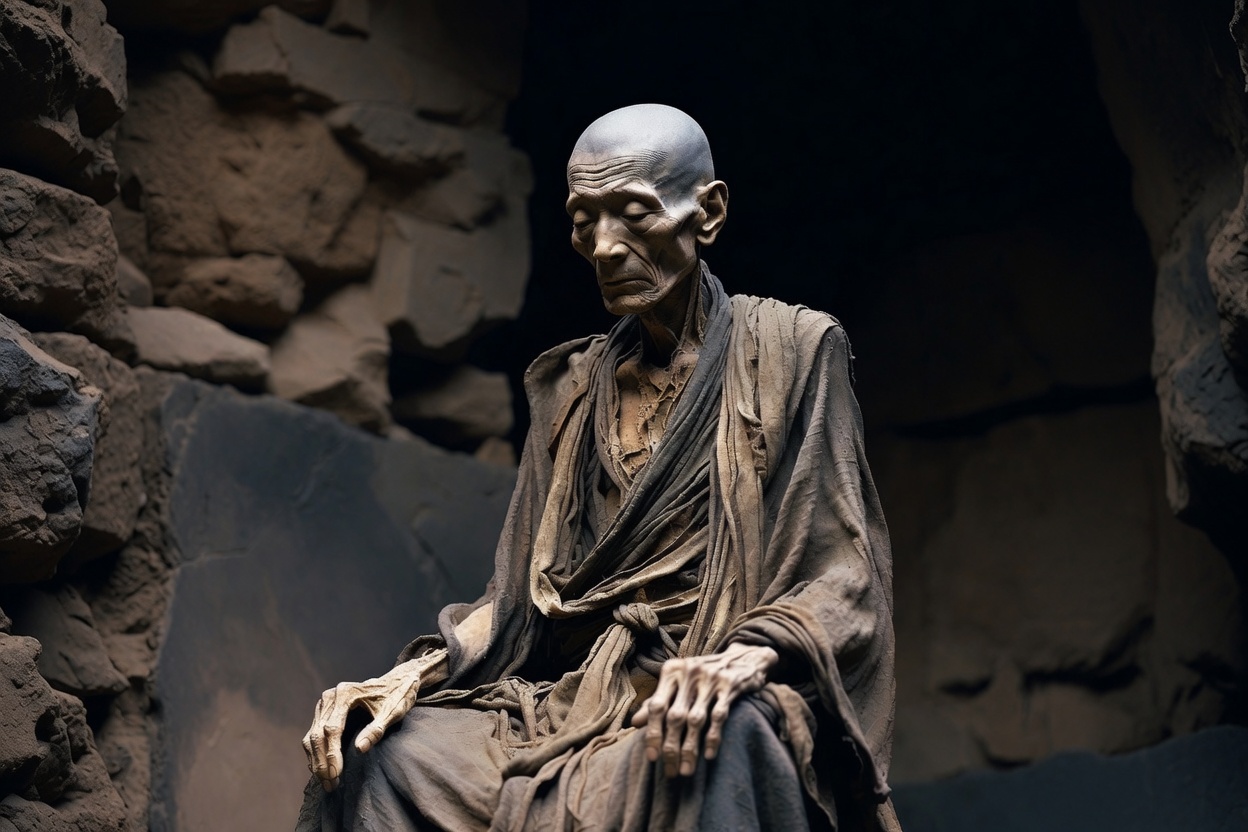
“While Egyptian pharaohs prepared for the afterlife, a small group of Japanese monks believed they could become Buddhas before they died.”
If ancient Egypt gave us the world’s most famous mummies, Japan may have given us its most astonishing ones.
Thousands of miles away from the pyramids, hidden in the mountains of northern Japan, a handful of Buddhist monks spent years—sometimes decades—doing something almost impossible.
They intentionally transformed their own bodies into mummies.
Not after death. Before it.
No royal tombs. No gold. No elaborate burial ceremonies. Just pine needles, tree bark, meditation, and a belief so profound that it pushed the limits of the human body.
Even today, centuries later, some of these monks remain seated inside quiet temples, still dressed in robes, still receiving prayers from visitors who regard them not as relics, but as living Buddhas.
It is one of Japan’s most extraordinary—and least understood—religious traditions.
The Ultimate Shortcut to Buddhahood?
Contrary to popular belief, Sokushinbutsu wasn’t about escaping death. It was about transcending it.
The practice emerged from the traditions of Shingon Buddhism and mountain asceticism, inspired by the teachings of Kūkai (Kōbō Daishi), one of Japan’s most influential Buddhist monks.
Kūkai taught that enlightenment wasn’t necessarily something reserved for another life.
With enough spiritual discipline, it could be achieved in this one.
Centuries later, some ascetic monks interpreted that idea in its most literal—and extreme—form.
Instead of waiting for reincarnation, they attempted to become Buddhas in their own bodies. It was arguably the hardest spiritual path ever attempted.
Forget Ozempic. This Was the World’s Most Extreme Diet.
Modern wellness culture has given us juice cleanses, keto, intermittent fasting, and detox teas.
The Sokushinbutsu monks would probably laugh. Their preparation lasted years.
First came mokujikigyō, literally “tree eating” which consists of pine needles, roots, seeds, tree bark, mountain nuts, wild berries.
Anything that could keep them alive while slowly stripping away body fat. Every ounce of fat mattered because fat feeds bacteria after death. The less fat remained, the better the chances the body would survive.
Drinking Poison on Purpose
Then came perhaps the most shocking part. Many monks drank tea made from the sap of the urushi tree.
Yes—the same tree whose resin is used to make traditional Japanese lacquerware. The sap is toxic. It causes vomiting, profuse sweating, and severe dehydration.
Some researchers believe it also made the body less attractive to insects after death.
Imagine willingly poisoning yourself because it might help preserve your body centuries later.
Suddenly, skipping dessert doesn’t seem so difficult.
One Tiny Chamber. One Bell. One Final Breath.
When the preparation was complete, the monk climbed into a narrow underground chamber.
There was just enough room to sit in the lotus position. A bamboo tube supplied air. Beside him rested a small bell.
Every day, he rang it and the sound told the outside world:
“I’m still meditating.”
One morning, the bell didn’t ring and the bamboo tube was removed. The chamber was sealed. For nearly three years, no one opened it.
Success Was Never Guaranteed
Here’s the part Hollywood usually leaves out. Most monks failed and nature won. Their bodies decomposed but they Even then, they were honored for their sacrifice.
But if the body remained naturally preserved, the monk was declared a Sokushinbutsu.
Not because people believed mummification itself was miraculous but because they believed the preservation reflected extraordinary spiritual attainment.
The Buddhist tradition honors all of them.
Meet the Monk Who Allegedly Gave Away His Eye
One of the best-known Sokushinbutsu is Tetsumonkai Shōnin. Temple tradition says he once donated one of his own eyes to save a sick child. Whether every detail is historically verifiable remains uncertain.
But stories like these explain why these monks continue to inspire devotion centuries later. Their legends weren’t built around supernatural powers. They were built around radical compassion. His preserved body remains enshrined today.
Japan’s Mummies Aren’t Museum Pieces
This may be the biggest cultural difference from Egypt.
Egyptian mummies belong largely to archaeology. Japanese Sokushinbutsu belong to religion. They’re still cared for, still dressed, still offered prayers, and some temples even change their robes periodically.
Visitors are expected to show respect.
Why So Many Are Found in One Place
Most surviving Sokushinbutsu are found around Dewa Sanzan, three sacred mountains in Yamagata Prefecture.
For over a thousand years, these mountains have attracted ascetic monks seeking spiritual purification. The harsh climate, isolation, and dense forests made them ideal places for meditation.
Today, temples such as Dainichibō and Chūren-ji preserve several of the surviving Sokushinbutsu.
Only about two dozen authentic examples remain in all of Japan.
Why the Tradition Ended
If the practice seems unbelievable today, that’s because it effectively disappeared more than a century ago.
During the Meiji Restoration in the late nineteenth century, Japan modernized rapidly. The government prohibited self-mummification, viewing it as incompatible with modern law and medicine.
No new Sokushinbutsu have been created since. The monks who remain are the final witnesses to a tradition that can never be repeated.
More Than a Curiosity
It’s easy to read about Sokushinbutsu and focus on the shock value but that’s not how the temples see them.
To the communities that continue caring for these monks, they are reminders of complete selflessness—a belief that compassion and enlightenment were worth sacrificing everything for.
You don’t have to agree with their methods to appreciate the depth of their conviction. After all, history is filled with monuments built from stone.
These monks chose to make one from themselves.
