

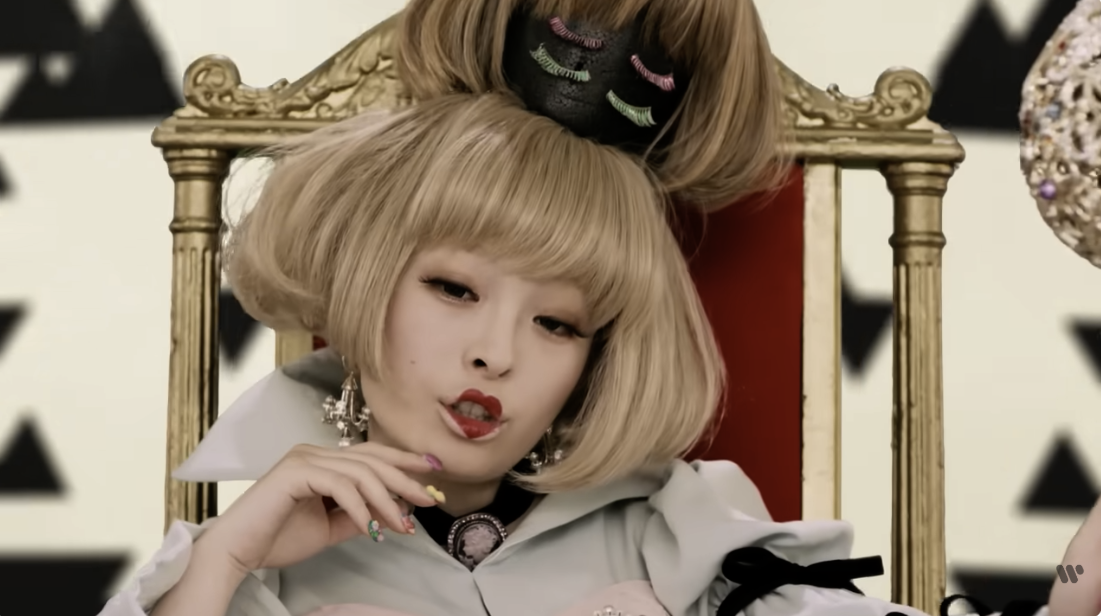
Most pop stars tell you a story through lyrics. Kyary Pamyu Pamyu tells you through what she’s wearing, how the camera is moving, and what’s happening in the background while you’re not looking directly at it. She’s Japan’s reigning Kawaii Queen, and her latest visual drop — the official music video for “KURU KURU HARAJUKU,” uploaded to YouTube on July 24, 2026 — is a reminder of exactly why that title still belongs to her.
The video arrived more than a year after the song itself first landed as a digital single on July 18, 2025, written, composed, and produced by her longtime collaborator Yasutaka Nakata. That gap between audio and visual isn’t a scheduling accident — it’s a structural fact of how Kyary works now. The song can exist as pure sound for a year, but the story isn’t finished until the visual half arrives. Fans clearly agree: the video has already pulled in well over 300,000 views.
That’s the whole thesis of Kyary as an artist. The music is only ever half the delivery system. The other half is costume design, set-building, and a camera that treats her like a walking diorama — and that other half is arguably the reason she became an international name in the first place, long before most Western listeners could understand a word of Japanese.
Who Is Kyary Pamyu Pamyu?
Born Kiriko Takemura on January 29, 1993, in Tokyo, Kyary Pamyu Pamyu is a Japanese singer, model, and television personality who built her name at the center of Harajuku, the Tokyo neighborhood where Japan’s most extreme, most experimental street fashion gets tested in public. That’s not incidental biography — it’s the foundation of everything she does visually. Nearly all of her music has been produced by Yasutaka Nakata, the electronic musician behind the duo Capsule and longtime producer for Perfume, but it’s Kyary herself who has always driven the visual language layered on top of his production.
She’s released five full-length studio albums — Pamyu Pamyu Revolution (2012), Nanda Collection (2013), Pika Pika Fantajin (2014), Japamyu (2018), and Candy Racer (2021) — and while most of her commercial success has been concentrated in Asia, she built a real foothold in Western markets too, largely because her videos traveled on their visuals alone, no translation required. Media outlets have nicknamed her a “Fashion Monster,” and she’s been shot for magazines like Dazed & Confused — coverage that treats her as a fashion figure first and a musician second, which is exactly how she’d probably want it read.


Artistic Identity: A Costume Department Doubling as a Narrative Engine
Kyary doesn’t wear an outfit so much as cast it in a role. Her videos function like miniature films where wardrobe carries plot: a coat built entirely out of teddy bears, a fishnet look topped with a shark headdress, a candy-colored world that curdles just slightly into something uncanny if you look a beat too long. The tension is deliberate — sweetness pushed exactly far enough that it turns strange, a style sometimes called kimokawaii, or “creepy-cute.”
Cinematography is doing just as much work as costume. Her videos favor dense, maximalist frames — every inch of the shot filled with something moving, blinking, or spinning — paired with editing so quick you have to rewatch to catch everything the first pass missed. That’s not decoration; it’s storytelling density. A single scene of Kyary surrounded by marching eyeballs or wallpaper made of faces tells you more about her artistic world in four seconds than a verse of lyrics could.
She’s been described as Japan’s answer to Lady Gaga for exactly this reason: both treat the visual package — not just the song — as the primary art object. The difference is which direction they push the strangeness. Gaga tilts grotesque. Kyary tilts cute, then makes you question why “cute” ever felt safe in the first place.
How She Began — and Her Breakthrough
Before she was a recording artist, Kyary was a model and blogger, photographing her own Harajuku street style and building an audience purely on visual instinct — no music involved yet. That eye for image is what got her scouted, and it’s why her debut single, “PonPonPon” (2011), landed as a fully-formed visual statement rather than a typical pop introduction.
“PONPONPON” wasn’t just a hit — it was a demonstration of everything she’d go on to build a career around. The video’s sensory-overload visuals — exploding food, spinning eyeballs, rooms wallpapered in faces — turned into an early viral phenomenon well before “going viral” was a predictable strategy for a Japanese pop act. It introduced Western audiences to a flavor of J-pop surrealism they hadn’t seen packaged this way before, and it set the template she still works from: a simple, catchy song wrapped in a visual world so dense it rewards rewatching.
The Kawaii Legacy — and the Reinvention
This is the part of her career that outlasts any single release cycle, and it’s worth sitting with directly.
Kyary didn’t invent kawaii culture — Harajuku’s cute-and-strange aesthetic predates her by decades. But she’s arguably the person most responsible for exporting a specific, weirder version of it to a global audience, almost entirely through visual language rather than music alone. Before Kyary, kawaii as most Western viewers understood it meant Hello Kitty-style softness. Her videos introduced the idea that kawaii could also be uncanny, even a little disturbing, and that idea has rippled outward into fashion, music video direction, and internet aesthetics well beyond Japan — a whole generation of artists and stylists now think of “cute” as a mode you can bend rather than a fixed look, and a lot of that shift traces back to her camera.
The reinvention is the other half of the legacy, and it plays out visually too. She’s moved from major-label ingenue on Warner Music Japan to fully independent artist running her own label, KRK Lab. She’s gone from arena-scale visual spectacle to a stripped-down, cinematic solo show about miscarriage and motherhood — the “dreamin dreamin” concert, staged October 25, 2025, at LINE CUBE SHIBUYA, her first live show since giving birth to her first child. The concert reused the visual grammar of her earliest performances on purpose: she opened emerging through a heart-covered door in a negligee-style outfit, walking toward a bed set piece deliberately staged to echo her debut-era shows. The song itself, a cover of CAPSULE’s 2006 track “dreamin dreamin” that she personally asked producer Yasutaka Nakata to let her record, became the emotional through-line of a set built entirely around the “happy dreams” and “sad dreams” of a pregnancy that included being told, then un-told, that she had miscarried.
Very few pop stars let you watch the visual persona flex that dramatically — from teddy-bear coats to a bed and a negligee — while the underlying artistic identity stays completely recognizable. That’s the reinvention Kyary fans keep coming back for: not a new sound each era, but a new way of telling the story on camera.
What She’s Good For
Kyary Pamyu Pamyu’s catalog isn’t one-mood material, and that’s the point. Her early, high-BPM, visually maximalist work — “PONPONPON,” “Fashion Monster,” “Candy Candy,” now joined by the newly released “KURU KURU HARAJUKU” video — is built for movement: dancing, getting ready to go out, or just wanting a jolt of chaotic color on a commute. It’s dense enough visually to reward full attention, which makes it just as good for genuine cultural immersion — a few minutes of pure Harajuku maximalism without leaving your apartment.
The newer, quieter material, especially “dreamin dreamin,” is a different use case: it’s for anyone interested in how a visual storyteller narrates something as private as a pregnancy scare without losing the aesthetic language that built her career. Put simply — reach for classic Kyary when you want color, chaos, and a set that looks like nothing else on the internet. Reach for 2025-2026 Kyary when you want proof that the person behind the costumes has a story worth watching unfold in real, cinematic detail.
