

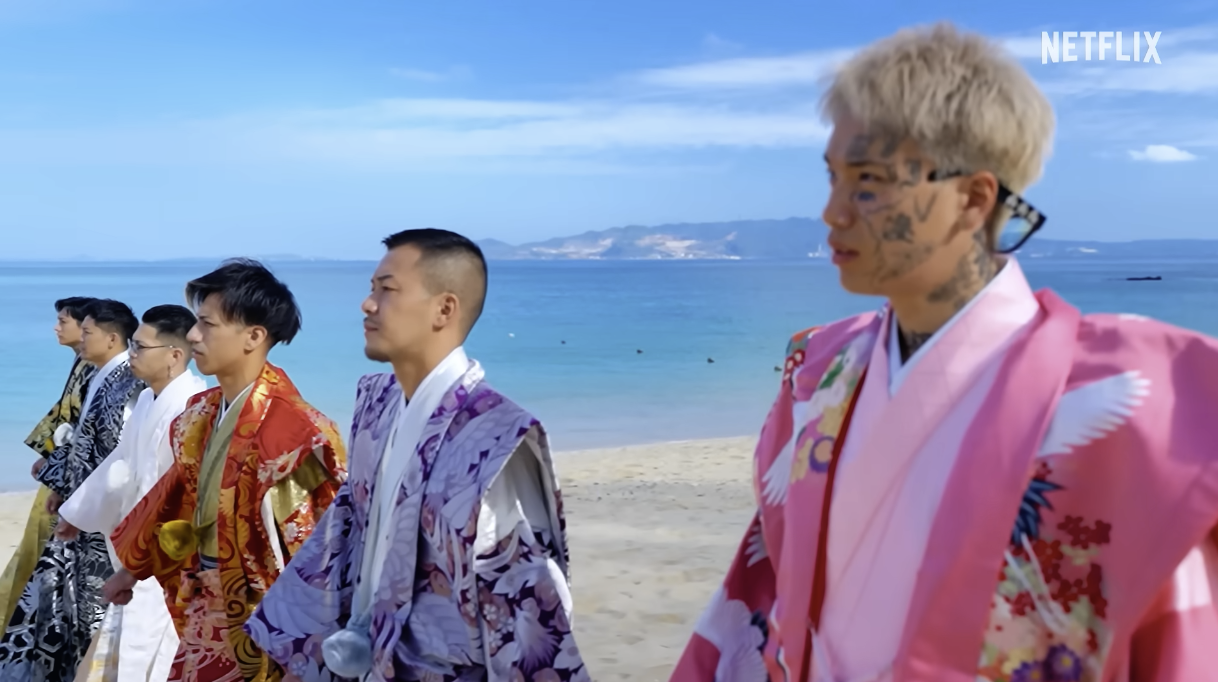
There’s a special kind of government meeting that ends with someone saying “let’s put the guy with no pinky on the poster,” and somehow that meeting happened. Earlier this month, Japan’s Ministry of Justice — the actual national body that oversees probation and prisoner reintegration — decided the best way to humanize its rehabilitation program was to co-brand with Badly in Love, Netflix’s runaway hit dating show where reformed yakuza, ex-motorcycle-gang members, and former juvenile delinquents live together and try to fall in love. The ministry printed roughly 2,000 posters. It hung them in probation offices nationwide. And then, seventeen days later, it quietly took them all back down.
The Pitch Made Sense on Paper
Badly in Love — Japanese title Love Joto, or “Love, Bring It On” — is built entirely on the premise that people society already wrote off deserve a second look. Season 1 dropped in December 2025 and did something no unscripted Japanese show had ever done: it held the No. 1 spot on Netflix Japan’s Weekly Top 10 for four straight weeks, stayed in South Korea’s Top 10 for four weeks, and cracked the Global Top 10 for non-English series for three weeks running. By the time Season 2 rolled out this summer — relocated to a beachside “Marine Academy” in Okinawa — the show had already picked up the Grand Prize for Best Reality & Variety at the 2026 Global OTT Awards in Busan, and its second season debuted as the No. 1 program in Japan.
The Justice Ministry’s rehabilitation bureau looked at all that and saw an opportunity: a hit show whose entire emotional engine is “people can change,” fronted by cast members who used to be exactly the population the ministry spends its budget trying to reintegrate. Tie your redemption arc to their redemption arc. Free marketing, built-in empathy, zero cynicism required.
The ‘Yankii Culture’
For anyone outside Japan, “yankii” needs a quick decoder. It’s the country’s homegrown delinquent-youth subculture — bleached pompadours, altered school uniforms, souped-up motorcycles, turf loyalty, and a general middle finger to the salaryman conformity track — that emerged out of working-class Japan in the ’70s and ’80s and never really left. What makes it useful shorthand rather than just “troubled teen” is the built-in contradiction: yankii have been romanticized in manga and anime for decades as tragic antiheroes with rough exteriors and loyal hearts, the same way American pop culture mythologizes the greaser or the biker with a heart of gold. But being an actual yankii in real Japan — especially at the end of the spectrum that overlaps with yakuza and bosozoku biker-gang culture — has historically meant real stigma, employment discrimination, and, for some, an actual arrest record. Fiction loves the yankii. Daily life still crosses the street.


Then a Contestant Talked About Arson
The collapse point was specific and ugly. In a Season 2 episode, one cast member described being arrested as a teenager for setting someone on fire — not accidentally, but to prove he wasn’t “chickening out”. That single confession, playing on a platform the government had just put its name on, was the exact moment the campaign stopped being a redemption story and started looking like the state cosigning a highlight reel of other people’s worst nights.
The backlash on Japanese social media was immediate and pointed, with critics accusing the ministry of using taxpayer money to run promotional material for what one recurring complaint called a “crime-bragging show,” and the outrage escalated into a full pile-on. Domestic press coverage zeroed in on the specific visual that had made rounds before the arson clip even aired: a poster showing fully tattooed former delinquents, missing fingers included, under taglines translating roughly to “Rehabilitation, bring it on” imagery that generated accusations the campaign was glamorizing crime and mocking its victims. MEGUMI, the show’s actress-producer, issued her own public apology in mid-August acknowledging the hurt caused before the ministry made anything official.
On August 21, the ministry made it official. Officials said the contestant’s comments read as an endorsement of criminal behavior, which cut against the entire point of the tie-up — building public understanding of rehabilitation, and confirmed that crime victims had specifically told the ministry the campaign left them feeling uncomfortable. The ministry’s own statement threaded the needle carefully — insisting rehabilitation work has never meant excusing what someone did, while stressing that both protecting victims’ dignity and supporting people trying to rebuild their lives matter to a safe society. <cite index=”11-1″>It added that concerns had also come in from the private volunteers who’ve long supported the rehabilitation system, whose worries the ministry said it was taking seriously alongside everything else.
Two Very Different Audiences, Watching Two Very Different Shows
Here’s where it gets genuinely interesting: outside Japan, almost none of this registered as a scandal — because Western audiences and critics were never watching the ministry campaign at all. They were watching the show, full stop, and reviewing it as a reality-TV curiosity rather than a national institution’s messaging problem.
American critics landed almost uniformly on the same comparison. Decider’s review flagged the show’s built-in tension the moment cast members’ “real baggage” met the genre’s usual dating-show mechanics, calling it a setup for genuinely explosive television. Common Sense Media rated it a serviceable if unoriginal entry in the dating-show genre, useful mainly for genre fans rather than anyone looking for something new. One recurring framing, repeated across outlets, nicknamed it Japan’s answer to Jersey Shore — a maligned-subculture show daring viewers to actually look at the people in it instead of past them. Notably, even The Japan Times’ own critic, reviewing the show itself rather than the ministry fallout, called its sincerity the biggest surprise of the whole format.
That gap is the real story. In the U.S., South Korea, Taiwan, and Hong Kong, Badly in Love is consumed as anthropology with a wink — a look inside a subculture (yankii) that’s mostly legible to outsiders through manga and music, filtered through a reality-format that Western audiences already have decades of vocabulary for. Nobody watching from Los Angeles or Seoul had a government poster campaign to be offended by; they had a Tuesday-night streaming pick.
In Japan, the same show sits inside an entirely different set of stakes. Yankii culture is, per domestic press coverage of the poster fallout, simultaneously romanticized in fiction and treated with real suspicion in daily life — nostalgically celebrated in music and manga, quietly avoided on the street. That contradiction is exactly what made the ministry’s gamble so combustible: pairing state authority with a show trading on outlaw glamour asked the Japanese public to accept, officially, a version of “cool” that plenty of citizens still associate with actual victims and actual harm. A streaming hit can hold irony and vulnerability in the same breath. A national ministry, it turns out, cannot.
Show: Badly in Love (Love Joto) — Season 1 & 2 Created by: MEGUMI Cast/Hosts: MEGUMI, AK-69, Nagano Streaming: Netflix (Season 1: December 9, 2025; Season 2: August 4, 2026)
