

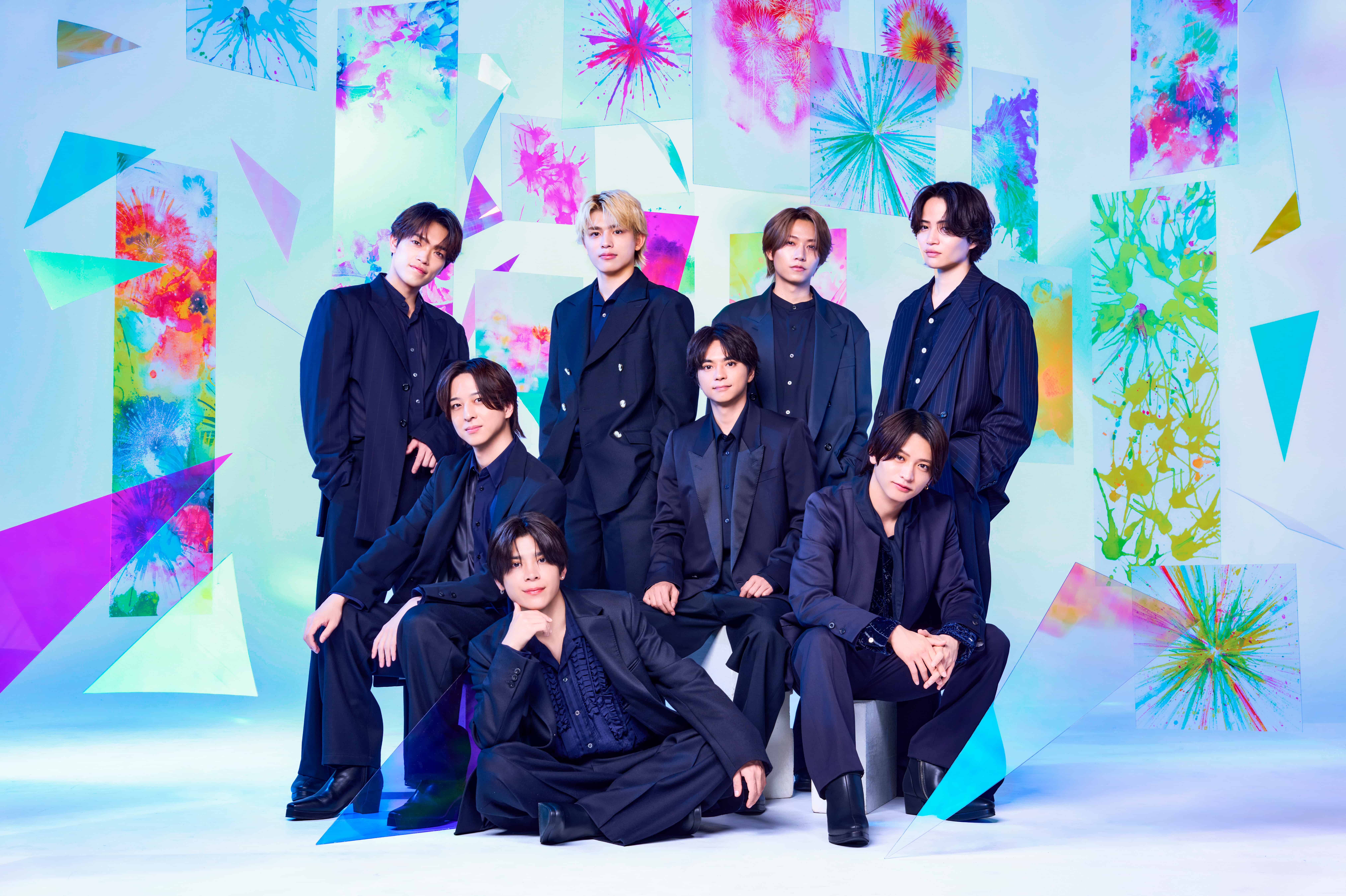
timelesz did not arrive as a finished product. That is the first thing worth knowing.
The eight-member STARTO ENTERTAINMENT group now pushing MOMENTUM onto YouTube Music, Spotify, Apple Music and the rest of the global platforms is the result of a public rebuild. Three original members — Shori Sato, Fuma Kikuchi and So Matsushima — kept the line going after Sexy Zone lost Marius Yo in 2022 and Kento Nakajima in 2024. They changed the name in April 2024.
Then they did something almost no established J-pop act of their generation has done: they opened the door on camera. Netflix’s timelesz project -AUDITION- drew nearly 19,000 applicants and, in February 2025, added Takuto Teranishi, Yoshitaka Hara, Masaki Hashimoto, Shuto Inomata and Taiki Shinozuka. The lowercase t is intentional. So is the premise. The group is not pretending the past never happened. It is arguing that past, present and future can sit in the same room.
A Classic J-Pop Core With Room to Move
MOMENTUM, the second studio album under the eight-man lineup, is built around a classic J-pop spine: bright choruses, clean hooks, songs written to be sung back. Officially it is described as 17 catchy tracks that fold other genres around that core. The record makes that claim without turning into a genre tour.
Lead track “GOOD TOGETHER” is the clearest statement. It is a forward-facing pop song with a disco pulse — the kind of track that treats togetherness as motion, not a pose. Last year’s FAM lead, “ONE AND ONLY,” was about new bonds taking shape. This one assumes those bonds already exist and asks what you do with them. The official video leans into that idea: color, party staging, a compact dance phrase fans quickly named the “gugugu” move. It looks simple. The timing is not. That combination — easy to copy, hard to fake — is how a J-pop hook travels on social media without losing the group’s own shape.
The rest of the album refuses to stay in one lane. “Yonpunkan dake Jikan wo Kudasai” (“Just Give Me Four Minutes”) opens on a lone guitar and swells into a pop-rock anthem aimed at the people who stayed. Live reports from the MOMENTUM arena tour treat it as a room-lifter, the song that turns gratitude into volume. “Believers,” the theme for Yoshitaka Hara’s drama Yokohama Neighbors Season 2, sits closer to television-ready midtempo pop. “Akubi,” the bonus track built around rest, is the opposite of a showpiece: eight voices easing off the accelerator.
Then there is “Kienai Hanabi” (“Timeless Fireworks”), released alongside the album’s global rollout. It is the current lineup’s first pop ballad single, written as the theme for the animated film Kimi to Hanabi to Yakusoku to, in which Sato takes his first starring voice role. The song works the contradiction in its title — a firework that vanishes, a memory that does not.
The unit cuts are the album’s most revealing experiment. They come from the groupings in the Netflix sequel timelesz project -REAL-. So Matsushima, Masaki Hashimoto and Shuto Inomata take “No Map Just Vibes.” Sato, Hara and Taiki Shinozuka take “We’re on the Top,” with a lower, harder edge. Kikuchi and Teranishi take “half & half,” a track they also helped shape. First unit songs are usually a catalog footnote. Here they function as proof that the eight men are no longer one undifferentiated block. The record can split without falling apart.


Photos: Starto Entertainment
The Visibility and Transparency
Most J-pop idol groups are assembled before the public is invited in. Training stays backstage. Chemistry is implied. timelesz inverted that. Viewers watched the three veterans look for partners, watched actors from STARTO’s acting division stand next to civilian applicants, and watched the final five get chosen in real time. Teranishi and Hara arrived with years of stage work and no group to call home. Hashimoto, Inomata and Shinozuka arrived from outside the usual junior pipeline. That mix — veterans, late-blooming actors, open-call winners — is still unusual inside the STARTO system, where debuting after a long junior period is the default.
The music follows the same logic. timelesz does not chase the high-concept, high-pressure performance model associated with K-pop, and it does not stay inside the older Johnny’s template of fixed roles and sealed process. The songs stay singable. The live show, at least on the MOMENTUM tour, treats the audience as part of the party rather than a gallery. Kikuchi directed the concert staging. That detail is easy to skip. It should not be. A member shaping the show is a different claim than a group executing someone else’s concept.
There is also the matter of time. The name itself is a thesis: nothing in their story is disposable. FAM was the album about becoming a family. MOMENTUM is the album about leaving the house. Kikuchi spelled that out when the title was announced — momentum as speed, and “moment” as the thing you refuse to waste. Eight letters for eight members. A little neat. Also accurate. This is the first album they built from the ground up as an eight.
How the Latest Release Is Landing
The domestic verdict arrived before the worldwide streaming date. MOMENTUM opened at No. 1 on Oricon and Billboard Japan’s album charts and was certified platinum. The supporting arena tour, We’re timelesz LIVE TOUR 2026 episode 2 MOMENTUM, closed at the end of August after eight cities and 28 performances. A live video package is due in November. Those are not novelty numbers. They are the numbers of a group that has already converted a reality-show spike into ticket sales.
The songs are doing their own work. “GOOD TOGETHER” has several million views on the official YouTube cut; the dance phrase keeps circulating because it is specific enough to recognize and light enough to try. Tour coverage in Japan has focused less on spectacle and more on tightness — the speed at which eight people who did not grow up in the same trainee class now look like one unit. Real Sound’s report from Yokohama Arena put it bluntly: this is where their real value starts to show. The unit tracks, which could have felt like homework from a docuseries, are being read onstage as evidence of range.
The global release on August 31 is a second test. Netflix already did the introductions. AUDITION made the names familiar outside Japan; REAL showed the work after the applause. Streaming the full 17-track MOMENTUM, plus “Kienai Hanabi,” is the first time international listeners can hear the argument without the edit. The argument is simple. Classic J-pop still works when the hooks are sharp. It works better when the group singing them has a documented reason to be together.
timelesz is moving as a group that chose to start again in public, then spent a year proving the choice. MOMENTUM is that year set to melody: disco-bright on the surface, heavier underneath, and finally available wherever the rest of the world actually listens.
