

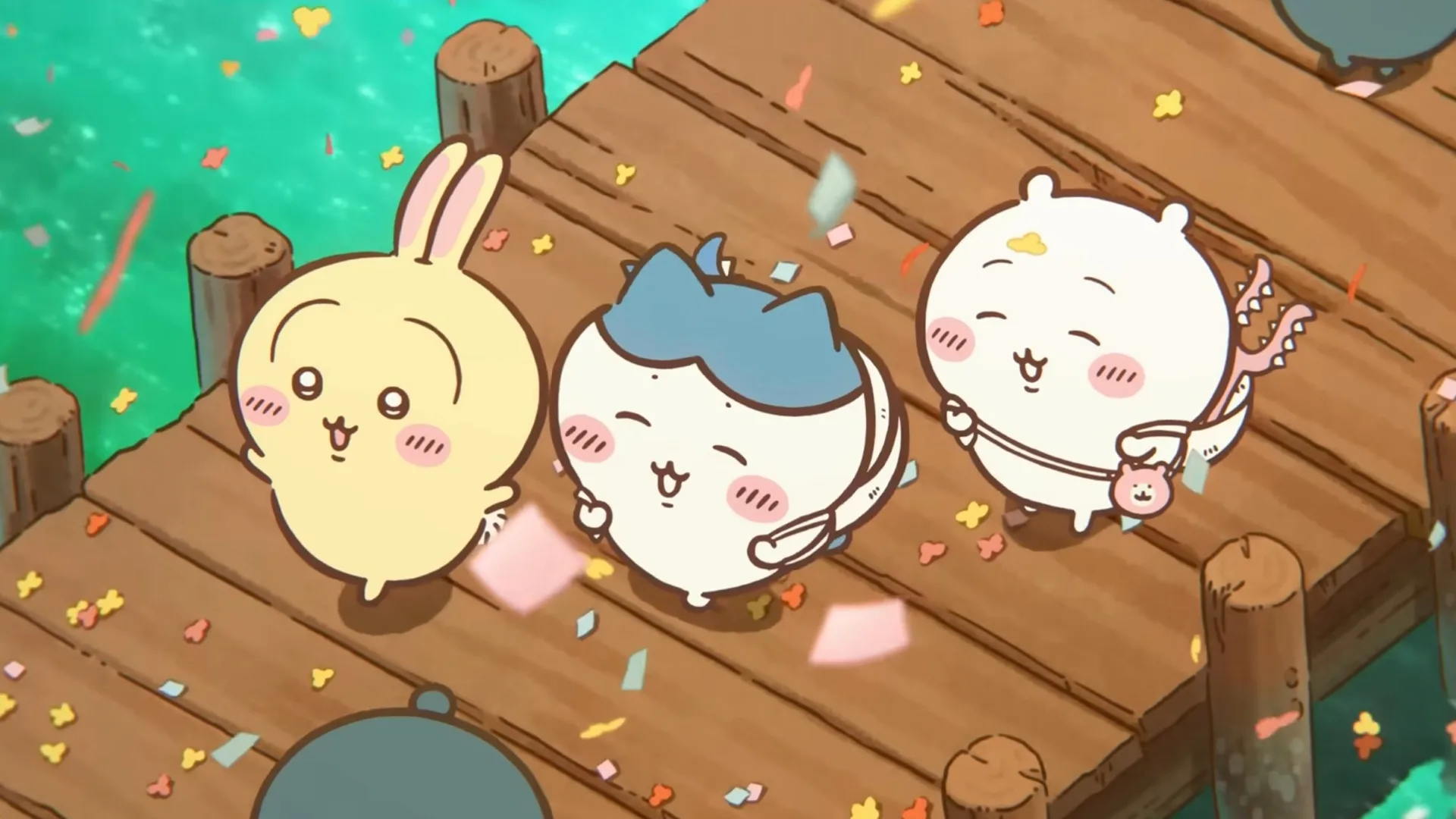
It’s hard to walk around Japan without coming across the cuddly characters of Chiikawa. They dangle from handbags, fill arcade claw machines, and smile from Uniqlo T-shirts. In the Reiwa years they have become one of the country’s most recognizable kawaii properties, the kind of face that shows up on convenience-store onigiri, temple charms, and morning television without anyone needing an explanation.
That ubiquity made the first feature film feel inevitable. Chiikawa the Movie: The Secret of Mermaid Island opened on July 24 and earned ¥990 million ($6.05 million) on its first day — the seventh-biggest opening day in Japanese box-office history — then ¥2.24 billion ($13.7 million) by the end of the weekend. A month later it had passed ¥11 billion ($69 million) and drawn more than 7.6 million viewers, putting a Twitter-born trio of small animals among the year’s top Japanese films. What many viewers did not expect from a summer cartoon was a story closer to Dostoevsky than Hello Kitty. Social media called it a horror movie. They were not entirely wrong.
From a Wish to a National Character
The character did not begin as a corporate mascot. In May 2017, the illustrator Nagano posted a sketch on Twitter with a simple wish: she wanted to live as something small and cute, a creature that could cry when scolded, run away, sleep, and dance. The Japanese phrase nanka chiisakute kawaii yatsu — “some kind of small and cute thing” — was later shortened by readers into Chiikawa. The first drawing was not a pitch. It was a fantasy of escape from adult life.
Nagano was already a working name in a crowded field. Born in 1988, she built her career on LINE Creators Market stickers — Joke Bear, Pagu-san, Burikko Usagi — and repeatedly topped the platform’s rankings. By the time Chiikawa appeared she had hundreds of thousands of followers. The dedicated Chiikawa account launched in January 2020, just as the pandemic locked people indoors. Daily one-page strips, not a traditional serialized chapter, did the work. Kodansha collected the comics in 2021. A short anime slot on Fuji TV’s Mezamashi Terebi began in April 2022. The Japan Character Awards gave Chiikawa the grand prize three years running. Official X followers now sit above 5 million. Manga circulation, print and digital, has passed 4.6 million copies.
The merchandising machine followed the same path as the drawings: small, constant, everywhere. Spiralcute handles licensing. Chiikawa Market crashed on launch from traffic. McDonald’s, 7-Eleven, Kura Sushi, incense makers, railway companies, and Uniqlo all used the faces. In China, official pop-ups with Miniso drew lines so long police intervened; one Shanghai store reported more than 8 million yuan ($1.1 million) in three days. The point is not that Chiikawa is cute. Plenty of properties are cute. The point is that a single-artist social feed became, in six years, an IP that can open a film like a Detective Conan sequel.


The World Behind the Plush
The trio is easy to sell as toys and harder to summarize as fiction. Chiikawa is a white, hamster-like figure who barely speaks — “wa,” “ya,” tears. Early on Nagano considered the name Nitori. Hachiware, once Ikeya, has the split-face marking of a bicolor cat and does most of the talking. Usagi, once Donki, is a yellow rabbit who shouts “ura” and “yaha.” They live in a fantasy that still runs on wages. They pull weeds, sit certification exams, hunt monsters for armored overseers called Yoroi-san, and spend the money on food. Hachiware lives in a cave because a house is out of reach. Chiikawa won a house in a yogurt lottery.
That mix is the franchise’s real invention. The drawings look like stickers. The plots treat cuteness as a thin covering over labor, luck, and fear. Nagano has said she is drawn to the ruthlessness of living things — a female praying mantis eating the male — and that she wants to draw creature-like mercilessness more than a message. The result is not grimdark. It is a world where a character can dance after dinner and, in the next strip, fail a test or watch a friend turn to stone.
Longtime readers already knew the Siren arc. The movie adapts that long-form story: an invitation to a special island, free food, a camp that is not what it claims to be. Under the pastel surface sit revenge, murder, guilt, and the question of whether a past can be outrun. There is an off-screen killing rendered as shadow and repeated blows. There is no neat moral reset of the kind family films usually offer. Patrick St. Michel compared it to Crime and Punishment. Horror reviewers called it a mystery that leaves a bad aftertaste. Children left some screenings in tears. Adults who only knew the plush were stunned. Readers of the original strips were not.
Why the Darkness Holds
Chiikawa’s scale is easy to measure in yen and followers. The harder fact is why a property this commercially total still refuses the Hello Kitty bargain — sweetness without consequence. Nagano’s earlier work already treated cute animals as caricature, closer to a newspaper cartoon than a brand mascot. Chiikawa kept that habit after it became a brand. The film did not invent the darkness. It simply gave the Siren story a ninety-nine-minute runtime, a Toho release, and IMAX seats, then let a mass audience meet a tone the daily strips had been training for years.
That is the Reiwa character story in compact form. The old model was a company inventing a face and flooding shops. Chiikawa came from a wish posted on a personal account, survived the LINE sticker lottery, and only then met a licensor. Frequency did as much as design: almost daily posts for years, short anime in the morning, goods that are cheap enough to buy again. The movie’s box office is the latest proof that the audience will follow the characters into material that is not safe. An ¥11 billion ($69 million) opening month for a film about guilt and eternal punishment, sold with the same faces that hang from commuter bags, is not a contradiction in this franchise. It is the method.
The small creatures were never only decoration. They were a way to draw how it feels to be fragile in a system that still asks you to work, pass tests, and keep smiling. The movie made that visible at theatrical scale. The plush on the bag and the story in the dark theater are the same invention. One is easier to hold. The other is why people keep buying the first.
