

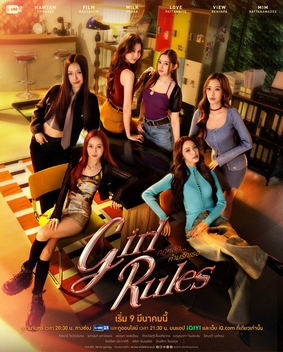
Girl Rules is pulling millions of views and dominating streaming platforms—but across Asia, it remains something audiences watch quietly, not publicly. From the Middle East to South Asia and China, cultural norms, religion, and regulation shape where GL can exist. The result is a powerful but private entertainment ecosystem that’s growing faster than acceptance itself.
Girl Rules (Thai: กฎหลัก…ห้ามรักเธอ / Kot Lak… Ham Rak Thoe, lit. “The Main Rule… Don’t Love Her”; Chinese title 女生規則:禁愛遊戲) is a 2026 Thai girls’ love (GL) ensemble drama produced by GMMTV in partnership with Moongdoo Studio.
It premiered on March 9, 2026, airing weekly on GMM25, iQIYI (uncut version), and GMMTV’s YouTube channel. Directed by Tichakorn Phukhaotong, the 12-episode series follows six young women—Prim (Namtan Tipnaree Weerawatnodom), her ex Bambi (Film Rachanun Mahawan), Min (View Benyapa Jeenprasom), and their circle including Milk Pansa Vosbein, Love Pattranite Limpatiyakorn, and Mim Rattanawadee Wongthong—whose friendships, careers at an ad agency, and romantic entanglements spiral into chaos when an ex-girlfriend returns for a major campaign.
What is Girl Rules about?
The story is built around “rules” in business and love that inevitably get broken, delivering messy, interconnected queer relationships, workplace drama, and sapphic web-of-connections energy.
How big of a success is it?
As of early April 2026 (roughly one month and several episodes in), Girl Rules is riding high on buzz rather than record-smashing domestic Thai ratings. It quickly became one of iQIYI’s “Top 1 Soaring Dramas,” with strong international streaming traction and viral social-media clips (especially NamtanFilm and MilkLove moments).
IMDb currently sits at a very solid 9.1/10 (from early voter sample), and fan communities on Reddit’s r/ThaiGL and X are highly active, calling it one of the year’s most anticipated and discussed GL releases.
It hasn’t dominated free-to-air Thai TV the way some prime-time hits do, but among the global GL audience (including huge fanbases in Taiwan, Southeast Asia, and beyond), it’s a major event. Pre-release hype already placed it high in fan surveys, and early episodes are pulling in millions of views per upload. Production values are noticeably glossy—vibrant visuals, stylish ad-shoot settings, and believable chemistry from proven pairings—which helps it stand out in a crowded 2026 GL slate.
Success here is more “cultural phenomenon among queer Asian media fans” than “national ratings monster,” but that’s typical for many GMMTV GLs aimed at streaming-first international viewers.
Why it resonates
The show taps into universal (yet very queer) themes: the chaos of chosen family, the blurred lines between friendship and romance, workplace power dynamics, and the messy reality of exes re-entering your life. Reviewers describe it as “the hottest, messiest, most toxic friend group of lesbians” in recent memory—relatable for anyone who’s navigated overlapping social circles where everyone has dated everyone.
It feels mature and adult compared with some sweeter high-school/college GLs: the characters are working professionals with careers on the line, not just teenagers figuring things out. The “rules” motif (don’t mix business and love, don’t fall for your ex, etc.) adds delicious tension, while the ensemble format lets multiple storylines breathe. Fans love the high-gloss aesthetic and the way it normalizes complex, flawed queer women without sanitizing their desires or conflicts.
In short, it scratches the itch for drama—the fun, addictive, “I can’t believe she did that” kind—while still centering authentic sapphic emotional lives.Is it a cross between
The L Word and Gossip Girl?
Yes—almost exactly. Critics and fans repeatedly call it “the Thai answer to The L Word” because of the tight-knit circle of queer women whose lives and beds are hopelessly intertwined (think Alice’s infamous relationship chart, but set in a Bangkok ad agency).
At the same time, the glossy production, wealthy/creative-class characters, backstabbing campaigns, secrets, and stylish betrayals scream Gossip Girl—the same heightened, soapy energy that made Leighton Meester and Blake Lively’s era so addictive, only with an all-female, all-GL cast. It’s The L Word’s ensemble sapphic messiness meets Gossip Girl’s glamorous, cutthroat young-adult drama. The advertising-shoot setting even gives it that “fashion-industry intrigue” flavor.
Popularity of “Y-Series” In Asia
Girl Rules is a perfect snapshot of Thailand’s current TV golden era for GL content. After years of BL dominance, Thai networks (especially GMMTV) are heavily investing in high-budget GL series—Girl Rules reunites proven pairings like MilkLove and NamtanFilm while adding fresh ones, showing confidence in the genre’s commercial viability. This reflects broader shifts: the Thai government has actively promoted “Y-Series” (BL and GL) as a key pillar of soft power and the creative economy, with projections showing massive market growth.
The challenge with measuring a show like Girl Rules is that traditional TV ratings don’t fully capture its reach.
On free-to-air Thai television (GMM25), GL and BL series rarely dominate the way primetime lakorns do. Mainstream Thai dramas—especially family-oriented or melodrama-heavy shows—can pull 3%–6% national ratings, with major hits occasionally pushing higher.
By comparison, most Y-series (both BL and GL) typically land in the 0.3%–1.5% range on linear TV.
Its broadcast ratings are modest by traditional standards, but that metric is increasingly irrelevant for this genre.
The real performance shows up elsewhere:
- iQIYI rankings: Top 1 “Soaring Drama” within weeks of release
- Streaming traction: Episodes pulling millions of views per upload globally
- IMDb: ~9.1/10 from early audiences
- Social media: Viral clips dominating X, TikTok, and Reddit communities
To put that into context:
A top-performing Y-series is considered successful if it trends internationally and sustains streaming engagement.
A mainstream Thai hit is judged primarily by domestic ratings and advertiser pull.
Those are two entirely different ecosystems.
What Girl Rules is doing—strong cross-border streaming, high engagement, and fandom-driven virality—places it firmly in the top tier of Y-series success, even if it doesn’t look like a traditional ratings powerhouse.
This is the same model that allowed earlier Thai BL and GL hits to scale globally despite modest domestic ratings. The metric isn’t “How many people watched it on TV?” It’s “How many people are talking about it across borders?”
Will GL Ever Go Fully Mainstream in Asia?
Girl Rules exemplifies the accelerating regional boom in GL content while illustrating the limits of industrial momentum alone.
The further you move across Asia, the more visible the structural boundaries become.
In much of the Middle East, GL—and queer media more broadly—are functionally inaccessible at the institutional level such as Broadcast.
That answers the question of endorsement. It’s not on the table.
But access is a different story. Streaming opens it for other things:
- VPN usage is widespread
- Global platforms still reach users, even if partially filtered
- Social media clips circulate in fragmented ways
This is a shadow audience.
South Asia: Scale Without Alignment
The region is massive—India alone represents one of the largest entertainment markets in the world—but cultural alignment with GL remains uneven.
Across countries like:
- Pakistan, Bangladesh, Maldives → predominantly Muslim societies with conservative public norms
- India, Nepal, Sri Lanka → more varied, with pockets of liberalization alongside traditional structures
The pattern is consistent:
- Digital consumption is rising rapidly
- Public endorsement lags behind
- Local production of queer content exists—but remains niche
India is the most notable outlier. Legal progress (such as the decriminalization of homosexuality in 2018) has opened creative space, and platforms like Netflix and Amazon Prime have begun hosting queer narratives.
But even there, GL is not yet a dominant genre. It remains:
- urban
- platform-driven
- audience-specific
In the rest of the region, GL is even more clearly positioned as private consumption rather than shared cultural experience.
China: Regulation Over Demand
China complicates the picture further.
Demand for BL and GL content has historically been enormous—arguably one of the largest in the world but policy has reshaped the landscape.
BL adaptations have been restricted or heavily censored and queer themes are often removed, coded, or restructured. Platforms also operate under strict content guidelines
This creates a split system:
- Domestic production → regulated, sanitized
- Imported/online content → accessed through indirect or informal channels
Even the “Open” Markets Have Limits
South Korea and Japan are often grouped as more liberal entertainment markets.
But even there, the ceiling is visible. BL has gained traction—but remains largely genre-specific, not fully mainstream. GL is even less developed commercially
Success for these themes rests on web dramas, niche streaming content, and projects aimed at younger, digital-native audiences.
So even in markets with advanced media industries, queer storytelling still operates adjacent to the mainstream, not at its center.
The Common Thread: Private, Personal Consumption
Across all these regions—whether restrictive, transitional, or relatively open—the same behavioral pattern keeps emerging:
GL and BLS are consumed privately on phones, laptops, and personal streaming accounts.
It tells you what role this content plays in people’s lives. It’s not always a collective cultural event. It’s often:
- an escape
- a form of identification
- a space to explore emotions and identities that may not be openly discussed
Why Culture Moves Slower Than Content
There’s a reason this gap persists, and it’s well-documented.
Research across media and cultural studies has consistently shown:
- Entertainment both reflects and reinforces social norms (Stuart Hall, representation theory)
- Audience reception is shaped by existing beliefs, values, and identity frameworks (encoding/decoding model)
- Media can normalize new ideas—but only gradually, through repeated exposure
In more recent terms:
Studies on global streaming (e.g., Netflix audience research, cross-cultural media consumption reports) show that viewers engage with diverse content even when it conflicts with dominant social norms—but often in private settings first
LGBTQ+ media studies highlight that representation often begins as subcultural or niche consumption before broader acceptance follows
Different regions are simply at different stages of that process.
GL and BL might become mainstream eventually but not on the timeline that streaming platforms alone would suggest. The shift cannot be purely industrial.
It has to be cultural.
And cultural change—especially when tied to faith, values, and long-standing social norms—moves at a different pace entirely.
