

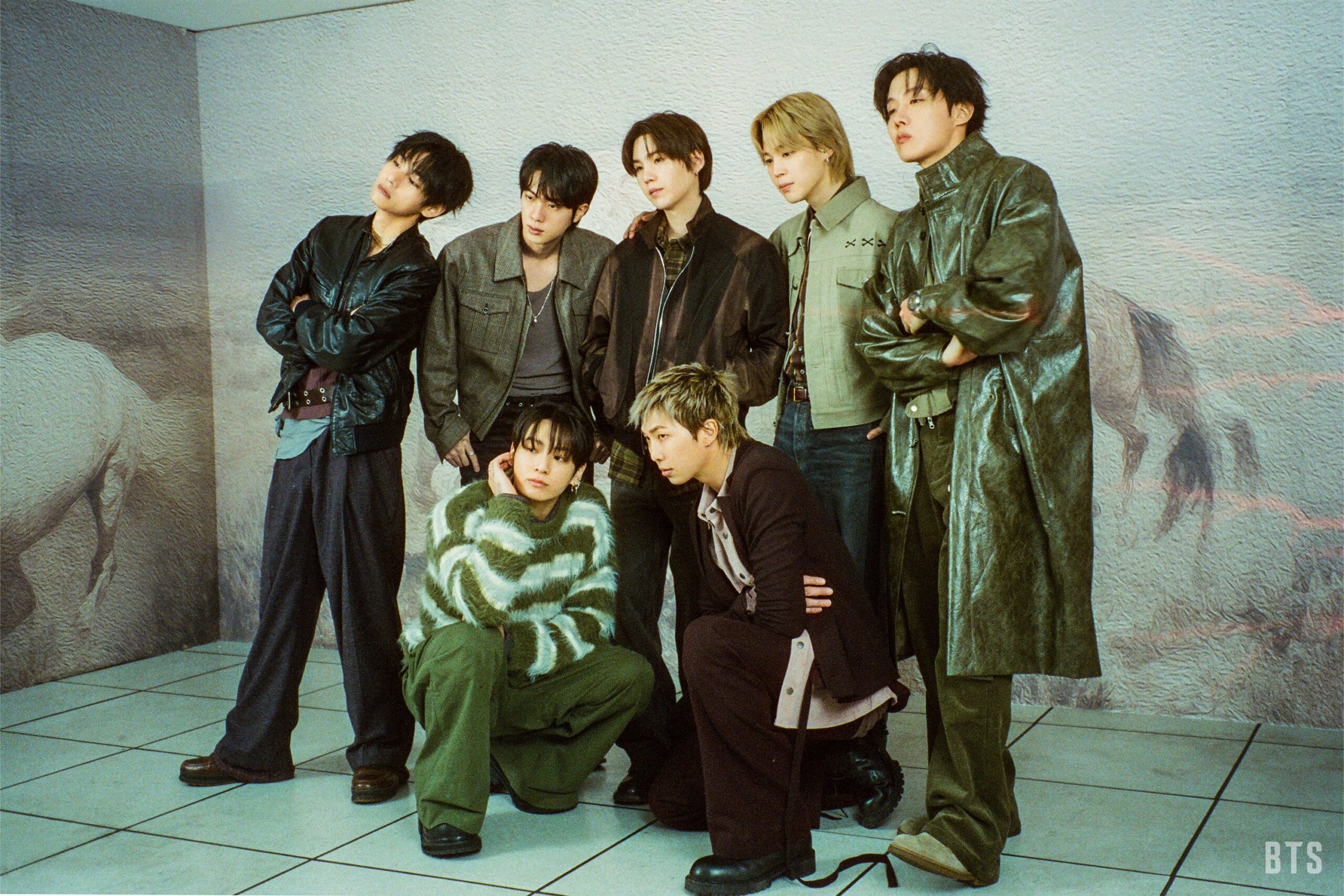
Merry-Go-Round is often interpreted as a song about BTS’s military service, but I think that reading is too narrow. The military is part of the story, but it is not the whole story.
According to RM, Merry-Go-Round is the saddest song on Arirang. It is about being trapped in a cycle—riding a carousel that never stops. Military service may have been the first time in years that the members were forced to step off that ride and sit alone with their thoughts. But the music video suggests that the cycle itself began much earlier.
What the MV repeatedly returns to is not the military. It is BTS’s entire journey—from Hwa Yang Yeon Hwa to the present day. Throughout the video, we see echoes of older eras, older symbols, and older stories. These references are not there to continue a larger narrative. They function more like memories. Together they form a portrait of the experiences, successes, burdens, and relationships that created the merry-go-round BTS finds themselves riding today.
Jungkook’s Collapsed Carousel


Jungkook opens the MV standing among collapsed carousel horses. The ride has stopped.
That image feels particularly significant because Jungkook was the member with the least urgent need to enlist. He could have delayed his service longer than many of the others. Instead, he chose to go.
I actually think there is a stronger Jungkook reading than the enlistment one.
Among all the members, Jungkook arguably had the most to lose from BTS stopping.
Yet he never seemed to hesitate. When the group announced the hiatus and military plans, Jungkook’s reaction was often the simplest: “We’ll come back.”
The collapsed carousel may represent something larger than military service. It may represent Chapter 1 itself. The machine that created global fame, stadium tours, records awards, unprecedented success… all lying in pieces and Jungkook walks away from it with no hesitation.
RM’s story throughout the MV is filled with questions.
But because he chose something else. Jungkook’s story has always been more instinctive.
When he says: I’ll do what I want. people often interpret it as rebellion. I don’t think it is. I think it’s clarity.
Throughout BTS’s history, Jungkook has repeatedly entrusted major decisions to the group. Not because he lacks independence. Because he believes in BTS and because he values the process more than the result.
The opening scene may therefore represent a choice. The carousel has stopped. The obvious question becomes: What now?
Jungkook’s answer is simple. He walks forward.
V’s Small Room


The strongest thing about V’s scene is actually how little we see. Every other member is given a fairly elaborate visual environment:
- J-Hope has the horse-covered room.
- Jungkook has the collapsed carousel.
- SUGA has the storm.
- RM has the tomb.
- Jimin and Jin have the curtain scene.
But V is sitting quietly in a small room with a single horse behind him. And then we’re gone. That brevity feels intentional. Throughout his solo era, V often appeared remarkably certain about what he wanted. Layover was not presented as a search for identity but as an expression of one. He knew the sound he wanted, the atmosphere he wanted, and the kind of artist he wanted to be.
Perhaps that is why his room feels so simple. There is no storm to weather, no tomb to stand upon, no collapsing carousel. Instead, there is only a glimpse. The scene almost suggests that there is more to V than we are allowed to see. The camera passes by without fully entering his world, leaving the impression that some parts of him remain private, even within a music video built around reflection and memory.
Jimin Following The Floating Carousel


Jimin is the only member who appears to be actively following a horse. The others are surrounded by horses, standing near horses, confronted by horses but Jimin is moving toward one.
In visual storytelling, when a character follows something, that object often represents a desire, a dream, a memory, or a truth that has not yet been reached. The horse is not something Jimin controls. Instead, it acts almost like a guide.
This actually aligns surprisingly well with Jimin’s role throughout BTS’s work. Among the members, Jimin often occupies the position of “seeker”. From “Lie” and “Serendipity” to FACE and “Set Me Free Pt. 2”, his stories frequently revolve around self-discovery, understanding himself, and searching for freedom. It feels natural that he would be the member following a symbol, trying to understand where it leads.
The answer he finds is not another destination. It is a person. This leads us to the Horse and the Curtain.
Jimin and Jin’s Horse Scene


The curtain scene may be the key to understanding the entire MV.
Remember that we came from Jimin following the carousel, searching for where it leads him. He sees a curtain and with a silhouette of a carousel horse. But when the camera moves behind the curtain, the horse is revealed to be Jin.
The metaphor immediately changes. The members are not simply trapped by fame, routine, success, or the industry. They are also bound to one another.
The ride is not just the carousel. The ride is BTS itself.
Jimin thinks he is facing the “ride,” but he is actually facing Jin. So the symbol shifts from machine/object to person/team. I think it means that Jimin thinks that it’s the ride the traps them but then when you pan to the other side you’re kind of realizing that it’s actually each other that they are the team is what keeps the cycle going.
In that case, they’re part of what traps them but it’s also the reason that they keep on moving and also what keeps them company.
BTS are not trapped by the ride alone. They are also bound to each other.
That makes it heavier, but also warmer. The thing keeping them moving is not just fame, pressure, or the industry. It is the members themselves. Their responsibility to the team. Their love for each other. Their inability to walk away from the shared dream.
Why Jimin Would Jimin Be The One To Recognize It?
RM has repeatedly described Jimin as the member everyone leans on, a sentiment SUGA has echoed. Jungkook has also said that when he needs advice or someone to talk to, he often turns to RM and Jimin. Within BTS, Jimin often functions as a bridge—the member who naturally connects people.
That makes it fitting that Jimin is the one following the horse.
If the horse represents the merry-go-round, then Jimin is literally pursuing the cycle RM says has trapped them. But when he finally reaches it, he doesn’t find a machine. He finds Jin. A member. A person.
The implication is that the thing holding BTS together was never the carousel itself. It was always the people riding it. And Jimin, as the group’s emotional center, would be the member most likely to recognize that.
The Horse Transformation


Throughout the MV, the members briefly transform into horses. At first this feels surreal. But when viewed alongside Jimin’s curtain scene, the meaning becomes clearer.
The horse becomes Jin. The members become horses.
The director even described the curtain scene as resembling a mirror. The implication is that the horses are not separate from BTS. They are reflections of BTS.
The members are not trapped by the carousel. They are the ones powering it.
The Door Corridor


There are several questions here. Many assume it’s the order by which they were discharged but RM is out of order. He enlisted and was discharged the same day as V.
The other question is Suga. He is the last person in the hallway but he has no door. I think it’s less about discharge and enlistment order as it was about their dispositions, conditions, psyche and experience.
SUGA: The cycle is complete
Throughout Agust D’s career, there is a recurring image of conflict, angler, resentment, and hatred.
From Agust D (2016) through D-2 and even parts of D-DAY, the journey is often about confronting demons. Then came one of the most revealing things he has said when we appeared in IU’s shows, he no longer feels anger the way he used to. He has let got of all the demons, forgiven people, including himself, and feels free.
In fact, he said he even stated that he will not make another album with this version of AGUST D again because that AGUST D is gone.
That is a remarkable statement from someone whose artistic identity was built around channeling anger. His scene shows debris flying, storm imagery, and apparent chaos.
Yet, he isn’t running, he isn’t fighting, he isn’t escaping, there is no horse around
He’s standing calmly. Almost ceremonially. Hands clasped.
The storm exists but it no longer controls him. That feels very much like the final chapter of Agust D. Not the destruction of the storm but the acceptance of it.
The closed door
Most analyses assume that a closed door means they are trapped but a closed door can mean the opposite.
It can mean, there is no need to keep moving. He is where he needs to be. If everyone else is moving through doors, passing thresholds, crossing stages— SUGA stands beyond that process.
RM: Still In transition
RM is trickier because unlike SUGA, RM has been very open about still being in the middle of something.
The conversations from FESTA, the documentary, Indigo, military letters—all point to a person who has been questioning. One of the most important admissions RM has made in recent years is exactly what you mentioned, he lost clarity after the success of Dynamite.
He felt like he didn’t know where BTS was going or who they were. Those are existential questions.
That’s why he was out of order, because his struggle wasn’t like everyone else. Jin, V, Jungkook, Jimin, and even Suga, wanted to fulfill their service and go back to performing. RM was struggling with his very existence as an artist.
RM’s Tomb
So, why the tomb? Well, it’s in his lyrics but in terms of imagery, it separates him from the others. The others are largely interacting with motion.
With horses.
RM’s imagery is a marker of death and rebirth., maybe even of legacy. A boundary between identities. That’s actually very consistent with Indigo.
The entire project feels like someone documenting the death of one version of himself before another emerges.
RM Joining Them In The End


That is why RM joining the others in the final scene feels so significant.
Throughout most of the music video, RM exists outside the merry-go-round. While the other members are shown navigating the cycle together, RM’s journey is more internal. His struggle is not simply about being away from the stage. It is about identity, creativity, and purpose.
The others seem focused on returning to what they love. RM, however, has openly spoken about questioning what he loved in the first place and whether he still understood himself as an artist.
That is why his eventual arrival matters. When he finally enters the room and joins the others, it feels less like a reunion and more like a resolution. After spending much of the video outside the cycle, he chooses to step back into it.
Not because all his questions have been answered, but because he has chosen the people waiting for him on the other side.
The Gathering
The gathering scene may also explain why RM is noticeably absent.
At the beginning of the music video, Jungkook, V, and Jimin are gathered in a room. Jin eventually joins them before V leaves. Many viewers have interpreted this as a reference to military leave, but that explanation feels incomplete. If the scene were simply depicting military breaks, RM’s absence would be difficult to explain, especially since he enlisted and was discharged alongside V.
I think the scene is less concerned with chronology and more concerned with where the members were emotionally and mentally during this period of their lives.
While all seven members entered military service, they did not enter it carrying the same questions or burdens. They were at very different points in both their personal and professional journeys.
RM’s struggle appears fundamentally different.
As he has openly discussed in interviews, documentaries, FESTA conversations, and military letters, his questions extended beyond military service itself. He was wrestling with his artistic identity, his purpose, and even his understanding of BTS after the group’s unprecedented success.
His journey was not simply about absence. It was about meaning.
That may be why he is treated differently throughout the MV and why he appears separated from the group for much of the story.
J-Hope’s Nod To Hwa Yang Yeon Hwa


One of the clearest examples is J-Hope’s scene. He stands alone in a room covered with painted carousel horses. The imagery immediately recalls Fake Love, where he was surrounded by broken carousel horses scattered across the floor.
The connection goes even deeper. In BTS’s Hwa Yang Yeon Hwa storyline, J-Hope’s defining trauma begins at an amusement park, where he was abandoned by his mother near a carousel. More than any other member, he has a long-standing connection to this imagery.
In “Merry-Go-Round”, the horses are no longer physical objects. They have become part of the walls themselves. The environment is built from them. It suggests that the experiences, expectations, and memories associated with that cycle never truly disappeared. They became part of the structure around him.
Rather than advancing a story, the scene feels like a memory. A reminder of one of the many moments that contributed to the life BTS lives today.
You Never Walk Alone
The music video opens with “You Never Walk Alone,” an unmistakable reference to Spring Day. RM has even said that he hoped Merry-Go-Round could become the new Spring Day, which makes the callback feel intentional.
I think it is also an important clue to the message of the entire MV.
Merry-Go-Round can feel incredibly sad. The members are shown carrying different burdens, questioning different things, and moving through different stages of their lives. But underneath all of that is a sense of hope.
The members are not in the same place, but they are still together.
Some are struggling. Some have found peace. Some are still searching for answers. Yet they continue to choose one another.
That is why RM’s final scene feels so important. After spending much of the video separated from the others and standing atop the tomb that symbolizes his personal struggle, he eventually joins the group. There is even a slight smile on his face. The message seems simple: no matter what questions he wrestles with, he ultimately chooses BTS.
What stands out even more is that the other members do not go looking for him. They simply wait.
There is confidence in that. An understanding that all seven members will go through different things at different times, but the others will always be there when they are ready to return.
That is why “You Never Walk Alone” matters.
It is not just a reference to Spring Day. It is the emotional conclusion of the entire music video.
Panopticon
The final panopticon image is often interpreted as a prison. A structure where everyone is constantly watched.
That interpretation is valid. BTS has spent over a decade living under extraordinary public scrutiny.
But the ending introduces another possibility.
The camera pulls back. The carousel becomes a spaceship. The group appears among the stars. The Big Dipper—an image frequently associated with BTS’s seven members—appears overhead.
The panopticon remains, but it no longer feels like a cage.
It feels controlled. By the end of the MV, the windows have become opaque. We can no longer see inside.
Perhaps the message is not that BTS remains trapped under observation. Perhaps the message is that they have learned to decide what is visible and what remains hidden.
