

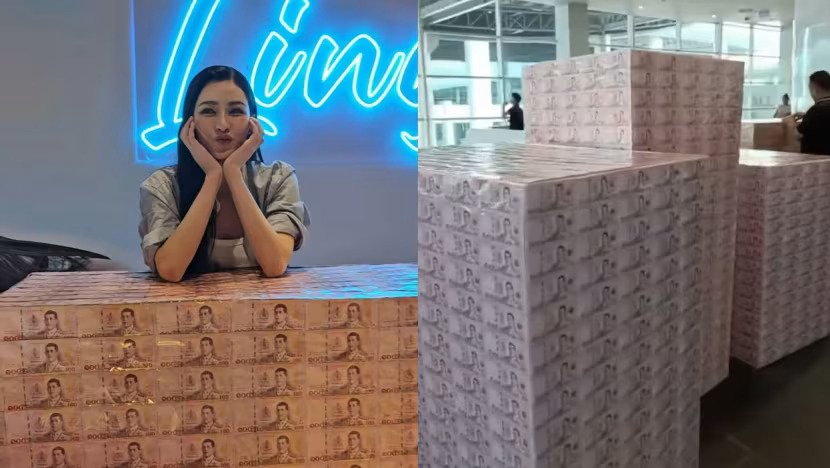
At fan meetings, gifts are expected. Flowers, letters, plush toys, luxury accessories—these are familiar gestures in Asian fan culture. But in Thailand and China, devotion has increasingly moved beyond symbolic giving into something far more literal.
Recently, Thai actress Lingling Kwong—who rose to prominence through The Secret of Us alongside Orm—held her first fan meeting in Thailand as part of the popular “LingOrm” duo. What followed stunned even seasoned observers.
Fans from Hong Kong and mainland China reportedly prepared 2 million yuan in physical cash (approximately S$367,000 / US$270,000), presented directly at the event. This figure does not include gifts from Thai fans or supporters from other regions. In addition, Lingling and Orm received luxury items from Christian Dior, Louis Vuitton, Loewe, and Chanel.
Online reactions ranged from awe to disbelief but in both China and Thailand, this behavior is not as shocking as it appears to outsiders.
Cash as Affection: A Known Pattern in Chinese Fandoms
In China, fandom has long operated as an organized economic force. Large fan unions—often structured with treasurers, planners, and reporting systems—regularly pool funds to support idols. These funds are used for:
- Birthday projects and city-wide billboards
- Album bulk purchases to boost chart performance
- Luxury gifts, watches, cars, or real estate down payments
- Direct cash gifts framed as “support funds”
While Chinese regulators have cracked down on excessive fundraising for idols in recent years, the culture of financial devotion remains deeply ingrained. Giving money is often framed not as indulgence, but as proof of loyalty and seriousness. Fans who contribute more are seen as more devoted—and, crucially, more visible within the fandom hierarchy.
In this context, cash is not impolite. It is practical.


Thailand’s Proximity Culture: Access as the Ultimate Currency
Thailand’s fan culture operates slightly differently, but with a similar outcome.
Thai entertainment fandom places high value on access and proximity—fan meetings, repeated interactions, personal recognition, and ongoing visibility. In this environment, gifts are often understood as a way to sustain closeness, not to buy favor outright, but to reinforce presence.
Cash gifts, while controversial, are not unheard of. They are sometimes justified as a way to “support the artist directly,” especially in industries where acting fees may be inconsistent, backend profits unclear, or agency cuts opaque.
In other words, fans see themselves not just as admirers, but as patrons.
Why This Happens: Devotion, Power, and Uneven Economics
What links Chinese and Thai fan cultures is not excess—it is asymmetry.
Fans often perceive:
- That idols are underpaid relative to their labor and visibility
- That agencies and platforms extract disproportionate value
- That direct giving bypasses intermediaries
In response, fandoms step in to redistribute money directly to the idol.
But this creates uncomfortable questions.
Cash gifts blur the line between affection and compensation. They raise issues around taxation, power imbalance, and expectation—especially when fans believe financial generosity leads to better access or recognition.
What begins as devotion can quietly evolve into obligation.
Not Just About One Actress
The Lingling Kwong fan meeting did not create this phenomenon. It merely made it visible.
As Asian entertainment continues to globalize, these practices are increasingly colliding with international norms that view cash gifting as inappropriate or exploitative. Yet within local contexts, they are often seen as rational responses to opaque industries and limited fan agency.
And it reflects a broader truth about modern fandoms—where belief, money, and intimacy are no longer separate, but deeply intertwined.
