

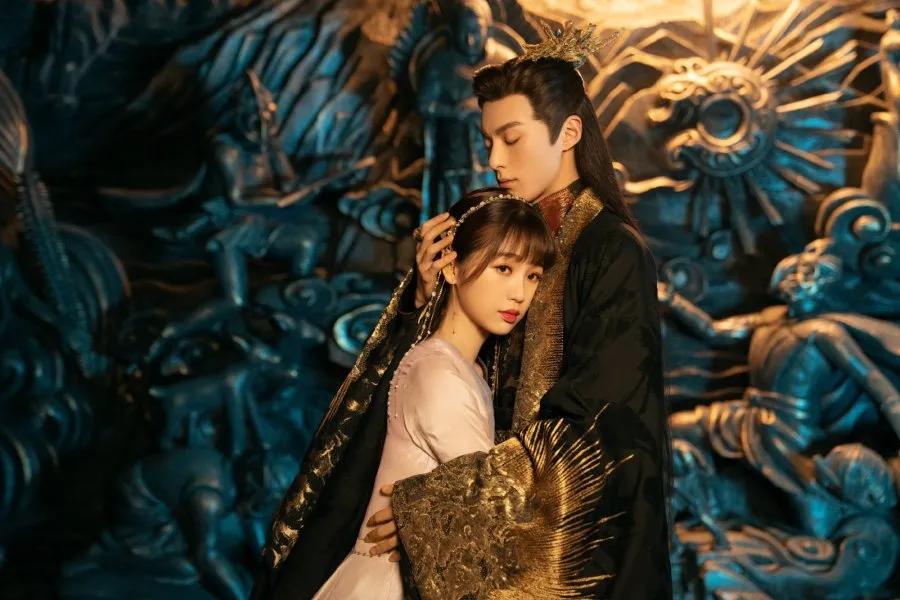
If you are relatively new to Chinese dramas, there is a particular kind of show that can initially feel as though someone threw The Lord of the Rings, Greek mythology, an elaborate royal wedding, a martial-arts movie and several thousand years of romantic suffering into the same production.
The men have impossibly long hair. Everyone owns approximately twelve layers of silk. Palaces float in the clouds. A seemingly harmless flower may turn out to be the reincarnation of an ancient goddess. Someone is always forbidden from falling in love with someone else. Death frequently turns out to be more of an administrative delay than a permanent condition.
Welcome to xianxia (仙侠), one of China’s most distinctive fantasy traditions and increasingly one of the country’s most recognizable entertainment exports.
Shows such as Eternal Love, Ashes of Love, Love Between Fairy and Devil and Till the End of the Moon have introduced international viewers to enormous celestial worlds populated by immortals, demons, gods, spirits and mortals whose romantic problems can continue across several reincarnations.
But calling xianxia simply “Chinese fantasy” misses much of what makes it interesting. Western fantasy often reaches backward toward medieval Europe, knights, castles and European folklore. Xianxia reaches into China’s own enormous reservoir of mythology, philosophy, religion, literature, visual art and ideas about immortality.
And that makes the genre particularly interesting at a moment when China’s television regulators are explicitly asking producers to create works that display more distinctly Chinese aesthetics and culture.
So What Exactly Is Xianxia?
The Chinese characters provide a useful starting point. Xian (仙) refers to an immortal or transcendent being, while xia (侠) is associated with the heroic or chivalric tradition.
In practice, xianxia is fantasy built around worlds where humans may cultivate themselves toward immortality, gods and demons interfere with mortal affairs, spiritual power can be accumulated, magical weapons have histories of their own and Heaven apparently has enough bureaucracy to operate several government ministries.
The genre draws from a mixture of Chinese mythology and traditions associated with Taoism, Buddhism, folk religion, martial arts, alchemy and traditional concepts of spiritual cultivation.
That last concept is particularly important.
Cultivation, broadly speaking, is the process through which a character develops spiritual or supernatural power. Depending on the fictional universe, characters may meditate, train, acquire spiritual energy, master techniques, overcome trials or ascend through different levels of existence.
This gives xianxia stories something similar to the leveling system of a role-playing game. A weak mortal does not necessarily have to remain a weak mortal. Theoretically, there is somewhere to go beyond being human.
Sometimes very, very far beyond.


China’s Fantasy Does Not Need Medieval Europe
One of the most fascinating things about xianxia is how culturally specific its fantasy vocabulary is.
Much of the fantasy familiar to Western audiences descends, directly or indirectly, from European traditions. Castles, knights, dragons, elves, wizards, medieval kingdoms and Arthurian imagery have become so internationally familiar that audiences rarely stop to consider where those visual languages originated.
China has an entirely different cultural warehouse to raid.
Xianxia can draw from ancient Chinese mythology, celestial bureaucracies, Taoist immortality traditions, Buddhist concepts of rebirth and karmic consequence, legendary creatures, traditional medicine, martial arts, classical poetry and centuries of stories about humans interacting with spirits and supernatural beings.
Its universe therefore operates according to assumptions that may initially feel unusual to international viewers.
Immortality is attainable. Reincarnation is possible. A human can become something greater than human. Gods are powerful but not necessarily morally perfect. Spirits can cultivate human forms. Romantic relationships may continue through multiple lives. Actions committed in one existence can carry consequences into another.
The result is fantasy that does not merely put Chinese actors into an otherwise Western fantasy structure. At its most culturally ambitious, xianxia builds fantasy using Chinese ideas about the universe itself.
Xianxia, Wuxia and Xuanhuan Are Not the Same Thing
International audiences understandably tend to put Chinese costume fantasies into one enormous category: people with beautiful hair flying through the air.
Chinese genre terminology is considerably more specific.
Wuxia (武侠) centers on martial heroes. Its characters are generally human, although their abilities can stretch reality considerably. The stories revolve around martial-arts schools, wandering swordsmen, honor, loyalty, revenge, justice and the jianghu, the semi-independent social world occupied by martial artists and outsiders.
A wuxia hero might leap onto a roof and defeat twelve swordsmen.
A xianxia hero might destroy the roof, the twelve swordsmen, the mountain underneath them and possibly his own immortal essence before being reincarnated 500 years later.
Then there is xuanhuan (玄幻), an even broader fantasy category. Xuanhuan can incorporate Chinese mythology and cultivation while mixing in invented systems, worlds and influences that do not necessarily follow the more recognizable religious and mythological vocabulary associated with xianxia.
Genre boundaries are not always clean. Chinese dramas regularly mix romance, wuxia, xianxia, mythology, palace politics and historical elements. Even Chinese platforms sometimes use overlapping genre labels.
But xianxia occupies a particularly recognizable corner of this universe: celestial fantasy on a spectacular scale.
And No, These Are Not Necessarily Historical Dramas
This is where comparing Chinese television with Korean television becomes especially useful.
Korean sageuk dramas are commonly connected to identifiable historical periods, particularly the Joseon Dynasty. Even fictional stories may use recognizable kings, political institutions, clothing, architecture, social hierarchies or historical events. Fantasy sageuks can obviously depart dramatically from recorded history, but history often provides the skeleton.
China certainly produces this kind of television too. There are dramas about actual dynasties, emperors, political struggles and historical figures, as well as heavily fictionalized stories placed within recognizable historical settings.
But someone wearing flowing ancient-looking robes in a Chinese drama does not automatically mean the story is supposed to be historical.
Xianxia may take place in a completely invented cosmology thousands or tens of thousands of years removed from ordinary human history. Its kingdoms may be celestial rather than Chinese dynasties. Its emperors may rule Heaven instead of China. Its clothing may borrow from recognizable Chinese historical silhouettes while being deliberately exaggerated into fantasy.
That gives Chinese costume television an unusually broad canvas. “Costume drama” can mean history, historical fiction, wuxia, mythology, xianxia, xuanhuan or some combination of them.
Sometimes the palace is based on history.
Sometimes the palace is floating above the clouds and the emperor has been alive for 80,000 years.
Check the genre before taking notes.
The Clothes Are Part of the Fantasy
And then there are the costumes.
Xianxia understands something extremely important about fantasy television: if someone is going to spend 30 episodes suffering because their soulmate was reincarnated into the wrong realm, they should at least look magnificent while doing it.
The genre’s visual appeal is enormous.
Characters sweep through enormous celestial halls in layered robes with wide sleeves, embroidered fabrics, elaborate crowns, ornamental hairpieces and enough fabric trailing behind them to provide employment for an entire costume department.
But these clothes should not simply be understood as historical reproductions.
ianxia costume designers can borrow silhouettes, patterns, hairstyles and decorative traditions from different periods of Chinese history and transform them into something deliberately fantastical. The objective is often less “this is exactly what someone wore in 742” and more “this is what an immortal Chinese deity might look like if budget were no object.”
Some productions go considerably deeper into specific artistic traditions.
Till the End of the Moon, for example, attracted attention for incorporating visual influences associated with Dunhuang, home to the famous Mogao Caves and centuries of Buddhist art. The production’s costumes and imagery were promoted specifically around this connection to Chinese cultural aesthetics.
That is one reason xianxia can function as a surprisingly effective cultural introduction. A viewer may arrive because Luo Yunxi looks spectacular in robes and leave having Googled Dunhuang Buddhist art.
There are worse cultural-export strategies.
Beauty Is Also Part of the Business
There is another reason xianxia looks the way it does.
Chinese entertainment, like Korean entertainment, has developed an enormous celebrity ecosystem in which actors can bring substantial pre-existing fandoms into television productions. Popular stars generate social-media conversation, advertising interest and platform subscriptions.
Xianxia is particularly compatible with celebrity glamour because the genre practically demands beautiful people.
These characters are supposed to be immortals, celestial princes, goddesses, demon lords and supernatural beings. Looking suspiciously flawless while standing on top of a mountain is practically in the job description.
Which makes China’s latest television directive particularly interesting.
In April 2026, China’s National Radio and Television Administration held a symposium on what it called “healthy aesthetics” in television. Representatives from major platforms including iQIYI, Tencent Video, Mango TV and Youku attended. Regulators called on the industry to move from a “star-centered” production model toward a “script-centered” one, reject “appearance worship,” reduce dependence on traffic and popularity, and place greater emphasis on acting and storytelling.
The regulator’s wonderfully straightforward standard was essentially: if you are playing something, you should look like it.
One catalyst was criticism surrounding Pursuit of Jade, whose battle-hardened male general looked so immaculate that Chinese viewers reportedly nicknamed him the “foundation-wearing general.” The character had supposedly spent years fighting wars but appeared on screen with porcelain skin, perfect hair and pristine styling.
The government was unimpressed.
China Is Not Actually Ordering Television to Become Ugly
There is an important nuance here because “China bans beautiful actors” makes a wonderful headline but would not accurately describe what happened.
The April directive did not order producers to stop casting attractive people.
Regulators criticized making appearance the overriding consideration, excessive makeup and costume or prop choices that conflict with characters and stories. They specifically called for costumes, makeup and props to support characterization while displaying “Chinese style” and strengthening cultural confidence. The discussion was connected to broader official cultural priorities, including study of Xi Jinping Thought on Culture.
That creates an interesting challenge for xianxia because xianxia is beautiful almost by design. The solution probably isn’t making the immortal prince less attractive. It is making sure there is an actual character underneath the immortal prince’s perfect cheekbones.
More importantly, the emphasis on recognizably Chinese aesthetics could potentially work with xianxia rather than against it. Few mainstream television genres offer producers a bigger playground for Chinese mythology, clothing traditions, architecture, music, philosophy, visual art and folklore.
The government may want fewer actors who look as though they walked out of a cosmetics advertisement and accidentally wandered onto a battlefield.
It does not necessarily want fewer beautiful Chinese worlds.
Xianxia Can Be Extremely Popular
These are not obscure genre productions surviving in some tiny fantasy corner of Chinese television. Major xianxia dramas can become genuine entertainment events.
Till the End of the Moon provides a particularly useful example. When it premiered on Youku in 2023, it recorded a reported 22.76% first-day market share and became the most-watched period drama premiere since 2020. It also reportedly pushed Youku to its highest number of App Store downloads since 2018.
Before its premiere, more than 5 million viewers had reserved the drama, and it reached Youku’s maximum heat index of 10,000 in roughly 29 hours. Its merchandise reportedly generated more than RMB 20 million during its initial run.
The genre travels, too.
Netflix’s published engagement data for the first half of 2023 showed Love Between Fairy and Devil accumulating about 20.9 million viewing hours, while Till the End of the Moon recorded approximately 20.4 million on the service during that period despite neither being a Netflix original.
More broadly, Chinese costume dramas have increasingly found international audiences. Chinese media reported that The Double, a 2024 costume revenge-romance rather than a straightforward xianxia, accumulated roughly 200 million overseas views after expanding onto services including Netflix. Love Between Fairy and Devil, Till the End of the Moon, The Starry Love and The Legend of Shen Li have similarly developed audiences beyond China.
So no, there isn’t solid evidence that “the most watched Chinese drama ever is xianxia”—and China’s fragmented platform measurements make sweeping all-time comparisons particularly dangerous—but there is plenty of evidence that xianxia belongs among China’s commercially important television genres.
Why Does It Work So Well?
Part of the answer is obvious. It is gorgeous. Fantasy benefits from spectacle, and xianxia provides it relentlessly: enormous sets, supernatural battles, magical creatures, elaborate costumes, impossible landscapes and celestial kingdoms.
But spectacle gets someone through an episode. It doesn’t necessarily get them through 36. Xianxia’s more powerful weapon is emotional scale.
Ordinary romance asks whether two people will end up together. Xianxia can ask whether two people will end up together after Heaven forbids their relationship, one sacrifices their immortality, the other forgets everything, both are reincarnated, somebody becomes a demon, one accidentally kills the other and 10,000 years pass.
This is melodrama liberated from the inconvenience of mortality.
And reincarnation gives writers a particularly effective narrative device. The same relationship can be explored under completely different circumstances. Powerful immortals can become vulnerable mortals. Enemies can become lovers. Lovers can forget one another. Characters can encounter the consequences of decisions made hundreds or thousands of years earlier.
The supernatural scale makes very human emotions enormous.
Love becomes destiny. Grief lasts centuries. Betrayal can destabilize Heaven. A bad breakup can become a national-security problem for three realms.
Underneath the Magic Is a Very Chinese Cultural Conversation
This is where xianxia becomes more interesting than its beautiful surfaces suggest.
Ideas about cultivation, transcendence, fate, reincarnation, filial obligation, duty, sacrifice, harmony, karmic consequence and the relationship between the individual and a larger cosmic order appear repeatedly across the genre.
Not every xianxia drama is a philosophical masterpiece. Some absolutely exist because attractive celebrities wearing expensive costumes falling tragically in love is an excellent business model.
But even commercial fantasy carries cultural assumptions.
Western superheroes often receive extraordinary power through an accident, technology, genetics or birth. Xianxia frequently imagines power as something that can be cultivated through discipline, knowledge, spiritual development and trials.
Western fantasy frequently builds conflict around good defeating evil. Xianxia can be fascinated with cosmic balance, destiny, cycles, ascension and the consequences of disrupting an established order.
And because characters can live for thousands of years, the genre can treat time differently. Human existence itself becomes one temporary stage inside a much larger universe.
These concepts do not belong exclusively to China, nor does every xianxia production treat them identically. But together they give the genre a philosophical vocabulary that feels distinctly connected to the culture that produced it.
Xianxia May Be One of China’s Most Exportable Cultural Products
South Korea demonstrated how entertainment can make cultural specificity internationally attractive rather than commercially limiting.
K-dramas did not become globally successful by removing everything Korean from them. Korean food, honorifics, family structures, workplace hierarchies, neighborhoods, fashion, history and social customs became part of what international audiences enjoyed discovering.
Xianxia offers China something similar, although through fantasy.
A viewer does not need to understand Taoist traditions before watching Love Between Fairy and Devil. They can simply enjoy a fairy accidentally becoming entangled with an extremely attractive demon lord.
But curiosity follows entertainment.
Why are people cultivating immortality? What exactly is a heavenly realm? Why are these costumes designed this way? What are those mythical creatures? Why does reincarnation work like this? Where did that architecture come from? What is Dunhuang?
A fantasy romance can quietly become someone’s first encounter with Chinese mythology, philosophy, art and aesthetics.
That makes the current government emphasis on cultural confidence especially interesting. China’s regulators want television that does more than manufacture attractive celebrities and chase online traffic. They have explicitly asked for stronger stories, stronger performances and aesthetics that communicate something recognizably Chinese.
Xianxia already possesses an extraordinary amount of that raw material.
The danger would be treating culture as decoration—adding traditional motifs because they look expensive while producing interchangeable stories underneath them. The opportunity is much larger: taking mythology, philosophy, art and storytelling traditions seriously enough that the fantasy could only have come from China.
Because Hollywood already has elves.
China has immortals who can spend 30,000 years cultivating spiritual energy, descend into the mortal realm, survive three reincarnations, accidentally awaken an ancient demon and still find time to have the most complicated romantic relationship imaginable.
There is absolutely no reason to compete with elves.