

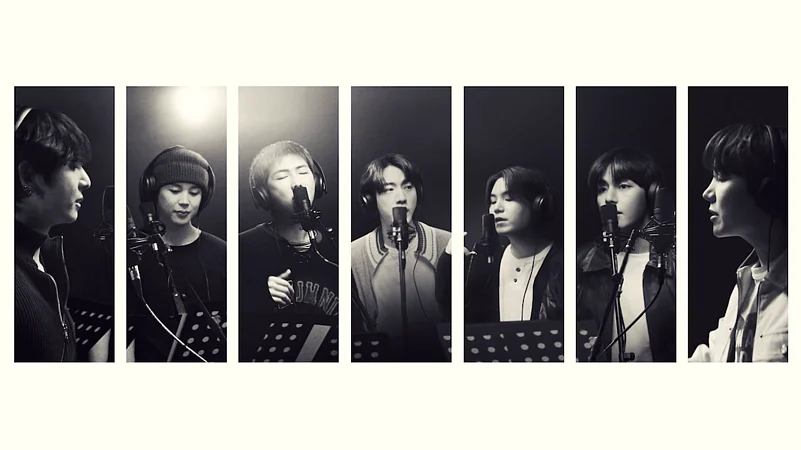
There has been a lot of chatter about the documentary—good and bad. But this is social media. The negative always carries louder.
That noise, however, prevents us from getting a real look at BTS creating together again after years apart. That alone has people watching closely—and reacting even faster.
Let’sbreak down what this documentary actually shows—what people are misreading, what’s really happening behind those moments, and why the process you’re seeing matters more than any single scene.
THIS IS A FRAGMENT OF A LONG AND BIG PROCESS
One thing we tend to do, almost instinctively, is judge people and situations based on what’s immediately visible. A few seconds, a single reaction, a brief disagreement—and we treat it as the full story.
That’s exactly what’s happening here.
People are taking isolated moments and turning them into conclusions. That RM and Suga not liking the Arirang sample at first means they never liked it at all. That Nicole suggesting English lyrics means she pushed them into something they didn’t want. That J-Hope rejecting the longer sample means his opinion never evolved.
But what we’re actually seeing is one hour pulled from roughly five months of work. Five months of seven artists—each experienced, opinionated, and deeply invested—working through ideas together.
This documentary is not the whole story. It’s a snapshot.
A photograph captures something real, but it never captures everything.
This is just one hour pulled from two months in LA, plus several more in Seoul. One hour out of five months of work by seven creative, intelligent, and incredibly disciplined men.
That’s what it is. It should be viewed like a photograph — a snapshot that captures a moment, not the entire story.
RM’S TAKE ON COMPROMISE
This isn’t to say the documentary doesn’t capture anything important. It just doesn’t capture everything that’s important.
One real benefit of having a director who’s an outsider — probably not even a fan — is the objectivity he brings, along with a certain kind of bravery. He doesn’t carry the same protective instincts that ARMYs do. That distance allowed him to highlight an aspect of their story that we rarely get to see.
He showed the pain that comes with creation: the disappointment, the frustration, the doubts, and the compromises. All of it is inevitable.
RM puts it simply—the longer they’ve been doing this, the more compromise becomes part of the process. That’s not surprising. They’ve been together for over a decade. They’ve reached a level of success most artists never come close to. Individually and collectively, they have more freedom than they’ve ever had—and at the same time, more perspectives to balance.
The documentary captures one painful part of their creative process. It does not mean the entire process was painful. It simply shows that they were willing to push through the mess and the discomfort in pursuit of their art.
“THEY STILL DON’T HAVE CONTROL OVER THEIR MUSIC”
That’s one of the more common reactions. But it misses what’s actually happening. From the start, they were divided when they first heard the Arirang sample in “Body to Body,” J-Hope, Jimin, and seemingly Jungkook liked it right away. RM, Suga, and V didn’t. From that moment, no matter who “won,” it already meant compromise. The seven of them will never have total control over every single detail.
What this shows is not a lack of control, but how control works in a group like BTS. It’s shared. It’s negotiated. And it’s constantly tested.
This is exactly why you surround yourself with smart, objective people — so when the team can’t agree, you have trusted perspectives to lean on. It doesn’t mean they lost control.
Even Pdogg — the producer who’s been with them since the beginning and has co-produced nearly 90% of their discography — couldn’t convince them to use the longer Arirang version in “Body to Body.” If Pdogg couldn’t sway them, that says everything.
When Bang Si-hyuk himself sat down with them, even he couldn’t change their minds on the musical side. He didn’t question their musicality. Instead, he appealed to something deeper: their identity as Koreans. He told them that even if they sacrificed a little on the musical side, they had a rare platform — the influence, power, and global stage — to highlight their cultural identity in a way few others could.
If you watch it again, you’ll notice that outside of J-Hope, most of their hesitation wasn’t that they thought the sample was inherently bad. It was concern about how ARMYs would receive it.
Bang understood that BTS wanted to give ARMY something that would truly resonate. That’s why when Nicole pushed for full English lyrics to appeal to the global market, she still didn’t get her way — because BTS wasn’t primarily worried about “going global.” They were worried about staying connected to their fans.
Bang knew their heart. So he spoke to the one thing he believed could outweigh their worry: their pride in being Korean.
At the end, RM summed it up beautifully. They went into this wanting to push themselves. They finally had the opportunity — would they back down just to stay comfortable?
JIN: “I don’t feel pressured at all.”
Jin went on tour with a completely unique concept, and because he’s Jin, it wasn’t surprising to hear him say he felt no pressure. He knew that if they enjoyed what they were doing and stood confidently behind their work, ARMY would enjoy it too.
It’s that “if he flings it, he flings it” energy. As long as they try their best and genuinely love it, ARMY will feel that love and enjoy it with them.
If there is anyone who embodies ARMY in that room, it was Jin.
SUGA: “I want my art to be intentional… with a distinct message.”
If there’s anything that gives us real perspective on the months leading up to those two weeks the documentary captured, it’s this. Suga’s desire for his art to be intentional shows the care, the deep thinking, and the seriousness with which he approaches his craft.
We can be confident the rest of the members carried that same attitude throughout the entire creation process — right up until Jin arrived. Everything was intentional. Never done for just one reason, but always with clear purpose and a message they believed in, both for themselves and for us.
J-HOPE’S MUSICAL INSTINCT
What stood out most about J-Hope was his sharp musical instinct. He just knows what will land. It’s never purely about commercial value — it’s about what is objectively a stronger track, musically and emotionally, while still connecting with people.
The moment he started jumping and dancing to the Arirang sample, he wasn’t overthinking it. He just felt it would work. That instinct is pure.
It probably also comes from his dance background — the same instinct that made Jimin and Jungkook like the sample immediately. They were already imagining how it would feel and resonate in a live stadium setting.
JIMIN’S CLEAR CREATIVE PREFERENCES
Throughout the documentary — and in many other stories they’ve shared — Jimin has always been vocal and crystal clear about what he wants. From pushing for a strong title track banger to how lines should be delivered, to firmly pushing back against certain English lyrics (not because it was English, but because of the quality). He was confident and certain in his vision.
He may not have gotten everything he wanted, but it shows how much the group — and each member individually — has evolved. They’ve become more sure of who they are as artists, and that naturally shapes the direction of BTS as a whole.
Diplo mentioned in a separate interview that many songs were cut because each member felt they represented them more as solo artists than as part of the group. It’s a beautiful reminder that BTS is its own distinct entity — something bigger than any one of them, where everyone contributes but no single voice dominates.
V’S REFLECTION ON CONSTANTLY CHANGING
One of the most insightful moments came from V, when he talked about how they were constantly evolving — even in that exact moment in LA. He pointed out that if they were changing, then ARMY was probably changing too.
He left the thought hanging, which felt perfect. Because that constant change has no real conclusion. It’s ongoing. It’s the “curse” of being an artist — you’re rarely ever fully content because you’re always shifting. What feels perfect today may not tomorrow. That’s the nature of growth.
JUNGKOOK STARTED AND ENDED IT
In a separate interview, the director mentioned how important it was that Jungkook both opened and closed the documentary. It shows the immense control they now have over their own narrative. And it feels especially fitting that the youngest one is the one calling the shots — the same member who was still a minor when they debuted and grew up in the public eye.
It’s a powerful signal: they decide now. They decide when we get to see them, when the story starts, and when it’s enough.
Jungkook also delivered the most important line — the one that beautifully concludes the messy process of not just making this album, but of coming back together as a band.
In the pictorial, standing in the center, he said:
“This is it, guys. We made it. We are back together as seven.”
And that’s what matters most.
Pain is inevitable. The creative process is always messy. There will always be compromises. But what truly counts is that they chose to come back together as seven—on their own terms.
And that choice didn’t come easily.
Because the real battle here wasn’t against outside forces. Not against critics, not against the media, not against people trying to tear them down. At this point, very few can actually challenge them from the outside.
The harder fight was internal.
They’ve already achieved more than most artists ever will. As a group, they’ve reached a level that could justify stepping back. As individuals, they’ve built careers that could stand on their own. It would have been easy—understandably easy—to stay in that space. To be comfortable. To move forward separately without having to go through this kind of friction again.
But they chose to come back and put themselves through the difficulty again. The disagreements, the uncertainty, the need to align seven different perspectives into one direction.
They chose the harder path—continuing to build, rather than settling into what they’ve already done.
THE NICOLE ISSUE
One of the most talked-about moments in the documentary was when Nicole suggested writing the lyrics in English for broader global appeal.
And that reaction says more about how people are watching this than what actually happened.
Nicole was hired to do a job. She was originally with Big Hit, moved to Columbia, then returned to HYBE. That kind of experience likely gave her insight into how the U.S. market operates—how radio works, what connects with a general audience, how songs are positioned beyond fandom.
So when she suggested English lyrics, she wasn’t overstepping. She was doing exactly what she was brought in to do—offer a different perspective.
That doesn’t mean she was pressuring the group. She doesn’t have that kind of authority. And the documentary makes that clear. Even Bang Si-hyuk, who has been with them from the beginning, doesn’t operate that way. He presents ideas. He makes a case. But the final decision still rests with the group.
And that’s the part people are missing.
If everyone in the room only echoed what BTS already wanted, there would be no expansion in thinking. No friction. No growth. And growth, especially at their level, comes from being challenged.
That’s what we’re seeing in that moment. Not control being taken away—but ideas being tested.
And in the end, the outcome speaks for itself.
She didn’t get her way. The album still includes Korean lyrics. The direction remained aligned with what the group felt was right.
Jimin even addressed this clearly. His pushback wasn’t about English as a language. It was about quality. About whether the lyrics felt right, whether they met their standard.
Different perspectives being brought into the room, considered, challenged, and ultimately decided on—by the people who have always had the final say.
LEGACY IN MOTION
That line — “We are back together as seven” — perfectly captures the heart of what BTS is and what they continue to build.
They aren’t finished. Their story is still being written, and the book is far from closed. After everything they’ve achieved, they’re still moving forward, still creating, still evolving together.
What makes this even more powerful is their clear statement that the decision to continue as a group rests entirely with them — not the label, not the industry, not even ARMY. It will be the seven of them who decide how long this journey lasts and what shape it takes next.
Whatever else they contribute to music, to culture, to each other, and to us — it will only happen because all seven choose it together. That unity, that shared vision, that willingness to keep showing up for one another even after all these years, is the real legacy.
It’s not just about the music anymore. It’s about seven men who grew up together, faced the world together, stepped away, and chose to return — stronger, wiser, and still deeply connected. Their legacy isn’t frozen in past achievements. It’s alive. It’s in motion. And as long as they keep choosing each other, the best chapters may still be ahead.
