

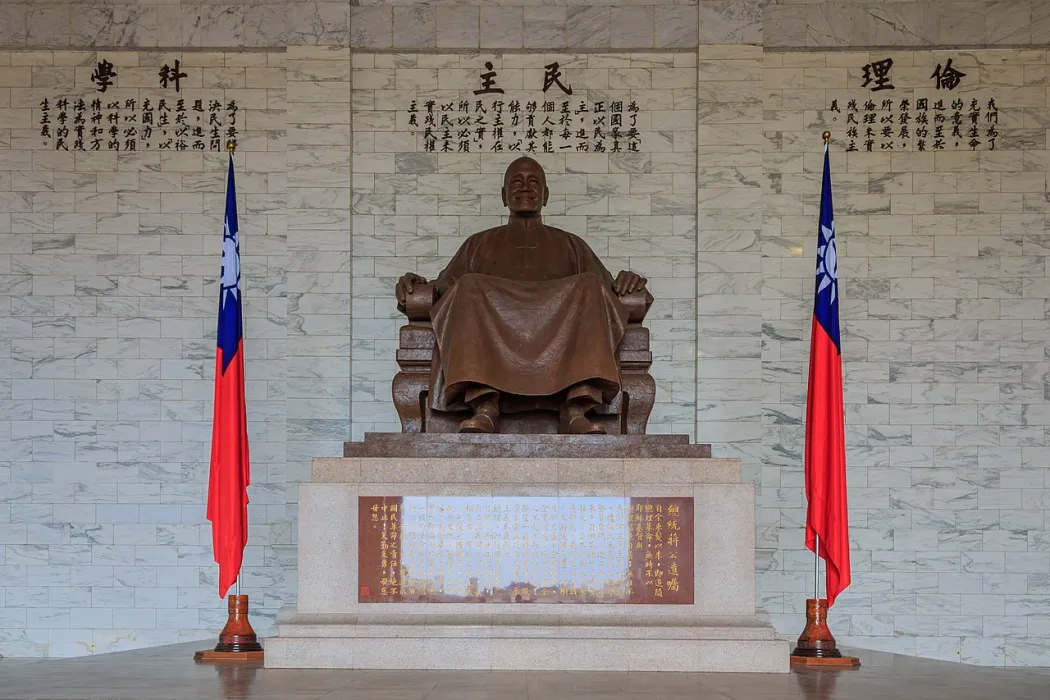
China wants Taiwan back. Taiwan doesn’t like the idea. They think that when Chiang Kaishek retreated to Taiwan, a new country was built and China had no part in it.
Chiang Kai-she became the leader of the Nationalist government of China in the 1920s.
Japan invaded China in the 1930s, throwing everyone into chaos. Chiang reluctantly joined forces with Mao Zedong to resist the Japanese during World War II. Mao was the leader of the Communist Party of China.
After Japan’s defeat in 1945, Mao’s party got stronger. China retreated to Taiwan.
The Retreat to Taiwan
Chiang and the KMT fled to Taiwan, taking about 2 million people with them, including soldiers, officials, and intellectuals. They also carried much of China’s gold reserves and cultural treasures.
In Taiwan, Chiang declared Taipei the temporary capital of the Republic of China (ROC), insisting that his government was the legitimate one and that mainland China still belonged to him. Mao, meanwhile, proclaimed the People’s Republic of China (PRC) in Beijing.
The tensions between the locals and the incoming refugees were high. But Chiang had a vision.
First is Land Reform: The government sold state-owned land (previously owned by the Japanese colonial government) to farmers at affordable prices. Farmers could pay in installments over several years, making land ownership more accessible. Over 300,000 tenant farmers became landowners, giving them a direct stake in their productivity and prosperity.
Next is Industrialization: Taiwan received $3Billion in economic and military aid. Taiwan used the funds to build infrastructure (highways, power plants) and promote industries. Chiang smartly channeled this aid into long-term economic projects rather than just military spending, a move that set Taiwan apart from other U.S.-backed regimes.
The land reform freed up labor. The government strategically focused on light industries like textiles and food processing to absorb this labor force. Cheap, skilled, and disciplined labor became the backbone of Taiwan’s manufacturing sector. Once they mastered light industries, they developed heavy industries like steel, petrochemicals and high-tech manufacturing (electronics) in the 1970s and 1980s:
Third is Education and Infrastructure: Schools were built, literacy improved, and the foundation for Taiwan’s tech industry was laid.
MARTIAL LAW
While Chiang modernized Taiwan, he ruled with an iron fist. Martial law was imposed in 1949, and it stayed in place for 38 years. After Chiang’s death in 1975, his son, Chiang Ching-kuo, succeeded him. Initially, he followed in his father’s authoritarian footsteps. But as Taiwan grew wealthier and more modern, pressures for democracy mounted. In 1987, Chiang Ching-kuo made a bold decision: he lifted martial law, allowing for political liberalization and paving the way for Taiwan to transition into a vibrant democracy.
China’s claim over Taiwan dates back to history. Taiwan was under Chinese rule during the Qing Dynasty but was ceded to Japan after the First Sino-Japanese War in 1895. When Japan lost World War II, Taiwan was returned to China. However, with the split between the PRC and ROC after the civil war, the question of sovereignty became contentious.
To the PRC, Taiwan is a “renegade province” that must eventually be reunified with the mainland.
Chiang Kai-shek remains a polarizing figure. To some, he’s a hero who preserved Chinese traditions in Taiwan and transformed the island into a thriving economy. To others, he’s an authoritarian who ruled with brutality and suppressed freedoms. His complicated legacy mirrors Taiwan’s complex history—a blend of resilience, ambition, and the enduring struggle for identity.
So, whether you see Chiang as a flawed visionary or a stubborn dictator, his story is undeniably central to understanding the modern relationship between China and Taiwan, a saga that continues to shape geopolitics today.
