

Look around right now in 2026 and you’ll see it everywhere: major tours getting axed or quietly postponed left and right. Post Malone just pushed back the first chunk of his Big Ass Stadium Tour to finish an album. Meghan Trainor scrapped her entire summer run. Zayn Malik pulled his whole tour. The Pussycat Dolls walked away from most of their North American reunion dates.
The reasons artists and teams give? Vague stuff like “scheduling,” “new music,” “family,” or “logistics.” But insiders are calling it the same thing: a full-blown case of blue dot fever.
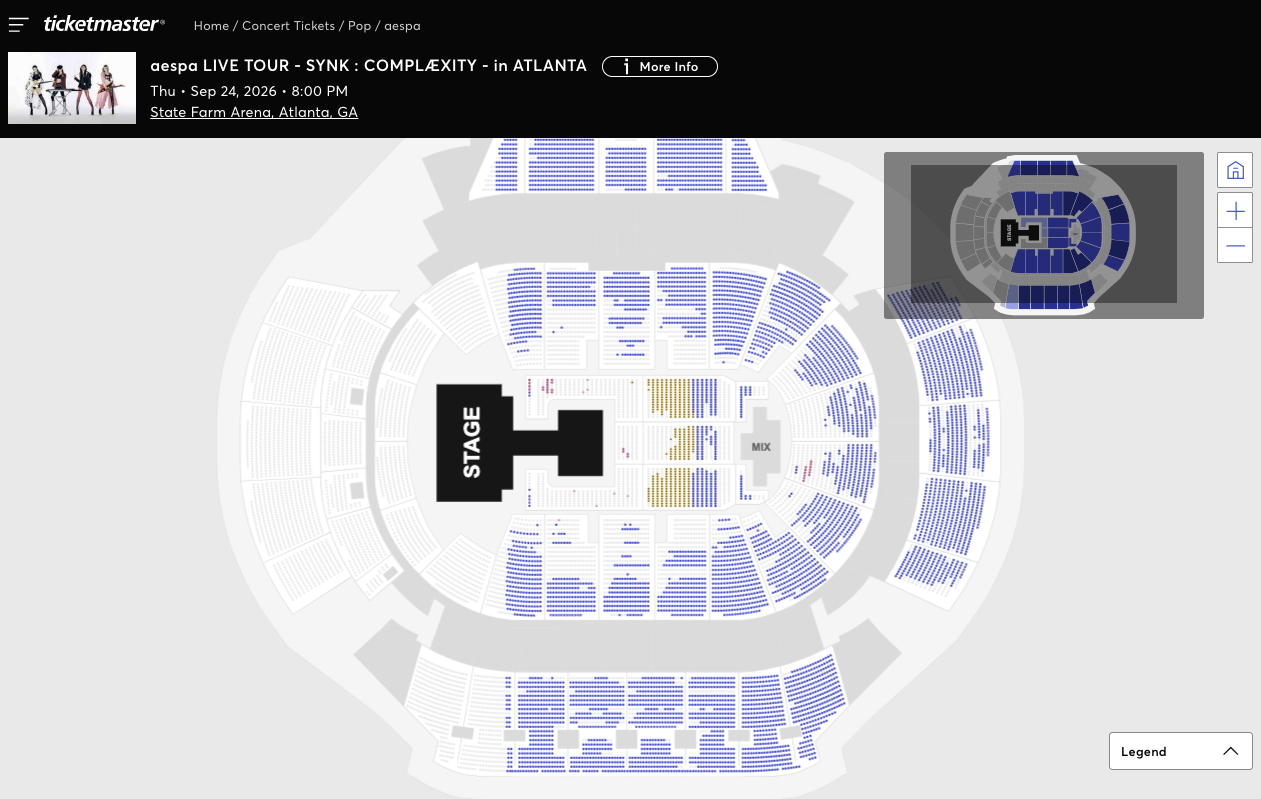
Blue dot fever is simple. On Ticketmaster’s venue maps, unsold seats show up as blue dots. When those blue dots start multiplying, demand isn’t matching the hype. It’s not bad luck or bad timing—it’s the moment the illusion cracks and nobody actually shows up.
Even K-pop felt the sting. I-DLE just canceled the entire North American leg of their Syncopation World Tour. Aespa has less than 25% of their tickets sold. IVE is blocking 2nd levels.
So, what’s happening?
Everybody Wants One Simple Answer
As always, fans immediately rush to explain it.Some use it to defend their favorite artists. Some use it to drag competing fandoms. Some use it as proof that their own favorite group is “bigger” or “more relevant.”
That reaction is understandable because people naturally want simple explanations for complicated problems.
In any kind of major shift, cultural, financial, or others, the reason is rarely just one thing. Major shifts usually happen when multiple developments collide at the same time until an old model stops functioning the way it used to.
And that is exactly what touring feels like right now.
A convergence of economic pressure, shifting consumer habits, changing entertainment culture, algorithm-driven marketing, oversaturation, and artists being pushed into touring cycles they may not actually be ready for yet.
The Economy Matters — But It’s Not The Whole Story
The global economy never fully stabilized after COVID even if people keep insisting we’re already “back to normal.” or maybe, what “normal” is has changed.
COVID changed people psychologically and culturally.
It changed how people spend money or how people experience entertainment and find joy. What’s worth a $100 then, may be worth $25 now.
For years people were trapped inside their homes consuming entertainment through screens. During that period, audiences discovered new creators, new genres, new habits, and new expectations.
People became more selective because we know just how vast the sea of alternatives is.
And because of that, consumers now think differently before spending hundreds of dollars on a concert. That absolutely affects touring.


Screenshots of the ticket availability on some AEPA and IVE’s stops as of May 9.
Is Ticketmaster To Blame?
Partly.
Ticketmaster fees, dynamic pricing, platinum pricing, and overall concert inflation absolutely priced some consumers out.
There are artists I would watc for $25 but not for $100. That is real but if pricing alone explained everything, then nobody would be selling out.
Except that’s clearly not true. BTS still sells out. Bruno Mars, Olivia Rodrigo, TWICE, Stray Kids.
And these acts are not selling tiny venues. They are doing multiple nights, larger capacities, and longer runs.
Too Much Too Soon
Some fans argue that the biggest artists simply have wealthier fanbases. And there is some truth there. A larger fanbase naturally means a larger subset of fans who can afford premium pricing.
But there are also smaller acts, playing smaller venues with fewer dates and are selling out. Fujii Kaze. SB19. They are not biting anything bigger than they can chew.
There are artists who look at their fanbase and choose venues they know they can fill before going back and grinding again for growth. They expand their music and find new ways to connect stronger with old fans and find new ones.
A lot of artists — especially in K-pop — are being rushed into touring cycles before they fully developed the artistic or brand identity needed to sustain long-term demand.
This is where the industry may have miscalculated.
Some groups had strong first tours because novelty itself generated excitement. People wanted to experience them once. But by the second or third cycle, audiences start asking a different question: What’s new?
If the music sounds similar, the performances feel similar, the concepts feel similar, and the overall artistic identity has not meaningfully expanded, then eventually growth stalls.
And once growth stalls, two things happen simultaneously:
- You stop attracting significant numbers of new fans.
- And older fans become less motivated to keep spending.
Fans need to feel there is something worth seeing now.
Artists who evolve and grow artistically, and take the time to develop a better relationship with their fans will survive and thrive.
The Illusion of Numbers
The internet made it incredibly easy to manufacture the appearance of influence. Not necessarily the influence itself. The appearance of it. You can buy streams, followers, YouTube views, engagement, and trending topics.
Even media visibility can be engineered if you have the right agency, the right publicist, and the right relationships.
And to be fair, entertainment has always involved strategic promotion. Labels have always pushed artists through radio, TV appearances, magazine features, playlisting, and partnerships.
The difference now is scale. Technology made “fake it till you make it” easier than ever before. There are literally companies openly offering streaming packages. Spend around $3,000 and suddenly your song gains 150,000 streams. For a major label, $3,000 is basically nothing. They can spend 10 times that if that means people will see you have millions of streams.
But the psychological and algorithmic effects are huge.
Repeat that spending consistently for several weeks and now your artist suddenly has over a million streams. At that point, the algorithm mathematically interprets the song as “active” or “growing.”
So the platform pushes it harder. More autoplay. More playlists. More accidental listeners.
That spills over to the audience. It gives fans more receipts of the supposed popularity. That translates to noise, bragging rights, proof that their favorites are more successful and popular.
And eventually people start confusing exposure with actual popularity. The same thing happens with social media. Follower counts and views can be inflated. Even comment sections are now filled with repetitive bot-like engagement designed to create the illusion of activity.
Fans help sustain this culture because numbers became a form of identity and validation. Everybody wants receipts. Everybody wants proof their artist is “winning.” So metrics became the easiest weapon.
It’s not illegal. It’s just math that works until it doesn’t.
Surface-Level Numbers vs. Real Influence
The issue is that many of these numbers are surface-level metrics or maybe a better way to describe it is this:
They measure visibility more than they measure attachment.
Spotify monthly listeners are probably one of the most misunderstood metrics right now. Monthly listeners are essentially impressions. It means someone encountered your music at least once within a 28-day period. That does not automatically mean fandom or that someone is listening to you.
It certainly does not mean loyalty. And it definitely does not automatically mean ticket buyers.
The same thing applies to streams themselves. Raw stream count without context means very little.
Where are the streams coming from? How concentrated are they geographically? How long are people listening? Are they replaying intentionally or landing on the song through passive playlists?
Because there is a massive difference between active listeners and passive exposure.
If the majority of streams are heavily concentrated in suspicious regions, suspicious cities, or low-payout markets while engagement elsewhere remains weak, people in the industry immediately start questioning whether playlist farming or stream manipulation is involved.
Same thing with social media. A million followers means very little if the engagement quality is weak.
Are people actually discussing the artist or are they simply scrolling past a post for three seconds before moving on?
This is why surface-level metrics can create a very distorted understanding of actual influence. Visibility and audience connection are not always the same thing.
And the lack of butts on the seats of their concert is exposing that difference in real time.
If the bulk of your plays are concentrated in low-payout regions or one random city, congratulations—you probably just rented a stream farm. That’s not a fanbase. That’s rented applause.
When Nobody Shows Up, the Fake Popularity Crumbles
Concerts are where the illusion becomes difficult to hide because unlike streams, empty seats are visible.
You cannot autoplay your way into a sold-out arena. You cannot stream-farm your way into emotional connection. You certainly cannot manipulate somebody into spending hundreds of dollars on an experience they do not truly care about.
What’s surprising is that some labels still seem willing to overestimate demand this aggressively.
Touring decisions are normally data-heavy.
Promoters usually study regional demand, historical sales, streaming concentration, audience conversion, pricing tolerance, and venue efficiency before greenlighting tours. This is supposed to be calculated carefully because touring is expensive. Very expensive.
A BTS-level stadium production with gigantic LED structures, pyros, moving stages, live production systems, transportation, staffing, dancers, security, venue labor, and logistics can easily cost millions per night before profit is even discussed. So when tours fail, they fail loudly.
Which raises an uncomfortable question:
Are some labels starting to believe their own constructed narrative?
Because if you spend years manufacturing visibility, eventually there is a risk that even the people behind the campaign begin mistaking it for actual market strength.
It’s exposing the fallacy of popularity constructed by manipulated numbers. Labels used to run real market studies—test markets, pre-sales, regional demand—to figure out where an artist could actually sell tickets. Now some seem to be skipping that step and believing their own press releases. The blue dots don’t lie.
The Market Became More Competitive Than Ever
Another major issue is that artists are now competing in a completely different entertainment ecosystem.
In the 1980s and 1990s, access to audiences was controlled by relatively few gatekeepers.
Radio stations. TV channels. Major labels. Program directors. Magazine editors.
If you controlled distribution, you controlled visibility.
Social media flattened access. Anybody with internet access can theoretically reach an audience. And audiences themselves learned how algorithms work.
Artists are no longer just competing against whoever shares their label or genre. They are competing against the entire world.
A teenager making music in their bedroom can suddenly compete for attention with artists backed by billion-dollar companies.
Independent creators can build direct relationships with audiences without needing traditional gatekeepers.
For the audience, it’s unlimited music, unlimited creators, and unlimited entertainment.
Which means earning attention became dramatically harder. And keeping attention became even harder than that.
Labels Can’t Count on the Old Tricks Anymore
Especially in K-pop, touring is slowly becoming the new mini album. For years, labels relied heavily on collectible album culture — multiple versions, photocards, fansigns, and bulk buying.
Streaming weakened music revenue. When BTS sold out their North American tour, they Kpop saw that as an opportunity. Touring became the new cash cow.
But audiences themselves evolved faster than the business model. If the live experience does not feel significantly better than staying home scrolling TikTok, watching YouTube, gaming, or streaming Netflix, people will simply stay home.
Life is expensive right now. Luxury spending now requires emotional justification. Artists like BTS or Bruno Mars understand this extremely well.
Their concerts feel like events people will regret missing.
Phones give people infinite entertainment at home. If your concert doesn’t feel like an event they can’t get on a screen—bigger production, better connection, something worth budgeting for—why bother? Fans proved with BTS and Bruno Mars they’ll splurge on luxury when it’s worth it.
The Ones Who Thrive Are The Ones Who Continuously Earn Their Fans’ Money
Artists cannot control the economy. They cannot control inflation. They cannot control cultural shifts. They cannot control how social media changed attention spans.
The world is too large for that.
The only thing artists can truly control is their own growth. Their identity. Their music. Their creativity. Their relationship with the audience.
And I think that is what this entire touring situation is exposing.
The artists surviving this moment best are usually the ones who kept evolving strongly enough that audiences still feel emotionally connected to the experience.
Because in 2026, people are still willing to spend money. They are just much harder to convince now.
Smart Moves: Festival Tours and Strategic Residencies
Some artists are adapting. When Jennie failed to sell out her limited theater tour in the US, she went straight to festival season—headlining Governors Ball, Roskilde, Open’er, Mad Cool, Lollapalooza, and Summer Sonic in 2026. Festivals prioritize exposure over conversion.
They place artists in front of wider audiences without requiring fans to fully commit to an expensive solo concert experience. She is working her way to gaining new audience.
At the same time, it gives media outlets crowd shots, headlines, and engagement. Jennie remained highly visible through fashion events, award shows, and brand partnerships in Korea.
Lisa took the opposite but equally calculated route: a limited four-date Vegas residency—VIVA LA LISA at The Colosseum at Caesars Palace in November 2026. First K-pop artist ever to get one. Smaller commitment, big financial upside, built-in media buzz, and a focused, high-production experience that feels special.
Both are still leaning on brand partnerships to keep the clicks and trends alive. They’re not panicking. They’re pivoting.
The Blue Dot Virus
The blue dot virus is a market correction. The era of buying your way to perceived dominance is hitting its limit when the lights go down and the seats stay empty. Artists and labels who treat fans like real people—grow with them, give them something worth leaving the house for, and stop believing their own hype—will be fine. The ones chasing numbers instead of connection? Well… the map doesn’t lie.
The blue dots are speaking. Time to listen.
