


For many Japanese viewers, Great Teacher Onizuka isn’t simply a television drama. It’s a cultural institution.
Twenty-eight years after Takashi Sorimachi first stepped into the role of Eikichi Onizuka, one of the most iconic teachers in television history is returning to the classroom. The newly announced serialized adaptation of GTO will introduce a new generation of students while reuniting audiences with a character who helped define Japanese television in the late 1990s.
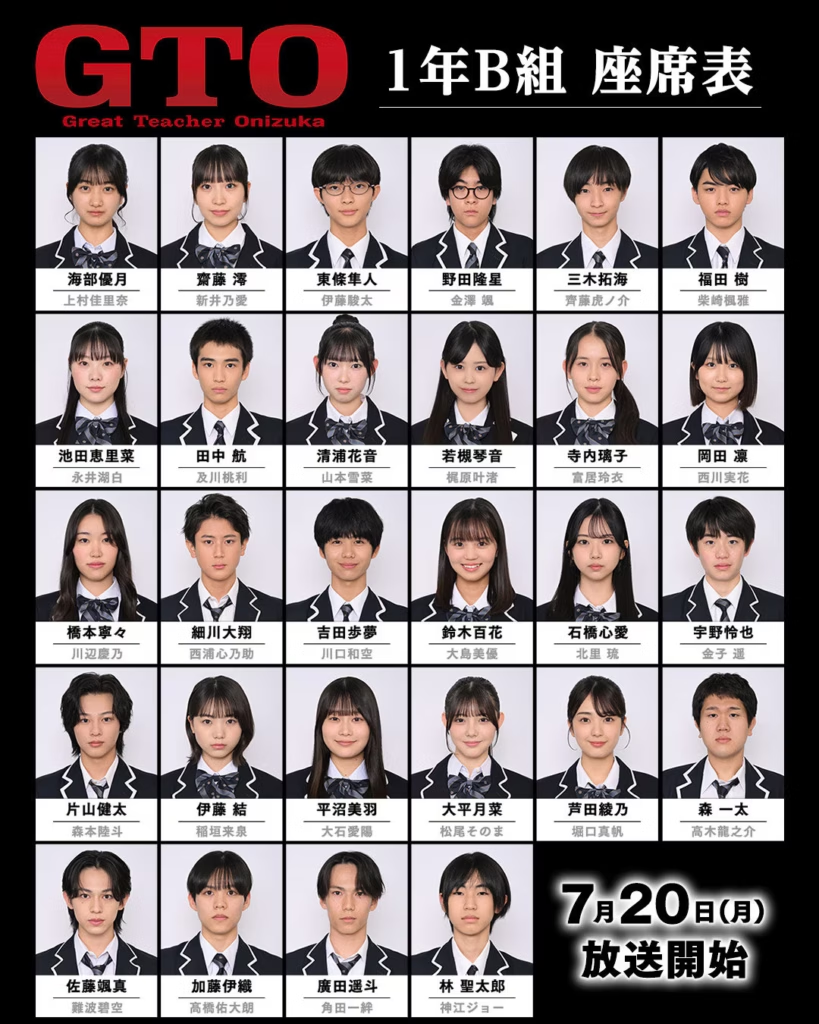
The series recently revealed the 28 young actors selected to portray Class 1-B, with more than 400 applicants competing for the roles. Joining Sorimachi is Meru Nukumi as vice homeroom teacher Mio Kashiwabara. Veteran screenwriter Kazuhiko Yukawa, who also worked on the original 1998 adaptation, returns to help bring Onizuka into Japan’s Reiwa era.
Yet the significance of this announcement extends far beyond nostalgia.
The Manga That Became a Phenomenon
Great Teacher Onizuka, commonly known as GTO, began as a manga created by Tohru Fujisawa in 1997.
At first glance, the premise sounds almost absurd.
Eikichi Onizuka is a former biker gang leader, delinquent, and self-described troublemaker who decides to become a teacher. He lacks the polish, professionalism, and discipline expected of educators. He often breaks rules, ignores procedures, and approaches problems with methods that would give most school administrators a heart attack.
What made the series work was that beneath the comedy and outrageous situations was a surprisingly serious examination of education, bullying, family dysfunction, academic pressure, social isolation, and the emotional struggles of teenagers.
Unlike traditional authority figures, Onizuka treated students as people first and pupils second. He wasn’t trying to create model students. He was trying to save them.
That was what hit home.

Why GTO Became a Hit
The late 1990s were a period of profound change in Japan.
The country’s economic bubble had burst. Social confidence had weakened. Schools were increasingly criticized for prioritizing conformity over individuality, while issues such as bullying, academic stress, and youth alienation became frequent topics of public discussion.
GTO arrived at exactly the right moment.
Onizuka represented the opposite of the rigid systems many people felt were failing students. He was flawed, reckless, and often ridiculous, but he possessed something many authority figures in the series lacked: genuine empathy.
Viewers watched him confront problems that teachers, parents, and administrators preferred to ignore.
Each week combined comedy, social commentary, and emotional storytelling in a way that appealed to both teenagers and adults. The result was a series that consistently delivered strong ratings and became one of the defining Japanese dramas of its era.
The character’s popularity eventually expanded beyond television through anime adaptations, films, specials, video games, and international remakes.
Even today, Onizuka remains one of the most recognizable characters in Japanese pop culture.
Takashi Sorimachi’s Career-Defining Role
Although Takashi Sorimachi had already established himself as an actor before GTO, the role transformed him into a household name.
His portrayal struck a delicate balance between comedy, toughness, vulnerability, and sincerity. Onizuka could be absurd one moment and deeply moving the next, and Sorimachi made both sides feel believable.
The show’s theme song, “Poison,” performed by Sorimachi himself, became almost as famous as the drama. Decades later, both the song and the character remain strongly associated with one another.
Few actors get a role that follows them for an entire career. For Sorimachi, Onizuka became that role.


A Launchpad for Future Stars
The original GTO also helped elevate several young performers who would later become major names in Japanese entertainment.
Among the most notable was Nanako Matsushima, who portrayed fellow teacher Azusa Fuyutsuki. Her popularity surged following the series, and she would later become one of Japan’s most successful actresses.
The drama’s young cast included numerous actors who went on to establish careers in television, film, music, and modeling. Like many school dramas, GTO served as a showcase for emerging talent, introducing audiences to performers who would shape Japanese entertainment throughout the 2000s.
That tradition appears set to continue with the new adaptation, whose producers emphasized personality and individuality over traditional acting credentials when casting the new Class 1-B.
Why Bring Back GTO Now?
The answer may lie in how much schools have changed.
The original series focused on issues such as bullying, family conflict, academic pressure, and social expectations. Today’s students face many of those same challenges, but they now exist alongside social media, digital surveillance, online harassment, AI-assisted learning, algorithmic evaluation systems, and the pressures of constant connectivity.
The new drama is set at Seishin Academy, where tablets, digital assessment systems, and modern educational technology have become part of daily life.
This creates an intriguing question.
What happens when a character who never respected rules enters a world increasingly governed by data, metrics, and algorithms?
That conflict may ultimately become the most interesting aspect of the reboot.
More Than a Nostalgia Project
The new series shifts to Seishin Academy in the Reiwa era, where tablets and digital evaluations dominate. Onizuka will confront modern problems like social media pressure, academic burnout, and digital disconnection.
Meru Nukumi joins as Mio Kashiwabara, vice homeroom teacher for Class 1-B. The 28-student cast was chosen from over 400 applicants (ages 15–17) with an emphasis on individuality and presence rather than polished acting skills. Standouts include Kurumi Inagaki, Touri Oikawa, Miyu Oshima, Kanna Kajiwara, Sora Namba (LIL LEAGUE), and others.
Director Satoru Nakajima and screenwriter Kazuhiko Yukawa — both from the 1998 original — are back, promising continuity in tone while refreshing the story for today’s audience.
This revival isn’t just nostalgia bait. It’s a chance to see how Onizuka’s “GTO” philosophy holds up against contemporary education challenges. In a world still struggling with youth mental health and rigid systems, the wild teacher’s message might be more relevant than ever.
Onizuka Army, assemble. This is going to be one wild ride back to school.
