

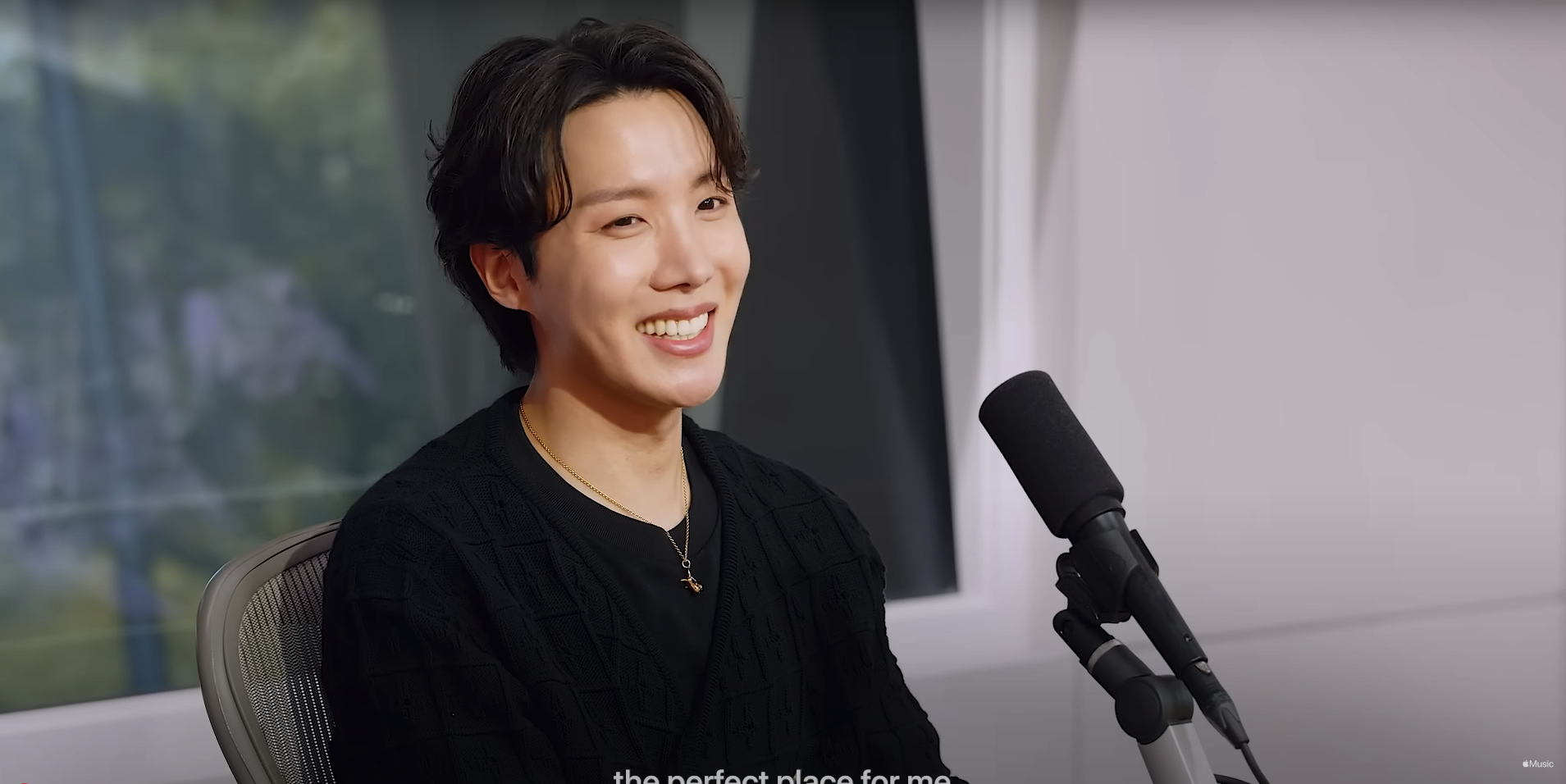
Zane Lowe’s conversation with J-Hope wasn’t just good—it was one of the most respectful, insightful, and emotionally intelligent interviews I’ve seen featuring a BTS member. And that’s saying a lot. Zane didn’t just scratch the surface—he dug deep into J-Hope’s artistry and humanity without ever feeling intrusive.
He asked personal questions without violating privacy, and that’s a rare skill in interviews. Whether it was about family, childhood, or fame, Zane always framed it through the lens of artistry. That’s what made this interview feel so respectful. If you haven’t seen it yet, it’s on YouTube—just search J-Hope Zane Lowe Interview. Trust me, it’s worth your time.
“ARE YOU ABLE TO TAKE IT IN?” – ON PRESENCE AND LEGACY
Zane asked J-Hope a deceptively simple question:
“Are you able to take it in?”
That question alone carries so much weight. We live in a culture obsessed with chasing the next big thing—new projects, new records, new milestones. But in that rush, many artists forget to actually live in their achievements.
J-Hope became the first native Asian solo artist to sell out a stadium in the U.S. That is a history-altering achievement. And yet, when you’re the one achieving it, there’s a danger of missing the moment—of being so focused on what’s next that you lose touch with what is.
Zane’s question wasn’t just journalistic—it was emotional, psychological, almost spiritual. And it reminded me of what Lea Salonga once said. When she played Kim in Miss Saigon at age 17, she didn’t fully absorb the magnitude of what she was doing. Only years later did she realize how deeply she had shaped representation for Asians in musical theatre.
And so, I hope this question struck something in J-Hope too. Because what he’s doing isn’t just monumental for him—it’s trailblazing for countless Asian artists coming after him.
REDISCOVERING PASSION THROUGH PAUSE
J-Hope shared that stepping away from music during military service gave him an entirely new appreciation for his craft.
He said he experienced a completely different kind of life—routine, uniform, stripped of glamor—and through that contrast, he saw with more clarity how much he values what he does. It wasn’t a break that made him uncertain. It was a break that reminded him just how deeply he loves music.
This is a powerful reflection. Because burnout is real. Fame can numb passion. But in his case, service grounded him. It didn’t take away his spark—it sharpened it.
He didn’t return from the military exhausted. He came back with clarity, presence, and a renewed sense of gratitude—not just for the music, but for the ability to keep doing it.
GRATITUDE AS A PRACTICE—NOT A FEELING
Zane touched on something most people ignore:
It’s not easy to stay grateful when you’re in the middle of stress, pressure, and expectation.
At the beginning of your career, you’d give anything just to have a chance. You’re hungry. You say yes to everything. But once you’ve made it—once the calendar is full, the audience is global, and the workload never stops—gratefulness can quietly fade. That’s a hard truth.
Zane acknowledged that, and J-Hope responded with such humility. He said that his gratitude begins with the people closest to him—his family, his staff, and his fans. The ones who walk with him every day. Not the ones who show up only when it’s convenient or trendy.
This is such a grounded perspective. It’s not gratitude for awards or applause. It’s gratitude for the human infrastructure behind the success.
CHILDHOOD AMBITION: NURTURED, NOT SHAMED
When asked whether he always dreamed of something big, J-Hope said yes—without hesitation. And more importantly, he shared that he was never made to feel bad for it.
That matters.
Because so many people are raised in environments where ambition is treated like arrogance, especially in collectivist cultures. But J-Hope’s home nurtured that dream. His parents gave him the freedom to envision something larger than life.
That type of support—especially early in life—creates artists who are fearless, but humble. You can feel that duality in him.
FAMILY AND FAME: RESPONSIBILITY OVER PRIDE
Zane then asked what J-Hope’s family thinks of his global success.
And J-Hope gave a classically Korean answer: they remind him of his responsibility. Not just the fame or the money—but the weight of being in the public eye, and the obligation to use his platform wisely.
This is such a reflection of Asian values. To be told: “You’ve made it. Now carry it with integrity.” And J-Hope doesn’t resist that pressure—he accepts it. He wears it like armor, not a burden.
“J-HOPE” WAS NEVER A MASK—IT WAS A CHOICE
There’s this narrative that J-Hope’s bright persona was forced on him. But in the interview, he said clearly:
“I never regretted choosing the name J-Hope. I’ve never felt burdened by it.”
That’s powerful.
Because it means the brightness isn’t fake. It’s a conscious part of who he is. That doesn’t mean he doesn’t have darkness—Jack in the Box proved he does—but it means he doesn’t see light and joy as something less serious or less authentic. His hope is deliberate.
That’s something his critics can’t understand—but his fans do.
THE FUN IN THE FIGHT
Zane asked something beautifully refreshing:
“What was the fun part of your journey?”
We always hear about the hardship. The grind. The years of struggle. And yes, those matter. But joy matters too.
J-Hope said that one of the most fulfilling things was doing what they love. Even in difficult times, BTS found ways to laugh, to bond, to enjoy the ride. The journey wasn’t joyless—it was full of meaning.
This is a reminder that success isn’t just about survival. It’s about finding value and joy in the process—not just the outcome.
A MUSICAL JOURNEY THROUGH COLOR
For the first time, a journalist actually asked J-Hope to map his evolution as an artist. And he did it brilliantly.
Hope World was vibrant, playful, colorful—expressing the joy and energy of a rising star.
Jack in the Box was introspective, darker, raw—revealing the parts he had hidden behind his bright exterior.
Hope on the Street is a return to roots—simple, rhythmic, grounded in dance and community.
He described these projects as the colors of his time—which is such a poetic way of saying that his music reflects exactly where he is in life. No pretension. Just truth in sound.
WHAT MILITARY SERVICE TAUGHT HIM
Zane asked something many of us were curious about:
What is it like to enter the military not as a rookie, but as a superstar?
And J-Hope answered with humility. He said that serving wasn’t just a requirement—it was a duty he believed in. He values his country and sees service as essential to protecting the freedom he and others enjoy.
But the most important part? It made him more grateful and more eager to return to music. It stripped away the noise and reminded him why he creates in the first place.
WHO IS J-HOPE RIGHT NOW?
When asked to define himself in the present moment, J-Hope said many things—but if there’s one word that captures it, it’s gratitude.
He’s grateful for the fans. Grateful for his team. Grateful for the journey.
And honestly, you can hear it in his voice and see it in his demeanor. He’s an artist standing on solid ground—not chasing relevance, but embracing purpose.
AFTER SOLO SUCCESS—WHAT’S NEXT FOR BTS?
Zane asked the question that needed to be asked:
After all this individual success, what does BTS look like when you come back together?
And J-Hope gave a deeply thoughtful answer. He said that doing solo projects gave each member a chance to explore different stories. And when they return as a group, they’ll bring those new stories with them.
The group dynamic won’t be the same—and that’s a good thing. Because now they’ll create with greater maturity, diverse perspectives, and healthier boundaries.
BTS IS COMING BACK—BECAUSE THEY WANT TO
And finally, the mic drop moment:
Zane said, “This time, coming back together isn’t a requirement. It’s a choice.”
And J-Hope confirmed it, “We want this.”
This wasn’t a label decision. This wasn’t pressure. This was seven individuals who’ve seen the world, grown as artists, and still choose each other.
That right there silences all the noise. All the speculation about “he’s too successful to go back” or “they’ve outgrown the group.” No—they’re coming back because they believe in what BTS represents.
Not just for themselves—but for each other. For their fans. For the legacy they’re still building together.
A SPACE TO REFLECT
This interview wasn’t just about J-Hope. It was about what it means to be an artist, a leader, and a human being in the middle of history. Lowe gave him the space to reflect—and J-Hope filled that space with clarity, grace, and gratitude.
And when BTS returns, it won’t be as the boys we once knew—but as men who chose this, together. Because this time—it’s not an obligation. It’s love.
And that’s what makes it powerful.
