

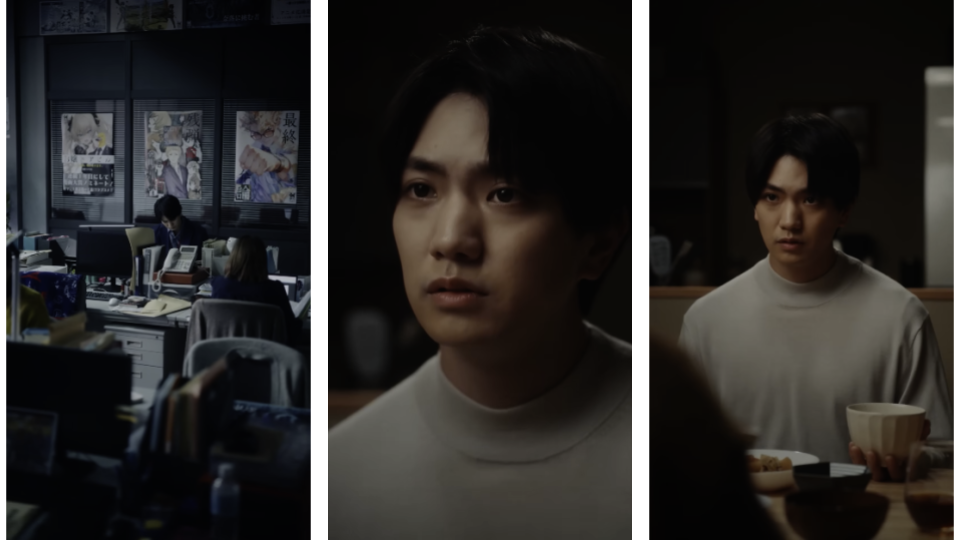
There’s a moment in the press screening for “Chat Boy” that says more about where this format actually stands than any pitch deck could: the movie theater lights dim, the audience settles in, and then the screen — the full, wide, cinema-sized screen — shrinks down to a strip one-third its normal width. Someone jokes that a dedicated vertical-video theater could cut screen costs by two-thirds. Everyone laughs, because it’s a joke. But it’s also, structurally, the whole story of vertical drama in one image: an industry-grade format still borrowing infrastructure built for something else entirely.
“Chat Boy,” a nearly two-hour AI-and-loneliness drama starring Yoshinori Masakado (Ae! Group) and Noel Kawashima (Travis Japan), is the newest release from Starto’s S Drama arm, and it’s a meaningful escalation for a format that, until recently, ran almost entirely on unknown talent and disposable romance plots.
The Money Is Real, But Japan Isn’t the Main Event Yet
Vertical drama gets talked about in two very different registers depending on who’s doing the talking. Globally, the numbers are no longer a rounding error: Omdia puts total microdrama revenue at roughly $11 billion in 2025, climbing toward $14 billion in 2026, and separate analysis from Media Partners Asia has China’s domestic short-drama market surpassing the country’s entire theatrical box office for the first time. In the U.S., ReelShort users reportedly spend more daily time in the app than they do on Netflix, Prime Video, or Disney+.
Japan is not where that action is happening. Omdia’s own regional breakdown lists Japan behind the U.S., and well behind China, in vertical-drama revenue — present on the list, but nowhere near driving it. There’s no Japanese equivalent yet to ByteDance’s Red Fruit or Tencent’s in-house short-drama arms, and no local platform putting up the kind of numbers ReelShort or DramaBox report in the U.S. What Japan has, so far, is interest: dedicated apps like Bump and Tatedora, production houses like Gokko Inc. treating vertical-first content as a real business line, and now a major idol talent agency deciding the format is worth putting its actual stars into.
Casting Masakado and Kawashima — recognizable names from established idol groups, not unknown microdrama regulars — is Starto testing whether a format built on cheap, disposable romance content can support name-brand talent and a real budget. It’s a first step, not proof the format has arrived financially in Japan. The gap between “the money is enormous” and “the money is enormous here” is exactly where “Chat Boy” is placing its bet.


The Real Argument Isn’t About Phones. It’s About What’s Missing From the Frame.
The more interesting tension in “Chat Boy” is a structural problem with the medium itself, and the film’s own cast and crew talk about it candidly. According to Masakado, shooting vertically doesn’t just change the shape of the final image; it shrinks the amount of usable space in every single frame. There’s less room to arrange actors, less room for props, less room for the environment a scene is supposedly happening in.
That’s not a small trade-off. A huge amount of what a story communicates lives in what surrounds the characters, not just in the characters themselves — the room that tells you someone’s financial situation before they say a word, the background action that recontextualizes a conversation, the negative space that makes a character look isolated without a single line of dialogue. Widescreen and even standard landscape framing evolved specifically to hold that information. Vertical framing, by contrast, forces a choice on every shot: cram the environment in around the edges, or give it up almost entirely and let the close-up carry everything.
“Chat Boy” leans hard into the second option — Masakado describes feeling like the camera was in constant close-up — and to the film’s credit, that’s a legitimate storytelling strategy, not just a limitation. But it is a limitation. Half the toolkit directors have used for a century to build a world around a character is architecturally difficult to use in portrait mode. Vertical drama hasn’t solved that problem so much as decided, for now, to mostly ignore it.
The Format Might Be Racing a Phone Screen That’s About to Get Wider
The phone screen itself may not stay narrow. After years of phones only getting taller and thinner, the industry is quietly moving toward foldables that unfold into something closer to a small tablet — width the point, not the compromise. Samsung is reportedly developing a “wide” foldable with a 7.6-inch inner display in a 4:3 aspect ratio, arriving alongside rumors of Apple’s first foldable iPhone with similarly wide dimensions, and Samsung is said to be planning multiple Z Fold variants for 2026 specifically to explore wider, shorter proportions instead of the tall narrow shape current foldables inherited from regular phones.
Early foldables have a reputation for fragility — hinge wear, screen creasing, durability complaints that showed up in reviews of earlier Z Fold generations — and that reputation isn’t unearned yet. But durability problems in first- and second-generation hardware are a extremely familiar pattern, not a permanent ceiling; camera phones, folding laptops, and every other “the tech isn’t there yet” category has eventually gotten there. If foldables normalize over the next several years the way smartphones themselves did, a meaningful slice of the audience vertical drama is building for may end up holding a device with room for a wider frame again.
That’s a strange position for a format to be in: an entire storytelling grammar built around the constraint of a narrow screen, potentially catching up to that constraint right around the time the constraint starts loosening.
Which Is Also, Genuinely, the Opportunity
None of that makes vertical drama a dead end — if anything, it’s the opposite. A format this cheap to produce, this early in its creative maturity, with this much room left to figure out is exactly the kind of environment where real innovation shows up eventually. Low production costs lower the barrier to experimentation dramatically; you don’t need a studio-scale bet to try something strange when a vertical series can be shot and released for a fraction of what conventional TV costs.
Right now, most of what’s filling that space is safe by design — the romance-heavy, cliffhanger-every-episode formula that built the Chinese duanju boom and now dominates ReelShort and DramaBox catalogs, because it’s proven to convert. “Chat Boy” is one of the more ambitious swings precisely because it trades disposable romance for something thematically heavier — AI dependency, loneliness, the ethics of synthetic companionship — while still working inside the format’s spatial limits.
The ceiling for vertical drama isn’t the phone screen. It’s creative ambition catching up to the audience that’s already there. Once more producers are willing to spend the way Starto just did — real talent, real budgets, real thematic risk — the question stops being “what can fit in a narrow frame” and starts being “what has anyone actually tried to do with one.” Right now, the honest answer is: not that much yet. Which, for a format this young and this cheap to bet on, is less a problem than it sounds like.
