

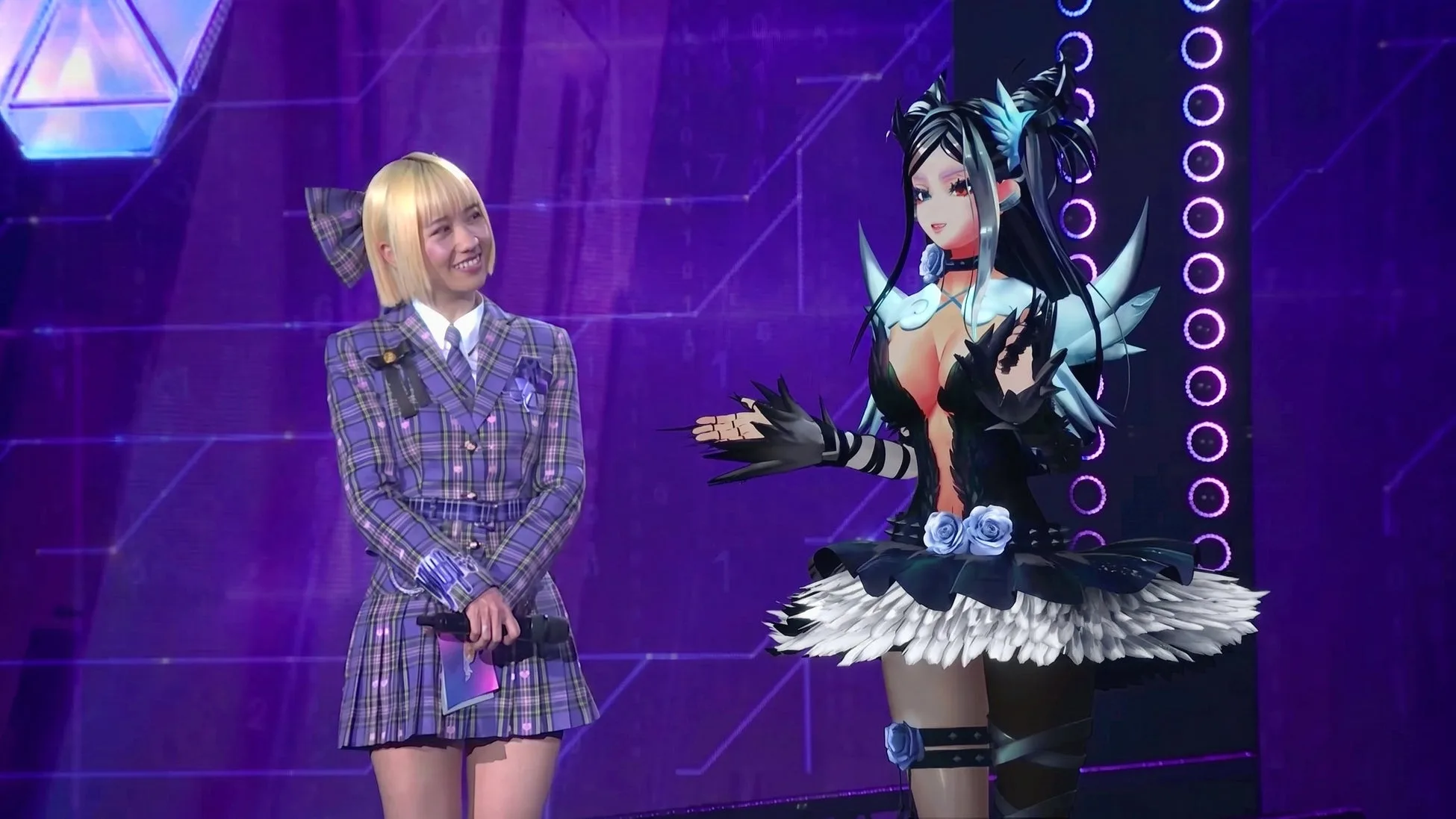
Somewhere in Taipei, a woman named Lulu spends her workdays high-fiving people she cannot see.
She is the host of “VPOP ASIA,” HTC VIVE Originals’ new virtual-idol singing competition, and the people she is high-fiving are very much in the room with her — sweating, singing, hitting their marks — except the show erases them and replaces them with cartoons before anyone watches at home. Fifteen motion-capture performers. Twenty-nine rotating judges. More than 120 Mandopop classics from the last three decades, rearranged from the ground up. A stage that costs roughly NT$7 million (about $220,000) to strike and rebuild for every single taping. Song rights alone have run past NT$10 million. Warner Music puts the covers on global streaming the same week each episode airs.
This is not a ring light and a filter. This is a television budget wearing a video-game skin.
The Casting Call Was Backwards
Most idol shows start with a person and build a persona around them. “VPOP ASIA” did it the other way. Producers designed all 15 avatars first — heights, personalities, entire little backstories — and then went looking for humans who could sing, dance and disappear inside them. The performers who made the cut, known in the industry as the “naka no hito,” or “the person inside,” put on motion-capture suits wired with sensors and perform live, in full, while a real band plays behind them. What viewers see on screen is a 3D character tracking their every move in real time.
The nondisclosure agreements are reportedly strict enough that even the performers’ own families are not supposed to know which cartoon belongs to which relative. And producer Liu Siming, general manager of VIVE Originals, has said the show turned down the genre’s standard backstage-crying-in-the-spandex footage on purpose. You get the voice. You get the performance. You do not get the face — that is the entire point. Strip away the trainee-hotness scorecard that has quietly driven idol competitions for decades, and what is left is just whether someone can sing.
Think “The Masked Singer,” except the mask is a full digital body, and it never comes off, not even in the finale.


Ballad Week Belonged to the Polygons
This past episode turned the contestants loose on heartbreak. Judges Eve Ai, Yoga Lin and HUSH sat through covers of “征服,” “天后,” “我的愛” and “分手後不要做朋友,” among others, grading contestants on arrangement and emotional delivery, not just vocal chops.
C.Song, usually the show’s dance-and-abs contestant, dropped the choreography and went quiet and controlled instead. Lin told him he had made love feel like it was melting in the air. Spicya, normally the group’s explosive, dance-first performer, went the opposite direction — a tender read of the Taiwanese-language song “查某囡仔” that had the judges talking about hearing a girl become a woman in real time inside a single vocal take. It was enough to win her the week’s top score.
That is a lot of poetry to spend on a character built in a 3D modeling program. It also means the format is working exactly as designed — the audience’s opinion of C.Song and Spicya is running entirely on performance, because there is nothing else to grade.
Episode 6 eliminated its second contestant. Episode 7, airing tonight on TVBS, cuts one more, bringing the field to 12 as the show moves into what producers are calling “extreme testing.”
Avatars With Feelings, Now Taking Meetings
The show is not staying inside the television set. This week, “VPOP ASIA” set up its first industry booth at the Taipei Music Expo, running through Sunday at the Taipei Music Center. Organizers say this year’s expo, built around technology and sustainability themes, has drawn more than 60 domestic and international labels and management companies and is on pace for upward of 500 one-on-one business meetings.
A cartoon idol show with a sales floor is either the most Taiwanese possible response to the VTuber economy or a genuinely shrewd bet that the format itself — not any single face behind it — is the exportable product.
It sounds like a gimmick. So did radio, once. So did putting a computer-generated raccoon in a nine-figure movie franchise. Taiwan is currently betting that Mandopop’s next big export does not need pores, does not need a face the audience will recognize on the street, and might not even need the same performer twice — as long as somebody, anybody, can still make a room full of judges believe a polygon just fell in love.
